Archive for the ‘Interesting chemistry’ Category
Wednesday, June 5th, 2019
In August 2016, the launch of a chemistry pre-print service ChemRxiv was announced. I was phoned a day or so later by a staff journalist at C&E News for my opinion. The only comment that was retained for their report was my instantaneous feeling that “the community needed a chemistry pre-print server like one needed a hole in the head“. I had been there before you see, recollecting a pre-print server launched by the ChemWeb service around 1996 or 1997 and which lasted only about two years before being withdrawn due to the low quality of the preprints. So what do I think of ChemRxiv now in 2019?
(more…)
Posted in Interesting chemistry | 14 Comments »
Sunday, June 2nd, 2019
This is a follow up to my earlier post about C⩸N+, itself inspired by this ChemRxiv pre-print[1] which describes a chemical synthesis of singlet biradicaloid C2 and its proposed identification as such by chemical trapping.
(more…)
References
- K. Miyamoto, S. Narita, Y. Masumoto, T. Hashishin, M. Kimura, M. Ochiai, and M. Uchiyama, "Room-Temperature Chemical Synthesis of C2", 2019. https://doi.org/10.26434/chemrxiv.8009633.v1
Posted in Interesting chemistry | No Comments »
Monday, May 27th, 2019
Although the small diatomic molecule known as dicarbon or C2 has been known for a long time, its properties and reactivity have really only been determined via its very high temperature generation. My interest started in 2010, when I speculatively proposed here that the related isoelectronic species C⩸N+ might sustain a quadruple bond. Shortly thereafter, a torrent of theoretical articles started to appear in which the idea of a quadruple bond to carbon was either supported or rejected. Clearly more experimental evidence was needed. The recent appearance of a Chemrxiv pre-print entitled “Room-temperature chemical synthesis of C2“.[1] claims to provide just this! Using the synthetic scheme outlined below, they trapped “C2” with a variety of reagents (see Figure 2A in their article), concluding that the observed reactivity best matched that of singlet “biradicaloid” C2 sustaining a quadruple bond.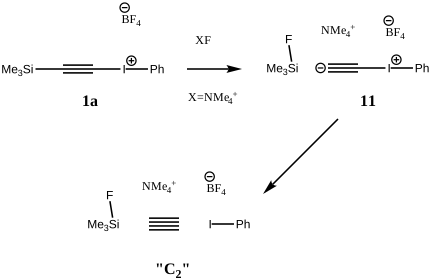
(more…)
References
- K. Miyamoto, S. Narita, Y. Masumoto, T. Hashishin, M. Kimura, M. Ochiai, and M. Uchiyama, "Room-Temperature Chemical Synthesis of C2", 2019. https://doi.org/10.26434/chemrxiv.8009633.v1
Posted in Interesting chemistry | 6 Comments »
Thursday, April 25th, 2019
Previously, I explored (computationally) the normal vibrational modes of Co(II)-tetraphenylporphyrin (CoTPP) as a “flattened” species on copper or gold surfaces for comparison with those recently imaged[1]. The initial intent was to estimate the “flattening” energy. There are six electronic possibilities for this molecule on a metal surface. Respectively positively, or negatively charged and a neutral species, each in either a low or a high-spin electronic state. I reported five of these earlier, finding each had quite high barriers for “flattening” the molecule. For the final 6th possibility, the triplet anion, the SCF (self-consistent-field) had failed to converge, but for which I can now report converged results.†
(more…)
References
- J. Lee, K.T. Crampton, N. Tallarida, and V.A. Apkarian, "Visualizing vibrational normal modes of a single molecule with atomically confined light", Nature, vol. 568, pp. 78-82, 2019. https://doi.org/10.1038/s41586-019-1059-9
Tags:019-1059-9, 10.1038, Biomolecules, Chelating agents, chemical bonding, Chemical compounds, Chemistry, Coordination chemistry, Coordination complex, Copper, copper metal surface, Cu–CO, E-type, energy, free energy, higher energy, impossible free energy, Inorganic chemistry, Jahn–Teller effect, lowest energy electronic state, Metabolism, metal, metal surface, modest planarisation energy, Molecule, Natural sciences, Physical sciences, planarisation, Porphyrin, reasonable energy, Resonance, Solid-state chemistry, sufficient energy, Teller, Tetraphenylporphyrin
Posted in Interesting chemistry | 1 Comment »
Thursday, April 18th, 2019
The topic of this post originates from a recent article which is attracting much attention.[1] The technique uses confined light to both increase the spatial resolution by around three orders of magnitude and also to amplify the signal from individual molecules to the point it can be recorded. To me, Figure 3 in this article summarises it nicely (caption: visualization of vibrational normal modes). Here I intend to show selected modes as animated and rotatable 3D models with the help of their calculation using density functional theory (a mode of presentation that the confinement of Figure 3 to the pages of a conventional journal article does not enable).
(more…)
References
- J. Lee, K.T. Crampton, N. Tallarida, and V.A. Apkarian, "Visualizing vibrational normal modes of a single molecule with atomically confined light", Nature, vol. 568, pp. 78-82, 2019. https://doi.org/10.1038/s41586-019-1059-9
Tags:anionic metal surface, Cambridge, chemical bonding, Chemistry, dihedral, energy, flat metal surface, metal, Natural sciences, Neutral Quartet, Physical sciences, Raman scattering, Raman spectroscopy, Resonance, spectroscopy, steric repulsion energy
Posted in Interesting chemistry | No Comments »
Monday, February 18th, 2019
Students learning organic chemistry are often asked in examinations and tutorials to devise the mechanisms (as represented by curly arrows) for the core corpus of important reactions, with the purpose of learning skills that allow them to go on to improvise mechanisms for new reactions. A common question asked by students is how should such mechanisms be presented in an exam in order to gain full credit? Alternatively, is there a single correct mechanism for any given reaction? To which the lecturer or tutor will often respond that any reasonable mechanism will receive such credit. The implication is that a mechanism is “reasonable” if it “follows the rules”. The rules are rarely declared fully, but seem to be part of the absorbed but often mysterious skill acquired in learning the subject. These rules also include those governing how the curly arrows should be drawn.† Here I explore this topic using the Graham reaction.[1]‡
(more…)
References
- W.H. Graham, "The Halogenation of Amidines. I. Synthesis of 3-Halo- and Other Negatively Substituted Diazirines<sup>1</sup>", Journal of the American Chemical Society, vol. 87, pp. 4396-4397, 1965. https://doi.org/10.1021/ja00947a040
Tags:/RT, activation energy, activation free energy, animation, arrow pushing, arrow-head, cellular telephone, Chemical kinetics, chemical reaction, Chemistry, computed energy, Ed Smith, energy, energy maximum, energy minima, energy plot, energy profile, energy surface, free energy, lecturer, mechanism, Natural sciences, Organic chemistry, overall reaction energy, Physical sciences, Reaction rate constant, Resonance, Transition state, Transition state theory, tutor, Tutorial
Posted in Curly arrows, Interesting chemistry | No Comments »
Saturday, February 16th, 2019
The title of this post comes from the site www.crossref.org/members/prep/ Here you can explore how your favourite publisher of scientific articles exposes metadata for their journal.
(more…)
Tags:Aaron Swartz, Academic publishing, API, Business intelligence, CrossRef, data, Data management, Elsevier, favourite publisher, Identifiers, Information, Information science, Knowledge, Knowledge representation, metadata, mining, ORCiD, PDF, Pre-exposure prophylaxis, Publishing, Publishing Requirements for Industry Standard Metadata, Records management, Research Object, Scholarly communication, Scientific literature, search engine, social media, Technical communication, Technology/Internet, text mining, Written communication, XML
Posted in Interesting chemistry | 1 Comment »
Tuesday, January 22nd, 2019
The Book of Kells is a spectacularly illuminated gospel manuscript dating from around 800AD and held in Trinity College library in Dublin. Some idea of the colours achieved can be seen below.
(more…)
Tags:Biblical manuscripts, Book design, Book of Kells, Books, City: Dublin, County Meath, Dublin, Hospitality/Recreation, Illuminated manuscript, Kells, Manuscripts, Trinity College, Trinity College Dublin, Trinity College Library, Trinity College Library Dublin, Western art, Woad plant
Posted in Interesting chemistry | No Comments »
Sunday, January 13th, 2019
Linear free energy relationships (LFER) are associated with the dawn of physical organic chemistry in the late 1930s and its objectives in understanding chemical reactivity as measured by reaction rates and equilibria.
(more…)
Tags:Benzoic acid, Chemical kinetics, chemical reaction, chemical reactivity, chemist, Chemistry, Electrophilic aromatic substitution, energy point, Equations, Equilibrium chemistry, Equilibrium constant, free energy overall route, Hammett equation, Linear free energy relationships, Natural sciences, Organic chemistry, Physical organic chemistry, Physical sciences, Reactivity
Posted in Chemical IT, Interesting chemistry, reaction mechanism | No Comments »
Thursday, January 3rd, 2019
There is emerging interest in cyclic conjugated molecules that happen to have triplet spin states and which might be expected to follow a 4n rule for aromaticity.[1] The simplest such system would be the triplet state of cyclobutadiene, for which a non or anti-aromatic singlet state is always found to be lower in energy. Here I explore some crystal structures containing this motif for possible insights.
(more…)
References
- A. Kostenko, B. Tumanskii, Y. Kobayashi, M. Nakamoto, A. Sekiguchi, and Y. Apeloig, "Spectroscopic Observation of the Triplet Diradical State of a Cyclobutadiene", Angewandte Chemie International Edition, vol. 56, pp. 10183-10187, 2017. https://doi.org/10.1002/anie.201705228
Tags:antiaromaticity, aromaticity, Baird's rule, Conjugated system, crystal structure search, energy, Hückel's rule, Nature, Physical organic chemistry, Physical sciences, search query, Triplet state
Posted in Interesting chemistry | No Comments »