MOST is a chemical method of converting photonic or light energy into storable thermal energy which can be released on demand. A recent breakthrough in such methods has been reported[1] in which a pyrimidone molecule is efficiently converted by 310nm light into the isomeric Dewar pyrimidone. This molecule is thermally stable, but when protonated, rapidly releases thermal (enthalpic) energy in converting down to protonated pyrimidone – the energy release is sufficiently rapid that it can boil water and reaching energy storage levels previously inaccessible to MOST systems. The basic chemistry is shown below – treatment with base makes it fully cyclic.
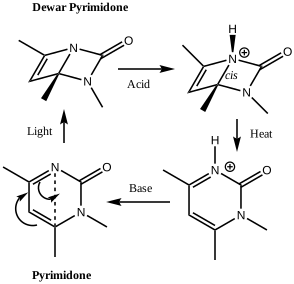
The chemical reactions are interesting. The light catalysed step is a pericyclic electrocyclic reaction, allowed by the Woodward-Hoffmann rules with stereochemical disrotation via suprafacial bond formation. The acid catalysed thermal reaction however, in order to conform to these rules, would nominally need to be an electrocycic ring opening with an antarafacial stereochemical component. This would require the bicyclic ring system to contain a trans rather than the cis bridgehead stereochemistry shown above.This reaction was first studied many years ago[2] when it was shown that the thermal ring opening of a cis Dewar isomer indeed has a high barrier, due to its “forbidden” character. This imparts one of the desirable characteristics of a MOST system, namely the ability to store the high energy compound if necessary for long periods of time. The key step in the above is recognising that protonating the bicyclic nitrogen of the Dewar form should significantly reduce the barrier to ring opening. Here to illustrate these two reactions, I show intrinsic reaction coordinates (IRCs) for both steps.
References
- H.P.Q. Nguyen, A.J. Maertens, B.A. Baker, N.M. Wu, Z. Ye, Q. Zhou, Q. Qiu, N. Kaur, D.B. Berkinsky, K.E. Shulenberger, K.N. Houk, and G.G.D. Han, "Molecular solar thermal energy storage in Dewar pyrimidone beyond 1.6 megajoules per kilogram", Science, vol. 392, 2026. https://doi.org/10.1126/science.aec6413
- M.J.S. Dewar, G.P. Ford, and H.S. Rzepa, "Electrocyclic ring opening of 1α,4α- and 1α,4β-bicyclo[2.2.0]hexa-2,5-dienes (cis and trans Dewar benzenes): MNDO (modified neglect of diatomic overlap) semiempirical molecular orbital calculations", J. Chem. Soc., Chem. Commun., pp. 728-730, 1977. https://doi.org/10.1039/c39770000728