This is an interesting result I got when studying the [1,4] sigmatropic rearrangement of heptamethylbicyclo-[3.1.0]hexenyl cations. It fits into the last lecture of a series on pericyclic mechanisms, and just before the first lecture on conformational analysis. This is how they join.
A conflation of concepts: Conformation and pericyclic.
January 10th, 2013NCI (non-covalent-interaction) analysis for some π-hydrogen bonded systems.
January 8th, 2013In this post, I looked at some hydrogen bonds formed by interaction of a π-system with an acidic hydrogen. Unlike normal lone pair donors, π-systems can involve more than two electrons, most commonly four or six. Here I look at examples of both these higher-order donors.
The mechanism of the Benzidine rearrangement.
January 6th, 2013The benzidine rearrangement is claimed to be an example of the quite rare [5,5] sigmatropic migration[1], which is a ten-electron homologation of the very common [3,3] sigmatropic reaction (e.g. the Cope or Claisen). Some benzidine rearrangements are indeed thought to go through the [3,3] route[2]. The topic has been reviewed here[3].
References
- H.J. Shine, K.H. Park, M.L. Brownawell, and J. San Filippo, "Benzidine rearrangements. 19. The concerted nature of the one-proton rearrangement of 2,2'-dimethoxyhydrazobenzene", Journal of the American Chemical Society, vol. 106, pp. 7077-7082, 1984. https://doi.org/10.1021/ja00335a035
- H.J. Shine, L. Kupczyk-Subotkowska, and W. Subotkowski, "Heavy-atom kinetic isotope effects in the acid-catalyzed rearrangement of N-2-naphthyl-N'-phenylhydrazine. Rearrangement is shown to be a concerted process", Journal of the American Chemical Society, vol. 107, pp. 6674-6678, 1985. https://doi.org/10.1021/ja00309a041
- H.J. Shine, "Reflections on the π‐complex theory of benzidine rearrangements", Journal of Physical Organic Chemistry, vol. 2, pp. 491-506, 1989. https://doi.org/10.1002/poc.610020702
π-hydrogen bonds as a function of ring size.
January 5th, 2013A simple correlation between a ring size and the hydrogen bonding as quantified by the O(Lp)/H-O σ* NBO interaction in that ring, indicated a 7- or 8-membered ring was preferred over smaller ones. Here is the same study, but this time using the π-electrons of an alkene as the electron donor.
The gauche effect: seeking evidence by a survey of crystal structures.
January 4th, 2013
I previously blogged about anomeric effects involving π electrons as donors, and my post on the conformation of 1,2-difluorethane turned out one of the most popular. Here I thought I would present the results of searching the Cambridge crystal database for examples of the gauche effect. The basic search is defined below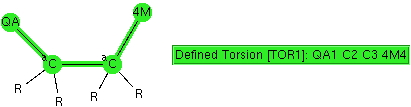
Hydrogen bond strength as a function of ring size.
January 3rd, 2013One frequently has to confront the question: will a hydrogen bond form between a suitable donor (lone pair or π) and an acceptor? One of the factors to be taken into consideration for hydrogen bonds which are part of a cycle is the ring size. Here I explore one way of quantifying the effect for the series below, n=1-5 (4-8 membered rings).
Sharpless epoxidation, enantioselectivity and conformational analysis.
January 3rd, 2013I return to this reaction one more time. Trying to explain why it is enantioselective for the epoxide product poses peculiar difficulties. Most of the substituents can adopt one of several conformations, and some exploration of this conformational space is needed.
Vitamin B12 and the genesis of a new theory of chemistry.
December 20th, 2012I have written earlier about dihydrocostunolide, and how in 1963 Corey missed spotting the electronic origins of a key step in its synthesis.[1]. A nice juxtaposition to this failed opportunity relates to Woodward’s project at around the same time to synthesize vitamin B12. The step in the synthesis that caused him to ponder is shown below.
References
- E.J. Corey, and A.G. Hortmann, "The Total Synthesis of Dihydrocostunolide", Journal of the American Chemical Society, vol. 87, pp. 5736-5742, 1965. https://doi.org/10.1021/ja00952a037