October 4th, 2026
I posed[1] this question back in 2010: “(Almost) 100 years of Lewis[2] structures: are they still fit for purpose?”. I was reminded of this when I came across this relatively recent article[3] describing the structures of three binary sulfur-nitrogen anions, as shown in Figure 1 of their article. These are reproduced below (Scheme 1) along with an additional S/N molecule reported separately.[4]
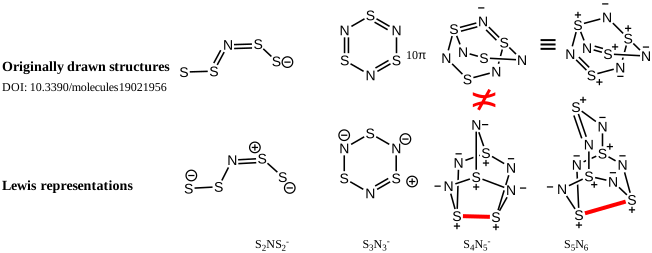 Scheme 1. Molecular structure representations of sulfur nitrides.
Read the rest of this entry »
References
- H. Rzepa, "(Almost) 100 years of Lewis structures: are they still fit for purpose?", 2010. https://doi.org/10.59350/rncje-xe063
- G.N. Lewis, "THE ATOM AND THE MOLECULE.", Journal of the American Chemical Society, vol. 38, pp. 762-785, 1916. https://doi.org/10.1021/ja02261a002
- R. Boeré, T. Roemmele, and M. Krall, "A Variable Temperature X-ray Diffraction Investigation of [PPN+][S4N5−]: Supramolecular Interactions Governing an Order/Disorder Transformation and the First High Resolution X-ray Structure of the Anion", Molecules, vol. 19, pp. 1956-1975, 2014. https://doi.org/10.3390/molecules19021956
- T. Chivers, and J. Proctor, "Preparation and crystal structure of a new sulphur nitride, S5N6; a molecular basket", Journal of the Chemical Society, Chemical Communications, pp. 642, 1978. https://doi.org/10.1039/c39780000642
Posted in General, Hypervalency | 2 Comments »
October 3rd, 2026
Metalla-aromatics have been defined as metallacycles that are derived from the formal replacement of a carbon atom in the framework of an organic aromatic ring with a metal fragment.[1]. Here I explore whether this simple definition can be broadened to sulfur-nitrogen rings which contain few[2],[3] if indeed any[4],[5],[6],[7] carbon atoms and which also happen to be planar aromatic molecules. Read the rest of this entry »
References
- D. Chen, Y. Hua, and H. Xia, "Metallaaromatic Chemistry: History and Development", Chemical Reviews, vol. 120, pp. 12994-13086, 2020. https://doi.org/10.1021/acs.chemrev.0c00392
- R. Jones, J.L. Morris, A.W. Potts, C.W. Rees, D.J. Rigg, H.S. Rzepa, and D.J. Williams, "Electronic and crystallographic structures of trithiadiazepines", Journal of the Chemical Society, Chemical Communications, pp. 398, 1985. https://doi.org/10.1039/c39850000398
- S.T.A.K. Daley, C.W. Rees, and D.J. Williams, "1,3,5,2,4-Trithiadiazepines and 1,3,5,2,4,6-trithiatriazepines, new 10? heteroaromatic systems", Journal of the Chemical Society, Chemical Communications, pp. 55, 1984. https://doi.org/10.1039/c39840000055
- P.N. Jagg, P.F. Kelly, H.S. Rzepa, D.J. Williams, J.D. Woollins, and W. Wylie, "The preparation, X-ray crystal structure and theoretical study of [CoCp
<sub>2</sub>
][S
<sub>3</sub>
N
<sub>3</sub>
], (Cp = cyclopentadienyl), a novel stacking compound incorporating multiple C–H ⋯ N(p
<sub>π</sub>
) interactions", J. Chem. Soc., Chem. Commun., vol. 0, pp. 942-944, 1991. https://doi.org/10.1039/c39910000942
- A. Haas, and M. Pryka, "New Pathways in Tellurium‐Chalkogen‐Nitrogen Chemistry: Preparations, Structures, and Properties of Telluraheterocycles", Chemische Berichte, vol. 128, pp. 11-22, 1995. https://doi.org/10.1002/cber.19951280103
- J. Galan-Mascaros, A.M. Slawin, J. Derek Woollins, and D.J. Williams, "π-facial interactions between Cl− and [S4N3]+. X-ray crystal structure of [S4N3]Cl", Polyhedron, vol. 15, pp. 4603-4605, 1996. https://doi.org/10.1016/0277-5387(96)00223-9
- T. Chivers, and R.S. Laitinen, "Chalcogen–Nitrogen Chemistry", 2021. https://doi.org/10.1142/12397
Posted in Interesting chemistry | No Comments »
September 14th, 2026
In the previous post[1] we described the orbital interactions involved in stabilising the formation of a Cp2TiS5 complex (figure 1 below, X=S) rather than a Cp2TiS4 complex when Cp2TiCl2 is treated with a mixture of polysulfide dianions – and how these interactions can be “tuned” by variation in the ring atoms.
Read the rest of this entry »
References
- H. Rzepa, "Identifying the origins of the ring-size specificity of transition metals for polysulfide anions: "tuning" the effect.", 2026. https://doi.org/10.59350/p8zwp-39q65
Posted in crystal_structure_mining, Interesting chemistry | No Comments »
September 10th, 2026
A recently published article addresses[1] the long standing problem of why transition metals complexes such as e.g. Cp2TiCl2 in the presence of solutions of polysulfide dianions containing sulfur chains of various lengths, can react to form sulfur ring complexes of a specific size, depending on the metal. Thus when the early transition metal is Ti (Cp = cyclopentadienyl) it forms only the six membered ring shown below (X=S), with none of the five-membered/four-sulfur ring present. However, other central and later transition period metals only form four-sulfur rings.[1]
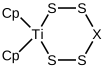
The effect was attributed to the degree of overlap of a localised sulfur p-orbital with a vacant Ti d-orbital as shown below (Figure 1. click on the diagram to get a 3D model).
Read the rest of this entry »
References
- H.S. Rzepa, and D.J. Woollins, "Identifying the origins of the ring-size specificity of transition metals for polysulfide dianions", Dalton Transactions, 2026. https://doi.org/10.1039/d6dt01849a
Posted in Interesting chemistry, reaction mechanism | No Comments »
August 20th, 2026
I have in the past (around 2012 to be specific) taken an interest in a particular type of [3,3]sigmatropic pericyclic reaction called the semibullvalene rearrangement.[1],[2],[3]. This system can apparently exhibit very long C-C bonds in the region of 2.1Å, in which form it would be called a “frozen” transition state, also referred to a bis-homoaromatic molecule, which in this form is NOT regarded as a [3,3]sigmatropic pericyclic transition state. Time for an update I thought, starting with a crystal structure search (Figure 1) for these types of species.
Read the rest of this entry »
References
- H. Rzepa, "Predicted properties of a candidate for a frozen semibullvalene.", 2012. https://doi.org/10.59350/cq2a3-g2g35
- H. Rzepa, "Frozen Semibullvalene: a holy grail (and a bis-homoaromatic molecule).", 2012. https://doi.org/10.59350/585c3-dpy86
- H. Rzepa, "The ten-electron homologue of semibullvalene.", 2012. https://doi.org/10.59350/8nkna-ycy23
Posted in crystal_structure_mining, pericyclic, reaction mechanism | No Comments »
July 18th, 2026
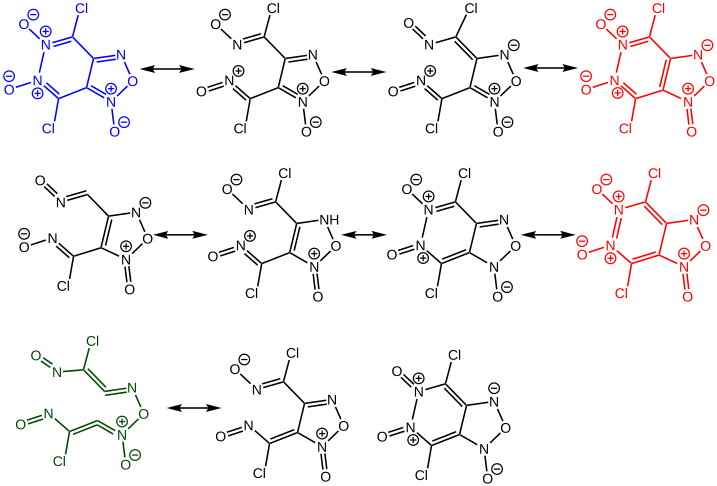
(Some) chemists have a strange fascination with bonds between two specified atoms – more exactly how short or how long can such a bond get? I asked a slight different question[1] of a molecule known as nitrosobenzene dimer, noting that both nitrogens were both connected to each other and carried a (formal) positive charge; one might naively imagine that the coulomb effects between two positive atoms might result in a repulsion which would greatly lengthen the bond between them (it does not, but it does weaken it). I moved from this to asking how many examples of such molecules there might be, and whether any exhibited unusual bond lengths. After a search of the CSD, one (“JEGRAS”) caught my interest, shown in blue below[2],[3] and exhibiting a crystallographic N-N distance of 1.695Å (to answer the question posed in the title above).
Read the rest of this entry »
References
- H. Rzepa, "The mysterious N=N double bond in nitrosobenzene dimer.", 2025. https://doi.org/10.59350/rzepa.29383
- Q. Zhang, C. He, and S. Pang, "Synthesis of heterocyclic (triazole, furoxan, furazan) fused pyridazine di-
<i>N</i>
-oxides
<i>via</i>
hypervalent iodine oxidation", New Journal of Chemistry, vol. 46, pp. 14324-14327, 2022. https://doi.org/10.1039/d2nj02908a
- Zhang, Qi., He, Chunlin., and Pang, Siping., "CCDC 2175700: Experimental Crystal Structure Determination", 2022. https://doi.org/10.5517/ccdc.csd.cc2c0zw8
Posted in Interesting chemistry | No Comments »
June 17th, 2026
Posted in Chemical IT | No Comments »
June 1st, 2026
In the previous post,[1] I noted the photochemical isomerisation of a pyrimidone into what is called the bicyclic Dewar form, being part of a solar energy storage system.[2] A colleague (thanks Alan!) has recollected a very similar example dating from 1965[3] in which a related molecule known as a diazepinone 72 (scheme below) is converted by light into a Dewar form 73.
Read the rest of this entry »
References
- H. Rzepa, "A breakthrough in Molecular Solar Thermal (MOST) energy storage – Dewar Pyrimidone.", 2026. https://doi.org/10.59350/jhsbq-sfs70
- H.P.Q. Nguyen, A.J. Maertens, B.A. Baker, N.M. Wu, Z. Ye, Q. Zhou, Q. Qiu, N. Kaur, D.B. Berkinsky, K.E. Shulenberger, K.N. Houk, and G.G.D. Han, "Molecular solar thermal energy storage in Dewar pyrimidone beyond 1.6 megajoules per kilogram", Science, vol. 392, 2026. https://doi.org/10.1126/science.aec6413
- W.J. Theuer, and J.A. Moore, "Heterocyclic studies. The photoisomerization of 2,3-dihydro-5-methyl-6-phenyl-4H-1,2-diazepin-4-one and derivatives", Chemical Communications (London), pp. 468, 1965. https://doi.org/10.1039/c19650000468
Posted in Interesting chemistry, pericyclic, reaction mechanism | 4 Comments »
May 14th, 2026
MOST is a chemical method of converting photonic or light energy into storable thermal energy which can be released on demand. A recent breakthrough in such methods has been reported[1] in which a pyrimidone molecule is efficiently converted by 310nm light into the isomeric Dewar pyrimidone. This molecule is thermally stable, but when protonated, rapidly releases thermal (enthalpic) energy in converting down to protonated pyrimidone – the energy release is sufficiently rapid that it can boil water and reaching energy storage levels previously inaccessible to MOST systems. The basic chemistry is shown below – treatment with base makes it fully cyclic.
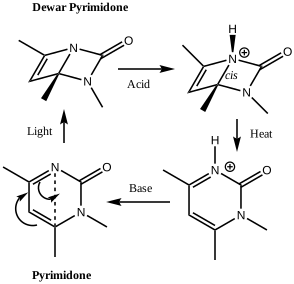
The chemical reactions are interesting. The light catalysed step is a pericyclic electrocyclic reaction, allowed by the Woodward-Hoffmann rules with stereochemical disrotation via suprafacial bond formation. The acid catalysed thermal reaction however, in order to conform to these rules, would nominally need to be an electrocycic ring opening with an antarafacial stereochemical component. This would require the bicyclic ring system to contain a trans rather than the cis bridgehead stereochemistry shown above.This reaction was first studied many years ago[2] when it was shown that the thermal ring opening of a cis Dewar isomer indeed has a high barrier, due to its “forbidden” character. This imparts one of the desirable characteristics of a MOST system, namely the ability to store the high energy compound if necessary for long periods of time. The key step in the above is recognising that protonating the bicyclic nitrogen of the Dewar form should significantly reduce the barrier to ring opening. Here to illustrate these two reactions, I show intrinsic reaction coordinates (IRCs) for both steps.
Read the rest of this entry »
References
- H.P.Q. Nguyen, A.J. Maertens, B.A. Baker, N.M. Wu, Z. Ye, Q. Zhou, Q. Qiu, N. Kaur, D.B. Berkinsky, K.E. Shulenberger, K.N. Houk, and G.G.D. Han, "Molecular solar thermal energy storage in Dewar pyrimidone beyond 1.6 megajoules per kilogram", Science, vol. 392, 2026. https://doi.org/10.1126/science.aec6413
- M.J.S. Dewar, G.P. Ford, and H.S. Rzepa, "Electrocyclic ring opening of 1α,4α- and 1α,4β-bicyclo[2.2.0]hexa-2,5-dienes (cis and trans Dewar benzenes): MNDO (modified neglect of diatomic overlap) semiempirical molecular orbital calculations", J. Chem. Soc., Chem. Commun., pp. 728-730, 1977. https://doi.org/10.1039/c39770000728
Posted in Interesting chemistry, pericyclic | No Comments »
May 6th, 2026
A little while back, I wrote about anomeric-like effects in the sulfur ring S7.[1] I had started that exploration by retrieving the crystal structure from the ICSD (Inorganic crystal structure database) and then optimising these coordinates using a DFT method (MN15L/Def2-TZVPP to be precise). In demonstrating this effect to a student, I decided to create an initial guess for the molecule coordinates not from the crystal structure but by drawing and then minimising using a simple molecular mechanics force field – and only then subjecting it to DFT re-optimisation.[2] It turns out the result was quite surprising in one respect and so here I tell the rest of the story.
Read the rest of this entry »
References
- H. Rzepa, "Cyclo-Heptasulfur, S<sub>7</sub> – a classic anomeric effect discovered during a pub lunch!", 2025. https://doi.org/10.59350/rzepa.28407
- H. Rzepa, "Anomeric isomerism in cyclo-heptasulfur.", 2026. https://doi.org/10.14469/hpc/15924
Posted in Interesting chemistry | No Comments »