A recently published article addresses[1] the long standing problem of why transition metals complexes such as e.g. Cp2TiCl2 in the presence of solutions of polysulfide dianions containing sulfur chains of various lengths, can react to form sulfur ring complexes of a specific size, depending on the metal. Thus when the early transition metal is Ti (Cp = cyclopentadienyl) it forms only the six membered ring shown below (X=S), with none of the five-membered/four-sulfur ring present. However, other central and later transition period metals only form four-sulfur rings.[1]
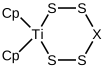
The effect was attributed to the degree of overlap of a localised sulfur p-orbital with a vacant Ti d-orbital as shown below (Figure 1. click on the diagram to get a 3D model).
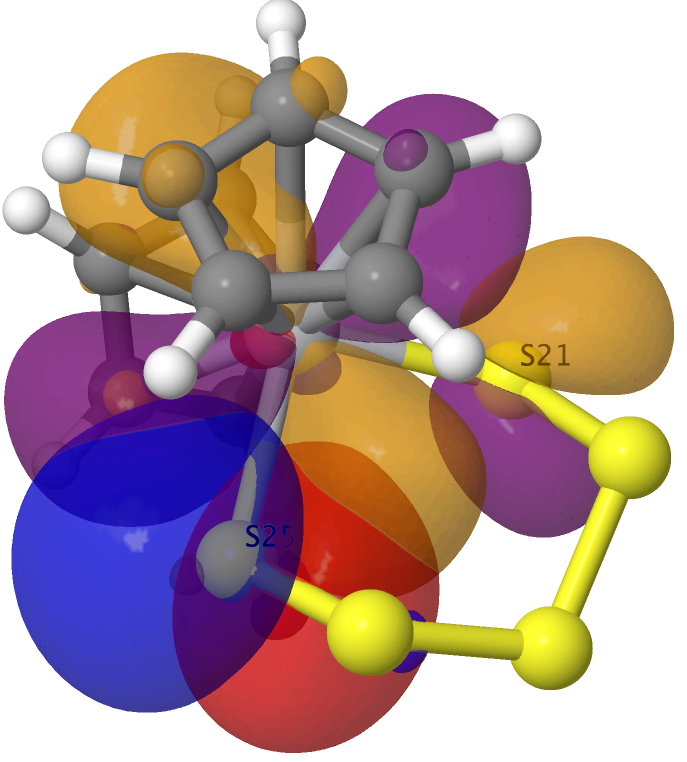
Figure 1. Overlap between a sulfur p-donor and a titanium d-acceptor.
One quantative estimate of the magnitude of the effect can be obtained using the NBO7 method[2], which provides a value for the perturbation interaction energy between the filled donor orbital (the S p-orbital) and the empty acceptor orbital (the Ti d-orbital) as a so-called E(2) energy. Thus in the article[1] the E(2) energy for the Ti six-membered complex shown above was reported as 21.2 kcal/mol (Table below) whereas for the analogous five-ring (for which the overlap between the two orbitals is less good) the value was 11.0 kcal/mol. This effect can be related [1] to the relative (free energy) stability of the product complex in the above reaction.
The question now arises whether the effect can be “optimised” by changing some of the ring atoms from S to another. In fact eight crystal structures have been reported with such substitutions (Table) and so here the NBO7 analysis is repeated for these systems and a few other as yet unreported examples.
| Table. NBO7 E(2) interaction energy for variants of Cp2TiS5. | ||||||
|---|---|---|---|---|---|---|
| CSD Name | Ring atoms | NBO7 E(2) | Ti-S length, Å | Ti-S dihedral | Lit/CSD | MN15L/Def2-QZVPP NBO7 |
| CYPTIS01 | S, S, S, S, S | 21.20 | 2.466, 2.470 | 62.0 | [3] | [4] |
| KIVTOY | S, S, Se, Se, Se | 21.70 | 2.471 | 65.7 | [5] | [6] |
| NIRXER | S, S, X=N-Me (ax)†, S, S | 15.35 | 2.462, 2.479 | 54.9 | [7], [8] | [9] |
| Unknown | S, S, X=P-Me (ax), S, S | 23.59 | 2.453 | 63.5 | unknown | [10] |
| SEDRUO | S, S, X=As-Me(ax), S, S | 23.49 | 2.454 | 65.7 | [11] | [12] |
| SEDRUO | S, S, X=As-Me(eq), S, S | 21.58 | 2.460, 2.470 | 64.8 | † | [13] |
| FEHTOB | S, S, X=Cp2TiS5, S, S | ‡ | 2.463 | 68.9, 63.9 | [14] | [15] |
| VOSMUO | S, S, Se, Se, Se | 21.70 | 2.472 | 65.7 | [5], [16] | [17] |
| VOSNEZ | S, S,Se, Se, S | 19.93 | 2.463, 2.475 | 65.1, 64.1 | [5], [18] | [19] |
| VOSNAV | Se,Se,Se,Se,Se | 21.38 | – | 66.2 | [20],[21] | [22] |
| ZEMXIV | S, Se, Se, Se, Se | 18.65 | 2.467 | 67.0 | [23] | [24] |
Analysis
- There appears to be a reasonable correction between the NBO E(2) energy and the Ti-S bond length. The shortest bond (X=PMe) corresponds to the highest E(2) value of 23.59 kcal/mol. SEDRUO is a known example (X=AsMe, Figure 2) and X=PMe is worthy of synthesis to reinforce this conclusion.
- The donation from the sulfur p-orbital to the Ti d-orbital appears to reach a maximum at ~65°, not far off the value for Cp2TiS5 itself (Figure 1).
- The series X=NMe, PMe, AsMe is interesting because the Me group has a favoured axial position (Figure 2), by an estimated 10.6 kcal/mol for X=NMe. This remarkable preference is probably caused by the bond angle subtended at X, since no strong stereoelectronic effect could be found (such as donation from the lone pair on the N/P/As).
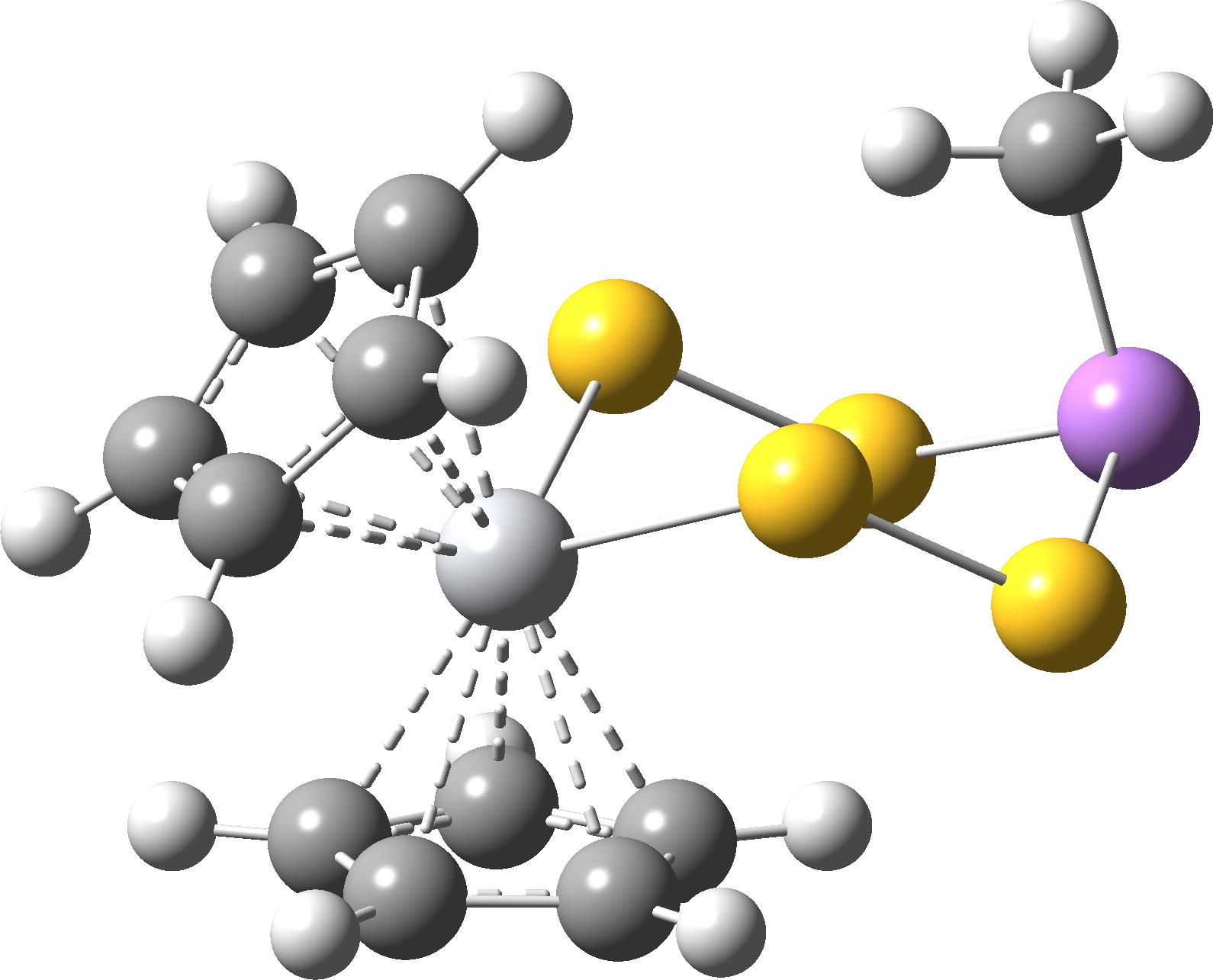
Figure 2.Structure of SEDRUO, showing the strong axial preference. - X = Cp2TiS5 is interesting because it should exhibit the effect twice, at each Ti. Unfortunately the wavefunction for this species appears to have a pathological problem with converging to an NBO localised solution – we hope to find a solution to this at some stage. The Ti-S bond lengths however do not suggest the effect noted above will be especially high for this species.
- PUJFUV[25] replaces one six-electron Cp ligand metal donor with an apparent two-electron contribution from an 2,6-di-isopropylphenoxy ligand. This has a measured Ti-O bond length of 1.795Å, which is towards the shorter end of the spectrum of Ti-O lengths (which range from ~1.7 to ~2.2Å). This intriguing example will be analysed in a separate post.
Conclusions
The effect identified previously[1] which is responsible for the preference of early transition metals such as Ti to form polysulfide rings with five sulfurs rather than four appears to reach a maximum for the known species X=AsMe (Figure 2) or the as yet unmade molecule with X=PMe.
†The equatorial isomer for X=NMe is a remarkable ~10.6 kcal/mol higher in free energy.[26] whereas for X=AsMe it is reduced to 4.59 kcal/mol. This is probably due to the angle subtended at N/As, which is 117.7° for N and 103.6° for As, which may also propagate to the values of the dihedral angle. ‡The NBO7 localisation search terminated unsuccessfully after considering 100000 bonding patterns.
Authors


References
- H.S. Rzepa, and J.D. Woollins, "Identifying the origins of the ring-size specificity of transition metals for polysulfide anions", Dalton Transactions, 2026. https://doi.org/10.1039/d6dt01849a
- E.D. Glendening, C.R. Landis, and F. Weinhold, "6 Natural bond orbital theory: Discovering chemistry with NBO7", Complementary Bonding Analysis, pp. 129-156, 2021. https://doi.org/10.1515/9783110660074-006
- E. Muller, J.L. Petersen, and L.F. Dahl, "Synthesis and characterization of Di-π-cyclopentadienyl- metal pentasulfides of titanium(IV) and vanadium (IV):an operational test of the influence of an unpaired electron on the molecular geometry", Journal of Organometallic Chemistry, vol. 111, pp. 91-112, 1976. https://doi.org/10.1016/s0022-328x(00)87061-8
- H. Rzepa, "CYPTIS5 MN15L/Def2-TZVPP, G = -3227.141839 Def2-QZVPP NBO", 2026. https://doi.org/10.14469/hpc/15689
- P. Pekonen, Y. Hiltunen, R.S. Laitinen, and J. Valkonen, "Selenium-77 NMR spectroscopic and x-ray crystallographic characterization of bis(cyclopentadienyl)titanium selenide sulfide mixtures [Ti(C5H5)2SexS5x]", Inorganic Chemistry, vol. 30, pp. 1874-1878, 1991. https://doi.org/10.1021/ic00008a036
- H. Rzepa, "KIVTOY MN15L/Def2-TZVPP DCM => NBO7 Def2-QZVPP", 2026. https://doi.org/10.5281/zenodo.22270368
- R. Steudel, O. Schumann, J. Buschmann, and P. Luger, "S4NR (R=Methyl,n-Octyl) as Novel Chelating Ligands in Titanocene Complexes and First Synthesis of Small Sulfurimide Heterocycles SnNR (n=5, 6)", Angewandte Chemie International Edition, vol. 37, pp. 492-494, 1998. https://doi.org/10.1002/(sici)1521-3773(19980302)37:4<492::aid-anie492>3.0.co;2-a
- Steudel, R.., Schumann, O.., Buschmann, J.., and Luger, P.., "CCDC 103650: Experimental Crystal Structure Determination", 1998. https://doi.org/10.5517/cc3gvky
- H. Rzepa, "NIRXER NBO7 Def2-QZVPP No solvent LP ( 2) S 4 88. BD*( 2)Ti 1- S 2 15.35", 2026. https://doi.org/10.5281/zenodo.22141983
- H. Rzepa, "SEDRUO (As-Me) => P-Me ax G = -3210.173356 Def2-QZVPP NBO7 LP ( 2) S 5 . BD*( 2)Ti 1- S 6 23.59", 2026. https://doi.org/10.5281/zenodo.22664179
- R. Steudel, B. Holz, and J. Pickardt, "Synthesis and Structure of [(C<sub>5</sub>H<sub>5</sub>)<sub>2</sub>TiS<sub>4</sub>AsCH<sub>3</sub>]—a New Reagent for the Synthesis of Sulfur‐Rich Heterocycles", Angewandte Chemie International Edition in English, vol. 28, pp. 1269-1271, 1989. https://doi.org/10.1002/anie.198912691
- H. Rzepa, "SEDRUO (As-Me) NBO7 LP ( 2) S 5 BD*( 2)Ti 1- S 6 23.49", 2026. https://doi.org/10.5281/zenodo.22286648
- H. Rzepa, "SEDRUO (As-Me) eq NBO7 => Def2-QZVPP LP ( 2) S 4 101. BD*( 2)Ti 1- S 2 21.58", 2026. https://doi.org/10.5281/zenodo.22669613
- D.M. Giolando, T.B. Rauchfuss, A.L. Rheingold, and S.R. Wilson, "Chemistry of (RC5H4)2TiE5 (E = S, Se). New information on its reactions with nucleophiles, syntheses and reactions of 1,4-[(RC5H4)2Ti]2E4, and a second isomer of (RC5H4)2TiS2C2(CO2Me)2", Organometallics, vol. 6, pp. 667-675, 1987. https://doi.org/10.1021/om00146a040
- H. Rzepa, "FEHTOB Cp2Ti(SS)2TiCp2 NBO7 TZVPP", 2026. https://doi.org/10.5281/zenodo.22655433
- Laasonen, Heli., Ikäheimonen, Johanna., Suomela, Mikko., Rautiainen, J. Mikko., and Laitinen, Risto S.., "CCDC 1887988: Experimental Crystal Structure Determination", 2019. https://doi.org/10.5517/ccdc.csd.cc21clvw
- H. Rzepa, "VOSMUO NBO7 Def2-QZVPP no solvent LP ( 2) S 2 116. BD*( 2)Ti 1- S 6 21.70", 2026. https://doi.org/10.5281/zenodo.22141977
- Laasonen, Heli., Ikäheimonen, Johanna., Suomela, Mikko., Rautiainen, J. Mikko., and Laitinen, Risto S.., "CCDC 1887990: Experimental Crystal Structure Determination", 2019. https://doi.org/10.5517/ccdc.csd.cc21clxy
- H. Rzepa, "VOSNEZ MN15L/Def2-TZVPP DCM", 2026. https://doi.org/10.5281/zenodo.22270375
- H. Laasonen, J. Ikäheimonen, M. Suomela, J.M. Rautiainen, and R.S. Laitinen, "Titanocene Selenide Sulfides Revisited: Formation, Stabilities, and NMR Spectroscopic Properties", Molecules, vol. 24, pp. 319, 2019. https://doi.org/10.3390/molecules24020319
- Laasonen, Heli., Ikäheimonen, Johanna., Suomela, Mikko., Rautiainen, J. Mikko., and Laitinen, Risto S.., "CCDC 1887989: Experimental Crystal Structure Determination", 2019. https://doi.org/10.5517/ccdc.csd.cc21clwx
- H. Rzepa, "VOZNAV MN15L/Def2-QZVPP (Se only) NBO7 LP ( 2)Se 2 BD*( 2)Ti 1-Se 6 21.38", 2026. https://doi.org/10.5281/zenodo.22286621
- C.P. Raptopoulou, A. Terzis, N. Tzavellas, and N. Klouras, "Sulfur‐Selenium Chelates: Crystal structure of the first titanocene derivative Ti(η<sup>5</sup>‐C<sub>5</sub>H<sub>5</sub>)<sub>2</sub>SSe<sub>4</sub>", Zeitschrift für anorganische und allgemeine Chemie, vol. 621, pp. 1800-1802, 1995. https://doi.org/10.1002/zaac.19956211032
- H. Rzepa, "ZEMXIY NBO7 Def2-QZVPP No solvent LP ( 2)Se 3 124. BD*( 2)Ti 1- S 2 18.65", 2026. https://doi.org/10.5281/zenodo.22141970
- A.V. Firth, and D.W. Stephan, "Monocyclopentadienyl−Titanium Aryloxide Sulfide Complexes", Inorganic Chemistry, vol. 37, pp. 4726-4731, 1998. https://doi.org/10.1021/ic9800839
- H. Rzepa, "NIRXER Def2-TZVPP, DCM equatorial N-Me G = -2923.496304 (G = -2923.513188) DG = 10.6", 2026. https://doi.org/10.5281/zenodo.22669635