(Some) chemists have a strange fascination with bonds between two specified atoms – more exactly how short or how long can such a bond get? I asked a slight different question[1] of a molecule known as nitrosobenzene dimer, noting that both nitrogens were both connected to each other and carried a (formal) positive charge; one might naively imagine that the coulomb effects between two positive atoms might result in a repulsion which would greatly lengthen the bond between them (it does not, but it does weaken it). I moved from this to asking how many examples of such molecules there might be, and whether any exhibited unusual bond lengths. After a search of the CSD, one (“JEGRAS”) caught my interest, shown in blue below[2],[3] and exhibiting a crystallographic N-N distance of 1.695Å (to answer the question posed in the title above).
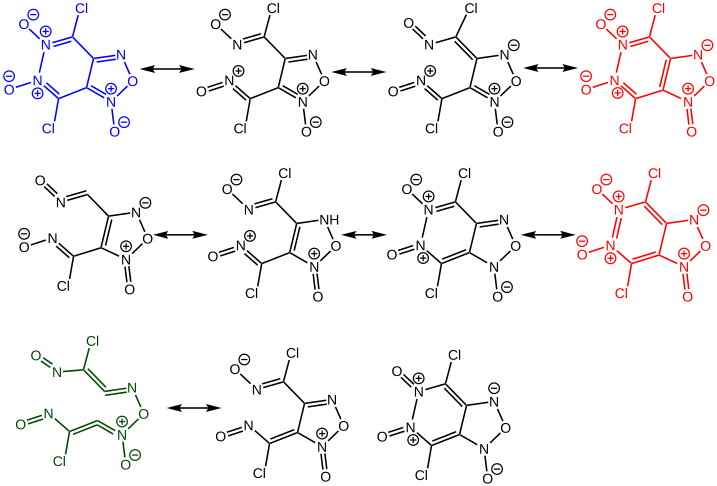
Now this is a long N-N bond, probably the longest such bond ever found! And the Lewis valence bond structure has a remarkable up to three centres containing groups with ionic charge separation. The one shown in blue is how it is represented in the literature[2], but many others can be devised. The list above is by no means comprehensive, some with a double bond between the two nitrogens and others with no bond there! Two are aromatic (red) and one has little charge separation (green). Some have three centres of charge separation, others with only one. This might be an interesting problem to set students in a tutorial – how many Lewis structures can they devise in a set time?
The first task is to see if this effect might be replicated using DFT theory. Here are some models (again by no means comprehensive). It seems that adding a DCM solvation field (to mimic the polar environment of a crystal) does make a difference.
Expt
| Method | N-N length | DOI |
|---|---|---|
| Expt | 1.695 | [3] |
| MN15L/Def2-TZVPP | 1.732 | [4] |
| MN15L/Def2-TZVPP + water solvation | 1.678 | [5] |
| MN15L/Def2-TZVPP + DCM solvation | 1.686 | [6] |
| MN15L/Def2-QZVPP | 1.728 | [7] |
| r2-SCAN-3c/Def2-mTZVPP + DCM | 1.787 | – |
The calculated (MN15L/Def2-TZVPP + DCM solvation[8]) Wiberg bond index of the N-N bond is 0.5594, an unusually low value for a σ-bond. The corresponding NBO localised orbital however has a normal electron occupancy (1.9507e).
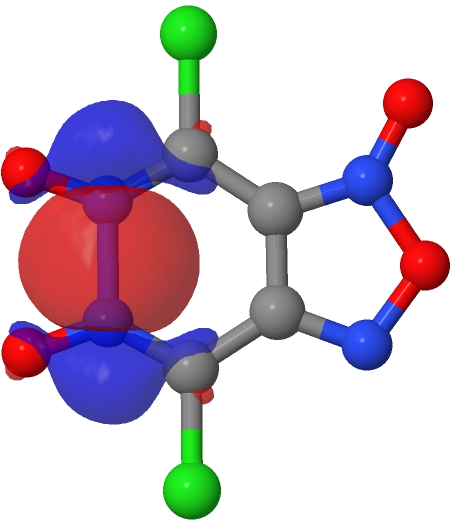
So this unusual N-N bond can be added to the list of “longest ever” bonds. However, unlike e.g. ultra long C-C single bonds, which tend to be dominated by steric repulsions, this one achieves its status purely electronically.
Update.
Looking at my old posts here, I recollected this one from 2012.[9] These are the “semi-bullvalenes’, an example of [3,3] sigmatropic rearrangements in which one bond is broken and another formed. The point where both bonds are equal in length is normally a transition state for the process, but for a few examples, this “mid-point” represents a stable minimum. So it was for a tetra-aza example with two N-N bonds participating in the bond breaking/forming. For the species below, the N-N lengths are in the region of 2.06/2.17Å So this molecule (it is as far as I know hypothetical) would be an example of a compound with an even longer N-N bond!
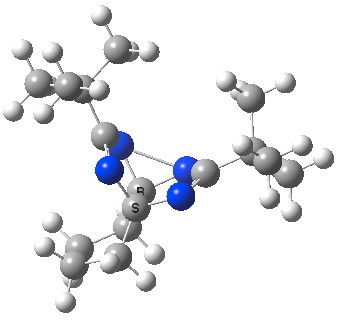
Tetra-azo semibullvalene. Click for animation of key frozen mode.
Author

References
- H. Rzepa, "The mysterious N=N double bond in nitrosobenzene dimer.", 2025. https://doi.org/10.59350/rzepa.29383
- Q. Zhang, C. He, and S. Pang, "Synthesis of heterocyclic (triazole, furoxan, furazan) fused pyridazine di- <i>N</i> -oxides <i>via</i> hypervalent iodine oxidation", New Journal of Chemistry, vol. 46, pp. 14324-14327, 2022. https://doi.org/10.1039/d2nj02908a
- Zhang, Qi., He, Chunlin., and Pang, Siping., "CCDC 2175700: Experimental Crystal Structure Determination", 2022. https://doi.org/10.5517/ccdc.csd.cc2c0zw8
- H. Rzepa, "JEGRAS N-N long bond", 2026. https://doi.org/10.5281/zenodo.21218277
- H. Rzepa, "JEGRAS N-N long bond in water Def2-QZVPP", 2026. https://doi.org/10.5281/zenodo.21416121
- H. Rzepa, "JEGRAS N-N long bond in DCM", 2026. https://doi.org/10.5281/zenodo.21424196
- H. Rzepa, "JEGRAS N-N long bond in water", 2026. https://doi.org/10.5281/zenodo.21416139
- H. Rzepa, "JEGRAS N-N long bond in DCM NBO7", 2026. https://doi.org/10.5281/zenodo.21425098
- H. Rzepa, "Frozen Semibullvalene: a holy grail (and a bis-homoaromatic molecule).", 2012. https://doi.org/10.59350/585c3-dpy86