I have in the past (around 2012 to be specific) taken an interest in a particular type of [3,3]sigmatropic pericyclic reaction called the semibullvalene rearrangement.[1],[2],[3]. This system can apparently exhibit very long C-C bonds in the region of 2.1Å, in which form it would be called a “frozen” transition state, also referred to a bis-homoaromatic molecule, which in this form is NOT regarded as a [3,3]sigmatropic pericyclic transition state. Time for an update I thought, starting with a crystal structure search (Figure 1) for these types of species.
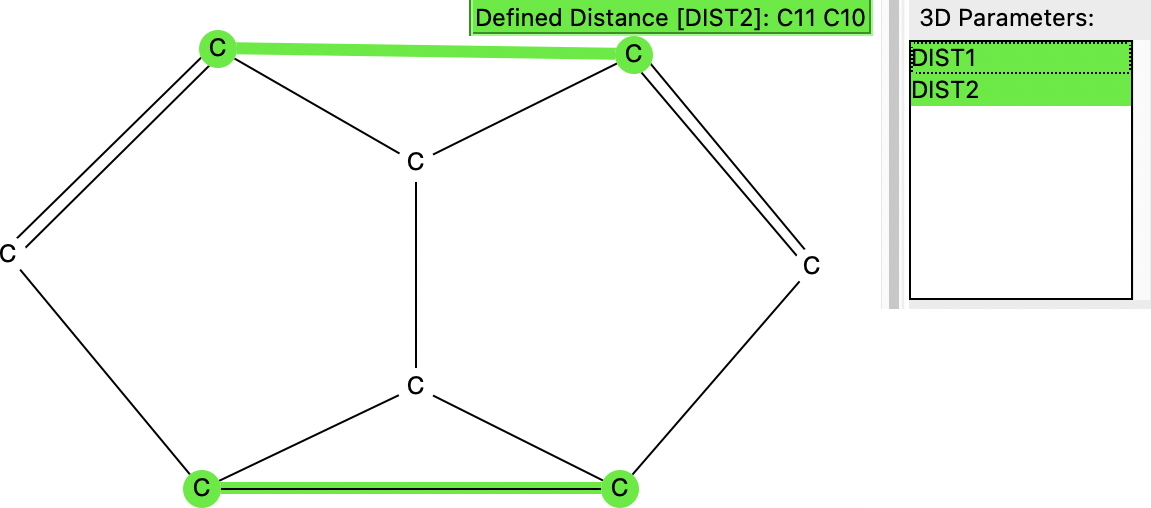
Figure 1. Search query.
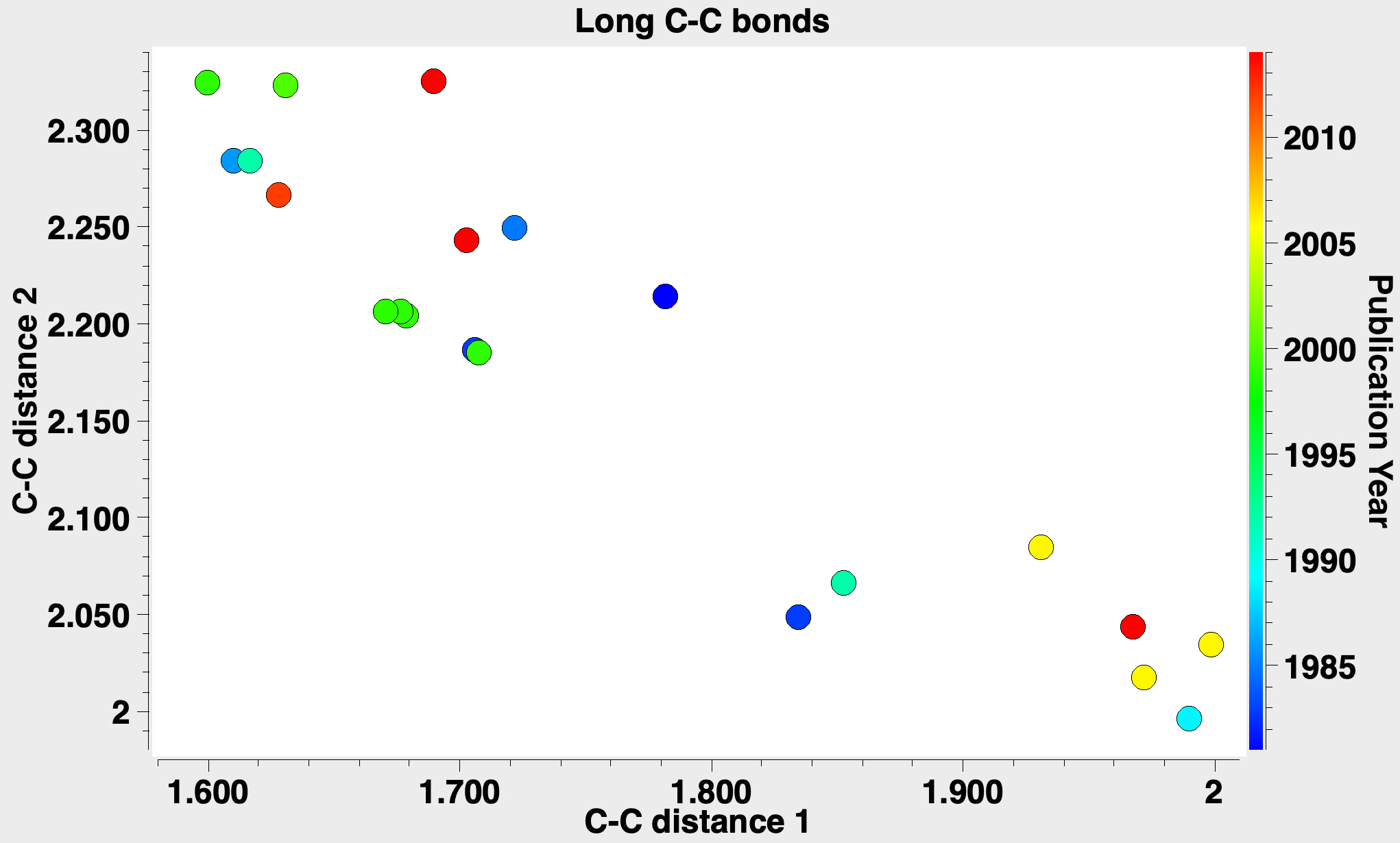
Figure 2. C-C bond lengths, showing publication date.
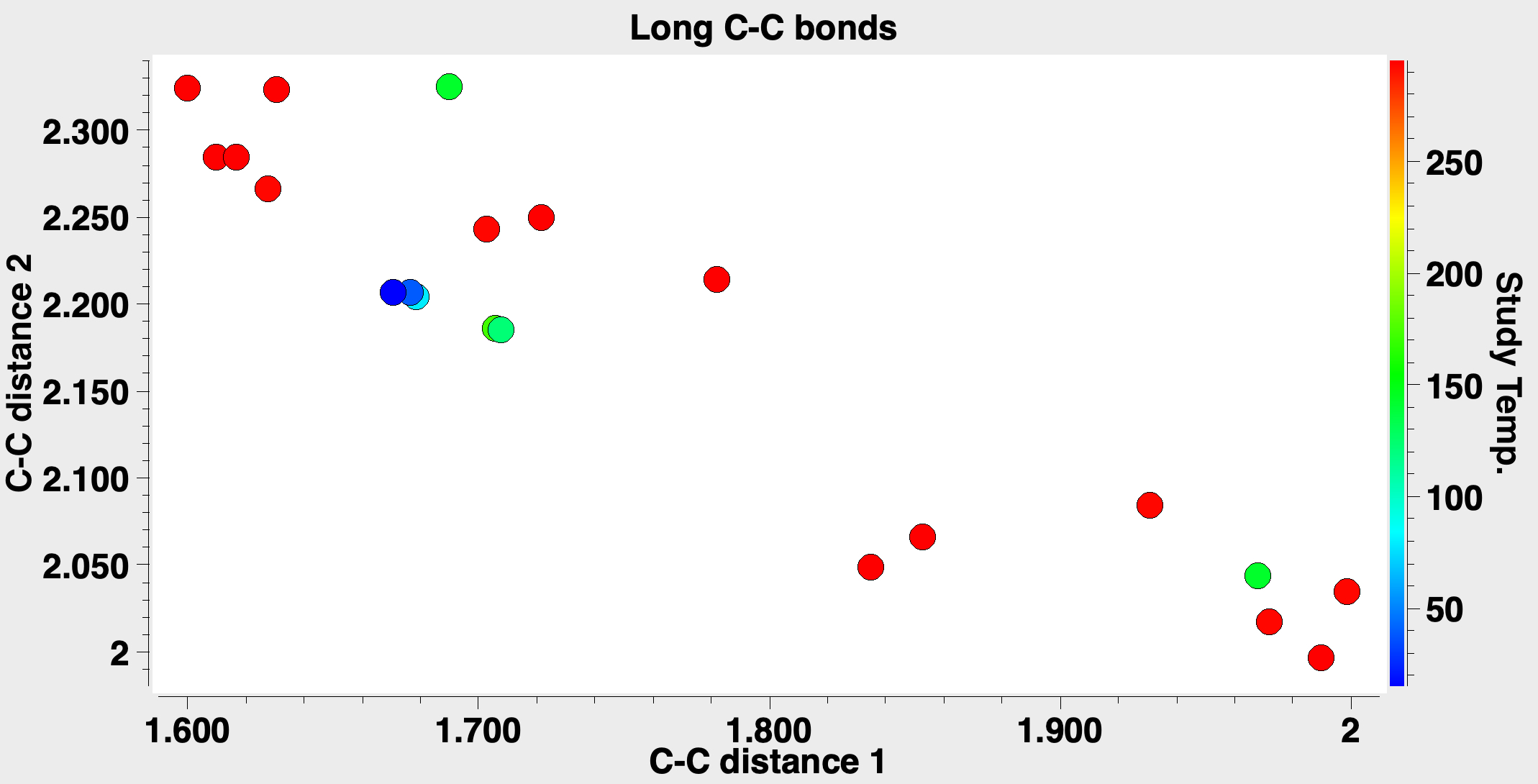
Figure 3. C-C bond lengths showing measurement temperature.
The bottom right region of these maps (Figures 2 and 3) contains examples for which both DIST and DIST2 are more or less equal with values of ~2.1A. Note that all but one have been measured at room temperatures, which means that the structure is measured with a lot of thermal motions for the atoms. Some molecules have been singled out from the map above and two of those have been selected for DFT calculations – ICILAI which is characterised by dispersion attractions between ethyl groups on the bulvallene unit and CASFUE which instead has polar cyano groups.
| CSD Entry | C-C 1 | C-C 2 | Temp | DOI |
|---|---|---|---|---|
| ICILAI | 1.931 | 2.084 | RT | [4] |
| ICILAI01 | 1.690 | 2.325 | 140 | [5] |
| ICIKUB | 1.972 | 2.017 | RT | [4] |
| CAZFUE01 | 1.990 | 1.996 | RT | [6] |
| LAGHOG03 | 1.671 | 2.206 | 15 | [7] |
Note that ICILAI, which has more or less equal bonds when measured at RT, shows very unequal bonds at 140K. The question we are asking here is whether there are any examples where the equal and long C-C bonds genuinely persist down to low temperatures and which therefore constitute especially “long” C-C bonds as part of a bis-homoaromatic molecule. The “bond” here would not be an abnormally long conventional σ-bond but instead what is called a “suspended π-bond” and considered a “normal” length for such an interaction.
| Entry | νC-C MN15L[8]/Def2-TZVPP |
DOI MN15L | νC-C r2SCAN-3c/Def2-mTZVPPL[9] |
νC-C ωB97XD[10]/Def2-TZVPP |
DOI ωB97XD |
|---|---|---|---|---|---|
| CAZFUE01 | +214.7 | [11],[12] | +234.1 (+291.6)‡ | -281.3 | [13],[14] |
| ICILAI | -38.6 | [15] | -155.8 | -356.0 | [16] |
What emerges from the calculations is that the characterisation as either a [3,3]-sigmatropic pericyclic transition state or as a bis-homoaromatic ground state is very dependent on the DFT functional being used.
- For CAZFUE the conventional ωB97XD/Def2-TZVPP method gives results belonging to the classical camp of predicting both examples above as being [3,3] sigmatropic transition states, with a characteristic strong calculated negative force constant and an IRC that shows the equal bond length position only as an energy maximum along the transition coordinate, albeit with a relatively modest barrier of ~5 kcal/mol. Such a value is higher than the energy of thermal vibrations, and so at low temperatures the structure will be frozen to either end of the IRC and show unequal C-C bonds of 1.614Å and 2.338Å, typical of those found in the table above.
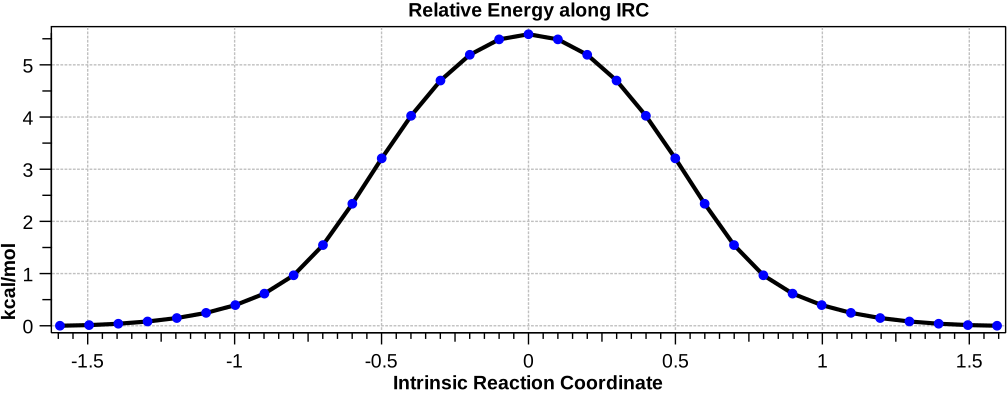
Figure 4. ωB97XD/Def2-TZVPP IRC for CAZFUE. - The MN15L DFT method[8] (which is optimised specifically for transition metal elements) predicts a symmetrical long bond bis-homoaromatic structure (C-C 2.135Å) for CAZFUE, with a positive antisymmetric C-C stretch of +215 cm-1, almost equal in magnitude to ωB97XD but opposite in sign for the force constant (Figure 5).
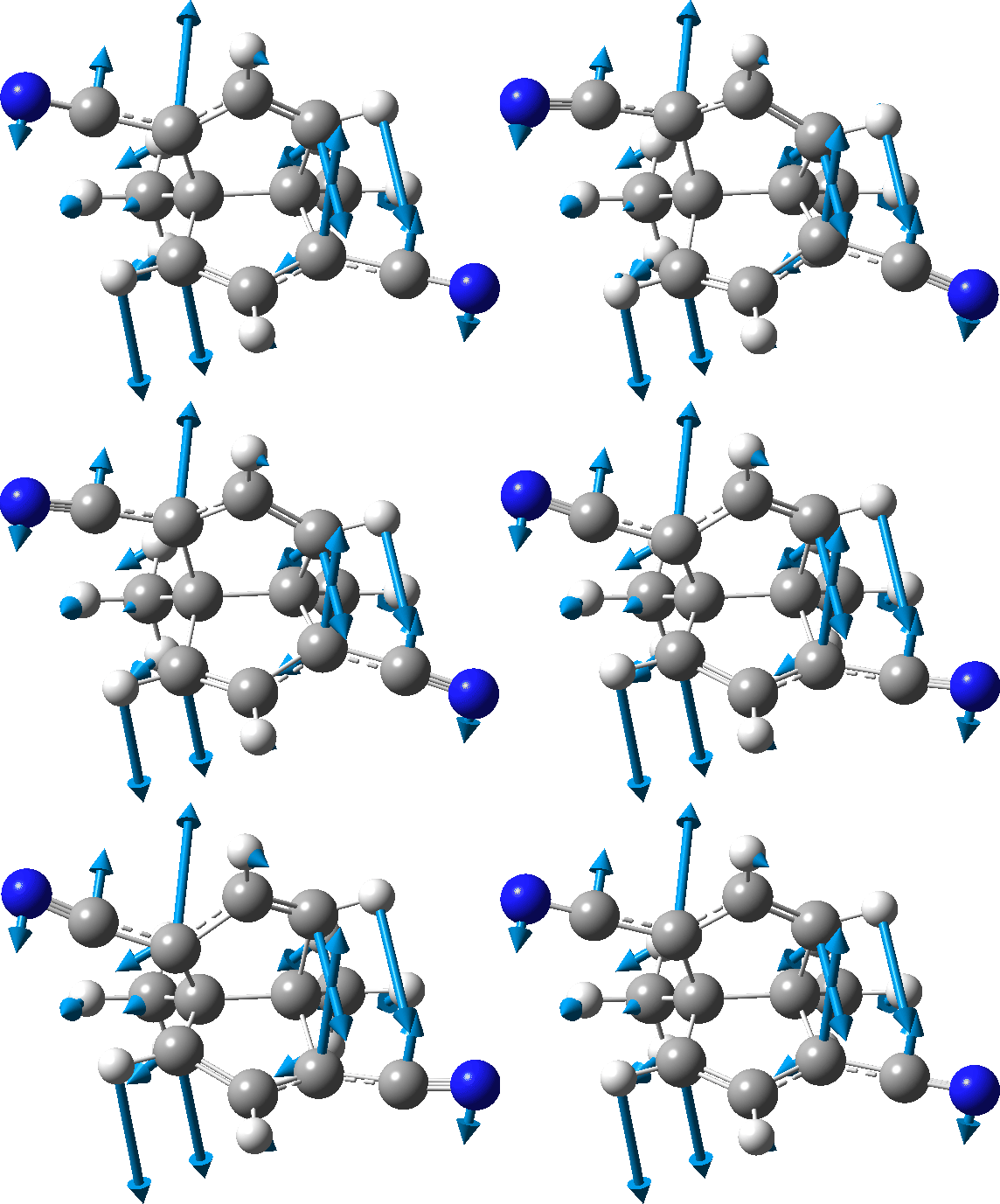
Figure 5. MN15L normal vibrational C-C mode for CAZFUI. - The newer r2SCAN-3c/Def2-mTZVPP functional is very similar in behaviour to MN15L.
- With MN15L, ICILAI however weakly retains the classical transition state mode, but now the C-C antisymmetric stretch is small with a negative FC (Figure 6). One wonders whether the difference is due to the dispersion attractions vs the electronic effect of a cyano group? The r2SCAN-3c/Def2-mTZVPP method predicts a larger -ve FC (ΔΔG‡ 3.2 kcal/mol) but not as large as using ωB97XD.
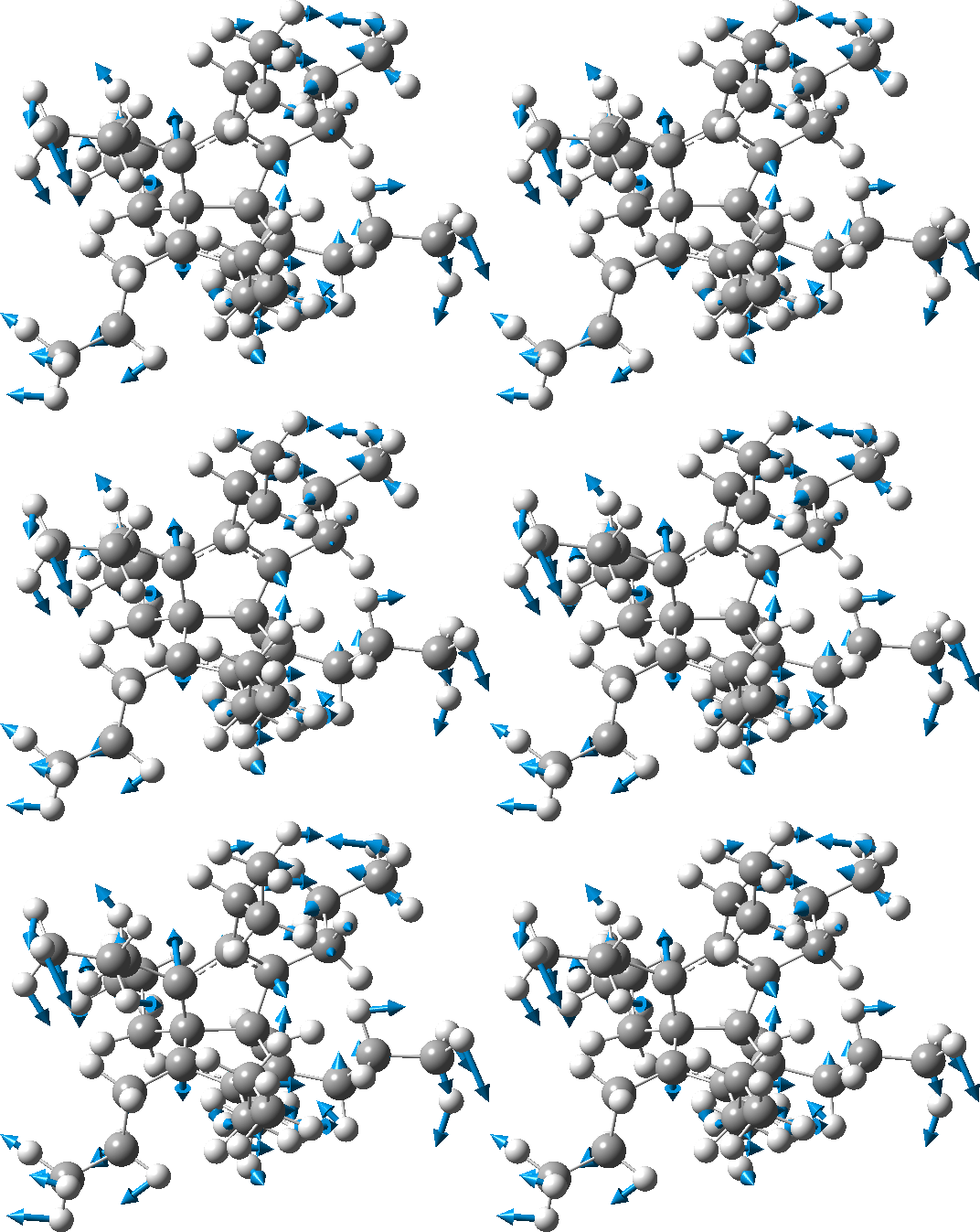
Figure 6. MN15L normal vibrational C-C mode for ICILAI. - In contrast to both MN15L and to a lesser extent r2SCAN-3c/Def2-mTZVPP, using ωB97XD for ICILAI reveals it is now strongly characterised as a [3,3] transition state.
I note from Figure 2 that many of these crystal structures are quite old – clearly this area of research is no longer highly active. But such structures are proving invaluable tests of how density functional procedures perform for these molecules. Thus r2SCAN-3c/Def2-mTZVPP as a recent new method[17] is giving significantly different results from the much older ωB97XD functional. But is it correct? More accurate and reliable crystal structures might help provide an answer – perhaps obtained using quantum crystallography? Or repeating the structure CAZFUI at say 15K.
‡ Value for C2v symmetric tetra-cyano derivative.
This post has DOI: 10.59350/sjyby-4yw41
Author

References
- H. Rzepa, "Predicted properties of a candidate for a frozen semibullvalene.", 2012. https://doi.org/10.59350/cq2a3-g2g35
- H. Rzepa, "Frozen Semibullvalene: a holy grail (and a bis-homoaromatic molecule).", 2012. https://doi.org/10.59350/585c3-dpy86
- H. Rzepa, "The ten-electron homologue of semibullvalene.", 2012. https://doi.org/10.59350/8nkna-ycy23
- C. Wang, J. Yuan, G. Li, Z. Wang, S. Zhang, and Z. Xi, "Metal-Mediated Efficient Synthesis, Structural Characterization, and Skeletal Rearrangement of Octasubstituted Semibullvalenes", Journal of the American Chemical Society, vol. 128, pp. 4564-4565, 2006. https://doi.org/10.1021/ja0579208
- S. Zhang, M. Zhan, Q. Wang, C. Wang, W. Zhang, and Z. Xi, "Synthesis of semibullvalene derivatives via Co <sub>2</sub> (CO) <sub>8</sub> -mediated cyclodimerization of 1,4-dilithio-1,3-butadienes", Org. Chem. Front., vol. 1, pp. 130-134, 2014. https://doi.org/10.1039/c3qo00019b
- L.M. Jackman, A. Benesi, A. Mayer, H. Quast, E.M. Peters, K. Peters, and H.G. Von Schnering, "The Cope rearrangement of 1,5-dimethylsemibullvalene-2,6- and 3,7-dicarbonitriles in the solid state", Journal of the American Chemical Society, vol. 111, pp. 1512-1513, 1989. https://doi.org/10.1021/ja00186a064
- R.V. Williams, V.R. Gadgil, P. Luger, T. Koritsanszky, and M. Weber, "The Search for Homoaromatic Semibullvalenes. 6. <sup>1</sup> X-ray Structure and Charge Density Studies of 1,5-Dimethyl-2,4,6,8-semibullvalenetetracarboxylic Dianhydride in the Temperature Range 123−15 K", The Journal of Organic Chemistry, vol. 64, pp. 1180-1190, 1999. https://doi.org/10.1021/jo981703q
- H.S. Yu, X. He, and D.G. Truhlar, "MN15-L: A New Local Exchange-Correlation Functional for Kohn–Sham Density Functional Theory with Broad Accuracy for Atoms, Molecules, and Solids", Journal of Chemical Theory and Computation, vol. 12, pp. 1280-1293, 2016. https://doi.org/10.1021/acs.jctc.5b01082
- S. Grimme, A. Hansen, S. Ehlert, and J. Mewes, "r2SCAN-3c: A “Swiss army knife” composite electronic-structure method", The Journal of Chemical Physics, vol. 154, 2021. https://doi.org/10.1063/5.0040021
- J. Chai, and M. Head-Gordon, "Long-range corrected hybrid density functionals with damped atom–atom dispersion corrections", Physical Chemistry Chemical Physics, vol. 10, pp. 6615, 2008. https://doi.org/10.1039/b810189b
- H. Rzepa, "CAZFUE01 MN15L/Def2-TZVPP => C2 symmetry => bis(homoaromatic) ? Gas phase", 2026. https://doi.org/10.5281/zenodo.22009539
- H. Rzepa, "CAZFUE01 => C2 symmetry => bis(homoaromatic) ? STABLE wavefunction? Gas phase", 2026. https://doi.org/10.5281/zenodo.22009550
- H. Rzepa, "CAZFUE01 wB97XD/Def2-TZVPP => C2 symmetry => bis(homoaromatic) transition state", 2026. https://doi.org/10.5281/zenodo.22012011
- H. Rzepa, "CAZFUE01 wB97XD/Def2-TZVPP => C2 symmetry => bis(homoaromatic) transition state Gas phase IRC", 2026. https://doi.org/10.5281/zenodo.22012031
- H. Rzepa, "ICILAI MN15L /Def2-TZVPP = TS (nu -31 cm-1). Gas phase", 2026. https://doi.org/10.5281/zenodo.22009559