Archive for the ‘reaction mechanism’ Category
Monday, May 19th, 2025
The monosulfoxide of cyclo-heptasulfur was reported along with cycloheptasulfur itself in 1977,[1] along with the remarks that “The δ modification of S7 contains bonds of widely differing length: this has never been observed before in an unsubstituted molecule. and “the same effect having also been observed in other sulfur rings (S8O, S7I1+ and S7O).” Here I take a look at the last of these other molecules, the monosulfoxide of S7, as a follow up to the commentary on S7 itself.[2]
(more…)
References
- R. Steudel, R. Reinhardt, and T. Sandow, "Bond Interaction in Sulfur Rings: Crystal and Molecular Structure of <i>cyclo</i>‐Heptasulfur Oxide, S<sub>7</sub>O", Angewandte Chemie International Edition in English, vol. 16, pp. 716-716, 1977. https://doi.org/10.1002/anie.197707161
- H. Rzepa, "Cyclo-Heptasulfur, S<sub>7</sub> – a classic anomeric effect discovered during a pub lunch!", 2025. https://doi.org/10.59350/rzepa.28407
Posted in Interesting chemistry, reaction mechanism | No Comments »
Tuesday, August 29th, 2023
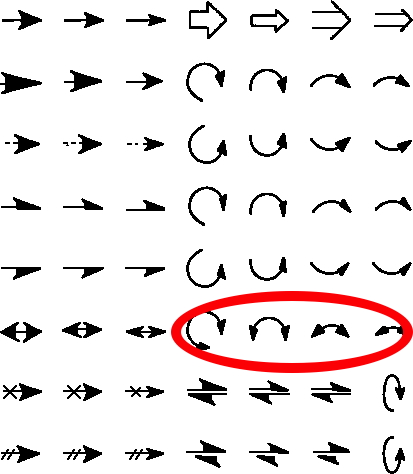
The schematic representation of a chemical reaction mechanism is often drawn using a palette of arrows connecting or annotating the various molecular structures involved. These can be selected from a chemical arrows palette, taken for this purpose from the commonly used structure drawing program Chemdraw. Explanations of how to apply the individual arrows are not always easy to find however! Circled in red are the ones to be discussed here, although most carry fascinating and often subtle meanings!‡
(more…)
Tags:Curly arrows
Posted in Curly arrows, reaction mechanism | No Comments »
Friday, August 25th, 2023
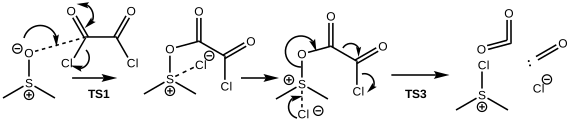
The Swern oxidation[1] is a class of “activated” dimethyl sulfoxide (DMSO) reaction in which the active species is a chlorodimethylsulfonium chloride salt. The mechanism of this transformation as shown in e.g. Wikipedia is illustrated below.‡ However, an interesting and important aspect of chemistry is not apparent in this schematic mechanism and to rectify this, a full computed mechanism is laid out below, for which the FAIR data has a DOI: 10.14469/hpc/13151
 (more…)
References
- K. Omura, and D. Swern, "Oxidation of alcohols by “activated” dimethyl sulfoxide. a preparative, steric and mechanistic study", Tetrahedron, vol. 34, pp. 1651-1660, 1978. https://doi.org/10.1016/0040-4020(78)80197-5
Posted in Curly arrows, reaction mechanism | 3 Comments »
Tuesday, November 29th, 2022
The topic of dicarbon, C2, has been discussed here for a few years now. It undoubtedly would be a gas! This aspect of the species came to the fore recently[1] when further experiments on a potential chemical precursor of dicarbon, the zwitterion X(+)-C≡C(-), showed that different variants of X(+), such as not only X=PhI(+), but also e.g. X=dibenzothiophenium(+) appeared to generate a gaseous species, which could be trapped as “C2” in a solvent-free connected flask experiment.
(more…)
References
- H.S. Rzepa, M. Arita, K. Miyamoto, and M. Uchiyama, "A combined DFT-predictive and experimental exploration of the sensitivity towards nucleofuge variation in zwitterionic intermediates relating to mechanistic models for unimolecular chemical generation and trapping of free C
<sub>2</sub>
and alternative bimolecular pathways involving no free C
<sub>2</sub>", Physical Chemistry Chemical Physics, vol. 24, pp. 25816-25821, 2022. https://doi.org/10.1039/d2cp01214f
Posted in reaction mechanism | No Comments »
Saturday, October 8th, 2022
Sometimes you come across a reaction which is so simple in concept that you wonder why it took so long to be accomplished in practice. In this case, replacing toxic ozone O3 as used to fragment an alkene into two carbonyl compounds (“ozonolysis”) by a relatively non-toxic simple nitro-group based reagent, ArNO2 in which the central atom of ozone is substituted by an N-aryl group. As reported by Derek Lowe, two groups have published[1], [2] details of such a reaction (Ar = 4-cyano or 3-CF3,5-NO2). But there are (at least) two tricks; the first is to use photo-excitation using purple LEDs (390nm light) to activate the nitro group. The second is to establish the best aryl substituents to use for achieving maximum yields of the carbonyl compounds and the best conditions for achieving the cyclo-reversion reaction, shown below as TS1. That step requires heating the cyclo-adduct up to ~80° in (aqueous) acetonitrile for anywhere between 1-48 hours. Here I take a computational look at that last step, the premise being that if such a model is available for this mechanism, it could in principle be used to optimise the conditions for the process.
(more…)
References
- D.E. Wise, E.S. Gogarnoiu, A.D. Duke, J.M. Paolillo, T.L. Vacala, W.A. Hussain, and M. Parasram, "Photoinduced Oxygen Transfer Using Nitroarenes for the Anaerobic Cleavage of Alkenes", Journal of the American Chemical Society, vol. 144, pp. 15437-15442, 2022. https://doi.org/10.1021/jacs.2c05648
- A. Ruffoni, C. Hampton, M. Simonetti, and D. Leonori, "Photoexcited nitroarenes for the oxidative cleavage of alkenes", Nature, vol. 610, pp. 81-86, 2022. https://doi.org/10.1038/s41586-022-05211-0
Tags:Interesting chemistry
Posted in reaction mechanism | No Comments »
Friday, September 30th, 2022
The term bispericyclic reaction was famously coined by Caramella et al in 2002[1] to describe the unusual features of the apparently innocuous dimerisation of cyclopentadiene. It shows features of two paths for different pericyclic reactions, comprising a 2+4 cycloaddition in the early stages, but evolving into a (degenerate) pair of [3,3] sigmatropic reactions in the latter stages. Houk (who also uses the term ambimodal) has in recent years extended the number of examples of such pericyclic sequences to trispericyclic[2] (see here) and even an ambimodel tetrapericyclic reaction, as reported at the recent WATOC event. Here I show an example of a new type of bispericyclic reaction, comprising a 2+4 cycloaddition combined with a electrocyclic ring opening.
(more…)
References
- P. Caramella, P. Quadrelli, and L. Toma, "An Unexpected Bispericyclic Transition Structure Leading to 4+2 and 2+4 Cycloadducts in the <i>E</i><i>ndo</i> Dimerization of Cyclopentadiene", Journal of the American Chemical Society, vol. 124, pp. 1130-1131, 2002. https://doi.org/10.1021/ja016622h
- X. Xue, C.S. Jamieson, M. Garcia-Borràs, X. Dong, Z. Yang, and K.N. Houk, "Ambimodal Trispericyclic Transition State and Dynamic Control of Periselectivity", Journal of the American Chemical Society, vol. 141, pp. 1217-1221, 2019. https://doi.org/10.1021/jacs.8b12674
Posted in reaction mechanism | No Comments »
Wednesday, August 17th, 2022
Previously, I looked at autocatalytic mechanisms where the carboxyl group of an oxetane-carboxylic acid could catalyse its transformation to a lactone, finding that a chain of two such groups were required to achieve the result. Here I look at an alternative mode where the oxetane-carboxylate itself acts as the transfer chain, via a H-bonded dimer shown below.
(more…)
Posted in reaction mechanism | No Comments »
Sunday, August 14th, 2022
Having established a viable model for the unexpected isomerism of oxetane carboxylic acids to lactones[1], and taken a look at a variation in the proton transfer catalyst needed to accomplish the transformation, I now investigate the substrate itself.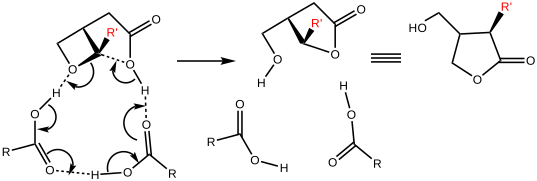
(more…)
References
- B. Chalyk, A. Grynyova, K. Filimonova, T.V. Rudenko, D. Dibchak, and P.K. Mykhailiuk, "Unexpected Isomerization of Oxetane-Carboxylic Acids", Organic Letters, vol. 24, pp. 4722-4728, 2022. https://doi.org/10.1021/acs.orglett.2c01402
Posted in reaction mechanism | 1 Comment »
Saturday, August 13th, 2022
Previously, a mechanism with a reasonable predicted energy was modelled for the isomerisation of an oxetane carboxylic acid to a lactone by using two further molecules of acid to transfer the proton and in the process encouraging an Sn2 reaction with inversion to open the oxetane ring. 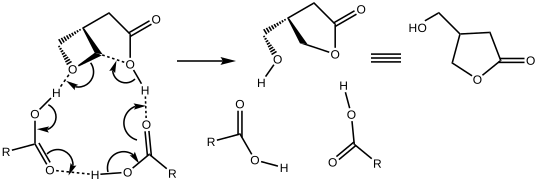
(more…)
Tags:Interesting chemistry
Posted in reaction mechanism | No Comments »
Sunday, August 7th, 2022
Derek Lowe’s blog has a recent post entitled A Downside to Oxetane Acids which picks up on a recent article[1] describing how these acids are unexpectedly unstable, isomerising to a lactone at a significant rate without the apparent need for any catalyst. This is important because these types of compound occur frequently in the medicinal chemistry literature.
(more…)
References
- B. Chalyk, A. Grynyova, K. Filimonova, T.V. Rudenko, D. Dibchak, and P.K. Mykhailiuk, "Unexpected Isomerization of Oxetane-Carboxylic Acids", Organic Letters, vol. 24, pp. 4722-4728, 2022. https://doi.org/10.1021/acs.orglett.2c01402
Posted in reaction mechanism | 4 Comments »