A recently published article addresses[1] the long standing problem of why transition metals complexes such as e.g. Cp2TiCl2 in the presence of solutions of polysulfide dianions containing sulfur chains of various lengths, can react to form sulfur ring complexes of a specific size, depending on the metal. Thus when the early transition metal is Ti (Cp = cyclopentadienyl) it forms only the six membered ring shown below (X=S), with none of the five-membered/four-sulfur ring present. However, other central and later transition period metals only form four-sulfur rings.[1]
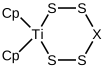
The effect was attributed to the degree of overlap of a localised sulfur p-orbital with a vacant Ti d-orbital as shown below (Figure 1. click on the diagram to get a 3D model).
References
- H.S. Rzepa, and J.D. Woollins, "Identifying the origins of the ring-size specificity of transition metals for polysulfide anions", Dalton Transactions, 2026. https://doi.org/10.1039/d6dt01849a