Author Archive
Friday, January 23rd, 2015
Sometimes you come across a bond in chemistry that just shouts at you. This happened to me in 1989[1] with the molecule shown below. Here is its story and, 26 years later, how I responded.
(more…)
References
- P. Camilleri, C.A. Marby, B. Odell, H.S. Rzepa, R.N. Sheppard, J.J.P. Stewart, and D.J. Williams, "X-Ray crystallographic and NMR evidence for a uniquely strong OH ? N hydrogen bond in the solid state and solution", Journal of the Chemical Society, Chemical Communications, pp. 1722, 1989. https://doi.org/10.1039/c39890001722
Tags:energy, high chemical shifts, New Hampshire, unusual chemical shift
Posted in Historical, Interesting chemistry | No Comments »
Thursday, January 15th, 2015
Derek Lowe in his In the Pipeline blog is famed for spotting unusual claims in the literature and subjecting them to analysis. This one is entitled Odd Structures, Subjected to Powerful Computations. He looks at this image below, and finds the structures represented there might be a mistake, based on his considerable experience of these kinds of molecules. I expect he had a gut feeling within seconds of seeing the diagram.
(more…)
Tags:created using spreadsheet software, Derek Lowe, Oxford, PDF, simulation
Posted in Chemical IT, General | No Comments »
Thursday, January 8th, 2015
About two years ago, I posted on the distribution of readership of this blog. The passage of time has increased this from 144 to 176 countries. There are apparently between 189-196 such, so not quite yet complete coverage! 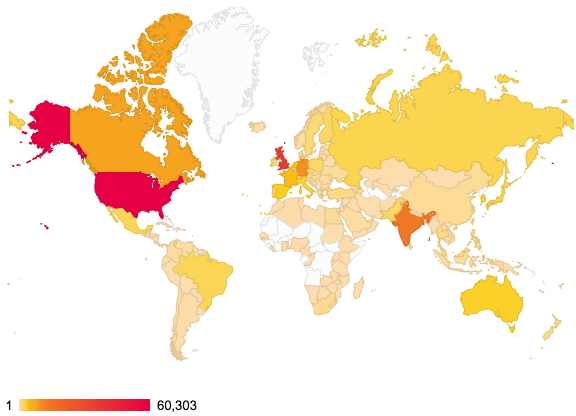
Of course, it is the nature of the beast that whilst we can track countries, very little else is known about such readerships. Is the readership young or old, student or professor, chemist or not (although I fancy the latter is less likely). Another way of keeping tabs on some of the activity are aggregators such as Chemical Blogspace, which has been rather quiet recently. Perhaps we have become too obsessed by metrics, and with the Internet-of-things apparently the “next-big-thing”, the metrics are only likely to increase. This will only encourage “game playing“, and I urge you to see a prime example of this in the UK REF (research excellence framework), the measure which attempts to rank UK universities in terms of their “excellence”.
(more…)
Tags:chemist, Internet-of-things, professor, United Kingdom
Posted in General | 2 Comments »
Monday, December 22nd, 2014
I started chemistry with a boxed set in 1962. In those days they contained serious amounts of chemicals, but I very soon ran out of most of them. Two discoveries turned what might have been a typical discarded christmas present into a lifelong career and hobby.
(more…)
Tags:A. N. Beck and Sons, Albert N. Beck, chemical stains, chemicals, chemist, christmas, Craven Cottage, GBP, London, pence, Shilling
Posted in Historical | 57 Comments »
Wednesday, December 17th, 2014
I have written earlier about the Amsterdam Manifesto. That arose out of a conference on the theme of “beyond the PDF“, with one simple question at its heart: what can be done to liberate data from containers it was not designed to be in? The latest meeting on this topic will happen in January 2015 as FORCE2015.
(more…)
Posted in Chemical IT | 4 Comments »
Sunday, December 14th, 2014
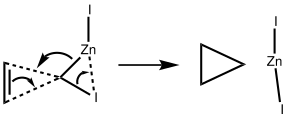
These posts contain the computed potential energy surfaces for a fair few “text-book” reactions. Here I chart the course of the cyclopropanation of alkenes using the Simmons-Smith reagent,[1] as prepared from di-iodomethane using zinc metal insertion into a C-I bond.
(more…)
References
- H.E. Simmons, and R.D. Smith, "A NEW SYNTHESIS OF CYCLOPROPANES FROM OLEFINS", Journal of the American Chemical Society, vol. 80, pp. 5323-5324, 1958. https://doi.org/10.1021/ja01552a080
Tags:computed potential energy surfaces, di-iodomethane using zinc metal insertion, Simmons
Posted in reaction mechanism | 1 Comment »
Sunday, December 7th, 2014
Continuing my hunt, here is a candidate for a strong(est?) halogen bond, this time between Se and I.[1]. 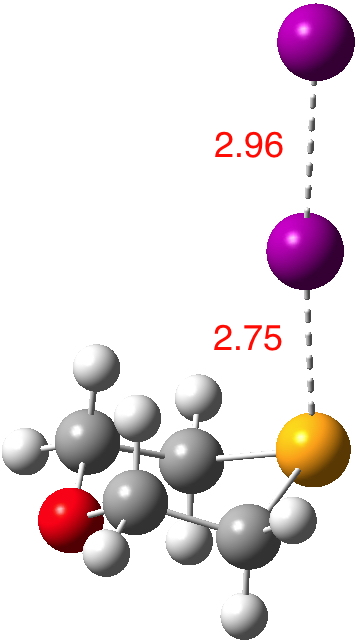 The features of interest include:
(more…)
References
- H. Maddox, and J.D. McCullough, "The Crystal and Molecular Structure of the Iodine Complex of 1-Oxa-4-selenacyclohexane, C<sub>4</sub>H<sub>8</sub>OSe.I<sub>2</sub>", Inorganic Chemistry, vol. 5, pp. 522-526, 1966. https://doi.org/10.1021/ic50038a006
Tags:chair, crystal structure search
Posted in crystal_structure_mining, Interesting chemistry | 7 Comments »
Sunday, November 30th, 2014
Pursuing the topic of halogen bonds, the system DABCO (a tertiary dibase) and iodine form an intriguing complex. Here I explore some unusual features of the structure HEKZOO[1] as published in 2012[2] and ask whether the bonding between the donor (N) and the acceptor (I-I) really is best described as a “non-covalent-interaction” (NCI) or not.
(more…)
References
- Peuronen, A.., Valkonen, A.., Kortelainen, M.., Rissanen, K.., and Lahtinen, M.., "CCDC 879935: Experimental Crystal Structure Determination", 2013. https://doi.org/10.5517/ccyjn03
- A. Peuronen, A. Valkonen, M. Kortelainen, K. Rissanen, and M. Lahtinen, "Halogen Bonding-Based “Catch and Release”: Reversible Solid-State Entrapment of Elemental Iodine with Monoalkylated DABCO Salts", Crystal Growth & Design, vol. 12, pp. 4157-4169, 2012. https://doi.org/10.1021/cg300669t
Tags:bond energy, co-operative, donor-acceptor interaction energy
Posted in Interesting chemistry | 5 Comments »