April 16th, 2010
Some molecules, when you first see them, just intrigue. So it was with carbobenzene, the synthesis of a derivative of which was recently achieved by Remi Chauvin and co-workers[1]. Two additional carbon atoms have been inserted into each of the six C-C bonds in benzene.
Read the rest of this entry »
References
- C. Saccavini, C. Sui‐Seng, L. Maurette, C. Lepetit, S. Soula, C. Zou, B. Donnadieu, and R. Chauvin, "Functional [6]Pericyclynes: Aromatization to Substituted <i>carbo</i>‐Benzenes", Chemistry – A European Journal, vol. 13, pp. 4914-4931, 2007. https://doi.org/10.1002/chem.200601193
Tags: aromatic systems, General, http, Missouri, Remi Chauvin
Posted in General | 4 Comments »
April 6th, 2010
Here I offer another spin-off from writing a lecture course on conformational analysis. This is the famous example of why 1,2-difluoroethane adopts a gauche rather than antiperiplanar conformation.
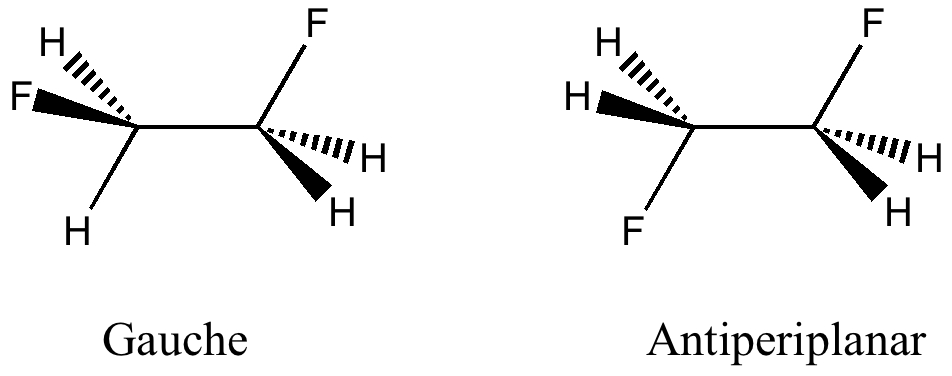
The gauche and antiperiplanar conformations of 1,2-difluoroethane
Read the rest of this entry »
Tags: appropriate algorithms, conformational analysis, energy gap, Here I, interaction energy, Interesting chemistry, spin-off
Posted in Interesting chemistry | 14 Comments »
April 2nd, 2010
One of the (not a few) pleasures of working in a university is the occasional opportunity that arises to give a new lecture course to students. New is not quite the correct word, since the topic I have acquired is Conformational analysis. The original course at Imperial College was delivered by Derek Barton himself about 50 years ago (for articles written by him on the topic[1] or the original[2] and so I have had an opportunity to see how the topic has evolved since then, and perhaps apply some quantitative quantum mechanical interpretations unavailable to Barton himself.
Read the rest of this entry »
References
- D.H.R. Barton, "The Principles of Conformational Analysis", Science, vol. 169, pp. 539-544, 1970. https://doi.org/10.1126/science.169.3945.539
- D.H.R. Barton, and R.C. Cookson, "The principles of conformational analysis", Quarterly Reviews, Chemical Society, vol. 10, pp. 44, 1956. https://doi.org/10.1039/qr9561000044
Tags: 10.1021, conformational analysis, Derek Barton, energy maxima, Imperial College, Interesting chemistry, lower energy, overall energy, potential energy surface, Tutorial material
Posted in Interesting chemistry | 11 Comments »
March 13th, 2010
One future vision for chemistry over the next 20 years or so is the concept of having machines into which one dials a molecule, and as if by magic, the required specimen is ejected some time later. This is in some ways an extrapolation of the existing peptide and nucleotide synthesizer technologies and sciences. A pretty significant extrapolation, suitable no doubt for a grand future challenge in chemistry (although the concept of tumbling a defined collection of atoms in a computer model and seeing what interesting molecules emerge, dubbed with some sense of humour as mindless chemistry, is already being done; see DOI: 10.1021/jp057107z).
Read the rest of this entry »
Tags: free energy, free energy barrier, Interesting chemistry, metal catalysts, nucleotide synthesizer technologies, similar energy
Posted in Interesting chemistry | No Comments »
February 21st, 2010
Stoyanov, Stoyanova and Reed recently published on the structure of the hydrogen ion in water. Their model was H(H2O)n+, where n=6[1] This suggestion was picked up by Steve Bachrach on his blog, where he added a further three structures to the proposed list, and noted of course that with this type of system there must be a fair chance that the true structure consists of a well-distributed Boltzmann population of a number of almost iso-energetic forms.
Read the rest of this entry »
References
Tags: animation, gas phase model, General, Interesting chemistry, Steve Bachrach
Posted in General, Interesting chemistry | 1 Comment »
February 20th, 2010
In the previous post, I ruminated about how chemists set themselves targets. Thus, having settled on describing regions between two (and sometimes three) atoms as bonds, they added a property of that bond called its order. The race was then on to find molecules which exhibit the highest order between any particular pair of atoms. The record is thus far five (six has been mooted but its a little less certain) for the molecule below
Read the rest of this entry »
Tags: bonding, ELF, Fluorine, Hiberty and co, Hypervalency
Posted in Hypervalency | 5 Comments »
February 16th, 2010
Climbers scale Mt. Everest, because its there, and chemists have their own version of this. Ever since G. N. Lewis introduced the concept of the electron-pair bond in 1916, the idea of a bond as having a formal bond-order has been seen as a useful way of thinking about molecules. The initial menagerie of single, double and triple formal bond orders (with a few half sizes) was extended in the 1960s to four, and in 2005 to five. Since then, something of a race has developed to produce the compound with the shortest quintuple bond. One of the candidates for this honour is shown below[1] which is a crystalline species (a few diatomics which exist in the gas phase are also candidates; for other reviews of the topic see [2],[3] and [2].
Read the rest of this entry »
References
- C. Hsu, J. Yu, C. Yen, G. Lee, Y. Wang, and Y. Tsai, "Quintuply‐Bonded Dichromium(I) Complexes Featuring Metal–Metal Bond Lengths of 1.74 Å", Angewandte Chemie International Edition, vol. 47, pp. 9933-9936, 2008. https://doi.org/10.1002/anie.200803859
- Y. Tsai, and C. Chang, "Recent Progress in the Chemistry of Quintuple Bonds", Chemistry Letters, vol. 38, pp. 1122-1129, 2009. https://doi.org/10.1246/cl.2009.1122
- Y. Tsai, H. Chen, C. Chang, J.K. Yu, G. Lee, Y. Wang, and T. Kuo, "Journey from Mo−Mo Quadruple Bonds to Quintuple Bonds", Journal of the American Chemical Society, vol. 131, pp. 12534-12535, 2009. https://doi.org/10.1021/ja905035f
Tags: gas phase, Hypervalency, Mt. Everest, pence
Posted in Hypervalency | 5 Comments »
February 14th, 2010
In an earlier post, I re-visited the conformational analysis of cyclohexane by looking at the vibrations of the entirely planar form (of D6h symmetry). The method also gave interesting results for the larger cyclo-octane ring. How about a larger leap into the unknown?
Read the rest of this entry »
Tags: chair, conformational analysis, final resting energy, free energy, Interesting chemistry
Posted in Interesting chemistry | 1 Comment »
February 9th, 2010
Scientists write blogs for a variety of reasons. But these do probably not include getting tenure (or grants). For that one has to publish. And I will argue here that a blog is not currently accepted as a scientific publication (for more discussion on this point, see this article by Maureen Pennock and Richard Davis). For chemists, publication means in a relatively small number of high-impact journals. Anything more than five articles a year in such journals, and your tenure is (probably) secure (if not your funding).
Read the rest of this entry »
Tags: astatine, Chemical IT, General, Google, helium, Maureen Pennock, public search facilities, rare gas, RDF, Richard Davis, Steve Bachrach
Posted in Chemical IT, General | 1 Comment »
January 31st, 2010
In the previous post, I suggested that inspecting the imaginary modes of planar cyclohexane might be a fruitful and systematic way in which at least parts of the conformational surface of this ring might be probed. Here, the same process is conducted for cyclo-octane. The ring starts with planar D8h symmetry, and at this geometry (B3LYP/6-311G(d,p), DOI: 10042/to-3742) five negative force constants (corresponding to imaginary modes) are calculated. The most negative is non-degenerate, and gives directly the crown conformation of D4d symmetry (DOI: 10042/to-3738). The remaining four modes comprise two degenerate pairs. Following either of the E2u eigenvectors downhill leads to another conformation, D2d (DOI: 10042/to-3741), with a geometry which is noteworthy for exhibiting a pair of unusually close non-bonded H…H contacts (1.908Å). This value is about 0.3Å shorter than the sum of the Wan der Waals radii (DOI: 10.1021/jp8111556). We can debate whether such a close approach or inter-penetration of two hydrogens is a bond or not (an AIM analysis appears at the bottom of this post). Read the rest of this entry »
Tags: 3g, conformational analysis, cuyclooctane, energy, General
Posted in General | 1 Comment »