(Some) chemists have a strange fascination with bonds between two specified atoms – more exactly how short or how long can such a bond get? I asked a slight different question[1] of a molecule known as nitrosobenzene dimer, noting that both nitrogens were both connected to each other and carried a (formal) positive charge; one might naively imagine that the coulomb effects between two positive atoms might result in a repulsion which would greatly lengthen the bond between them (it does not, but it does weaken it). I moved from this to asking how many examples of such molecules there might be, and whether any exhibited unusual bond lengths. After a search of the CSD, one (“JEGRAS”) caught my interest, shown in blue below[2],[3] and exhibiting a crystallographic N-N distance of 1.695Å (to answer the question posed in the title above).
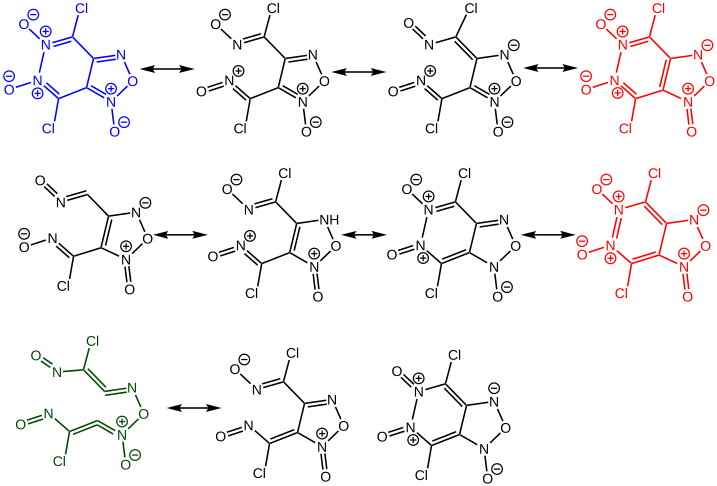
References
- H. Rzepa, "The mysterious N=N double bond in nitrosobenzene dimer.", 2025. https://doi.org/10.59350/rzepa.29383
- Q. Zhang, C. He, and S. Pang, "Synthesis of heterocyclic (triazole, furoxan, furazan) fused pyridazine di- <i>N</i> -oxides <i>via</i> hypervalent iodine oxidation", New Journal of Chemistry, vol. 46, pp. 14324-14327, 2022. https://doi.org/10.1039/d2nj02908a
- Zhang, Qi., He, Chunlin., and Pang, Siping., "CCDC 2175700: Experimental Crystal Structure Determination", 2022. https://doi.org/10.5517/ccdc.csd.cc2c0zw8