A simple correlation between a ring size and the hydrogen bonding as quantified by the O(Lp)/H-O σ* NBO interaction in that ring, indicated a 7- or 8-membered ring was preferred over smaller ones. Here is the same study, but this time using the π-electrons of an alkene as the electron donor.
Archive for the ‘Interesting chemistry’ Category
π-hydrogen bonds as a function of ring size.
Saturday, January 5th, 2013The gauche effect: seeking evidence by a survey of crystal structures.
Friday, January 4th, 2013
I previously blogged about anomeric effects involving π electrons as donors, and my post on the conformation of 1,2-difluorethane turned out one of the most popular. Here I thought I would present the results of searching the Cambridge crystal database for examples of the gauche effect. The basic search is defined below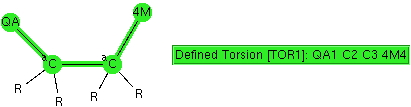
Hydrogen bond strength as a function of ring size.
Thursday, January 3rd, 2013One frequently has to confront the question: will a hydrogen bond form between a suitable donor (lone pair or π) and an acceptor? One of the factors to be taken into consideration for hydrogen bonds which are part of a cycle is the ring size. Here I explore one way of quantifying the effect for the series below, n=1-5 (4-8 membered rings).
Sharpless epoxidation, enantioselectivity and conformational analysis.
Thursday, January 3rd, 2013I return to this reaction one more time. Trying to explain why it is enantioselective for the epoxide product poses peculiar difficulties. Most of the substituents can adopt one of several conformations, and some exploration of this conformational space is needed.
Vitamin B12 and the genesis of a new theory of chemistry.
Thursday, December 20th, 2012I have written earlier about dihydrocostunolide, and how in 1963 Corey missed spotting the electronic origins of a key step in its synthesis.[1]. A nice juxtaposition to this failed opportunity relates to Woodward’s project at around the same time to synthesize vitamin B12. The step in the synthesis that caused him to ponder is shown below.
References
- E.J. Corey, and A.G. Hortmann, "The Total Synthesis of Dihydrocostunolide", Journal of the American Chemical Society, vol. 87, pp. 5736-5742, 1965. https://doi.org/10.1021/ja00952a037
Non covalent interactions in the Sharpless transition state for asymmetric epoxidation.
Wednesday, December 19th, 2012The Sharpless epoxidation of an allylic alcohol had a big impact on synthetic chemistry when it was introduced in the 1980s, and led the way for the discovery (design?) of many new asymmetric catalytic systems. Each achieves its chiral magic by control of the geometry at the transition state for the reaction, and the stabilizations (or destabilizations) that occur at that geometry. These in turn can originate from factors such as stereoelectronic control or simply by the overall sum of many small attractions and repulsions we call dispersion interactions. Here I take an initial look at these for the binuclear transition state shown schematically below.
Why is the Sharpless epoxidation enantioselective? Part 1: a simple model.
Sunday, December 9th, 2012Sharpless epoxidation converts a prochiral allylic alcohol into the corresponding chiral epoxide with > 90% enantiomeric excess[1],[2]. Here is the first step in trying to explain how this magic is achieved.
References
- J.M. Klunder, S.Y. Ko, and K.B. Sharpless, "Asymmetric epoxidation of allyl alcohol: efficient routes to homochiral .beta.-adrenergic blocking agents", The Journal of Organic Chemistry, vol. 51, pp. 3710-3712, 1986. https://doi.org/10.1021/jo00369a032
- R.M. Hanson, and K.B. Sharpless, "Procedure for the catalytic asymmetric epoxidation of allylic alcohols in the presence of molecular sieves", The Journal of Organic Chemistry, vol. 51, pp. 1922-1925, 1986. https://doi.org/10.1021/jo00360a058
Di-imide reduction with a twist: A Möbius version.
Monday, November 26th, 2012I was intrigued by one aspect of the calculated transition state for di-imide reduction of an alkene; the calculated NMR shieldings indicated an diatropic ring current at the centre of the ring, but very deshielded shifts for the hydrogen atoms being transferred. This indicated, like most thermal pericyclic reactions, an aromatic transition state. Well, one game one can play with this sort of reaction is to add a double bond. This adds quite a twist to this classical reaction!