Archive for the ‘crystal_structure_mining’ Category
Thursday, October 13th, 2016
Chemists are as fond of records as any, although I doubt you will find many chemical ones in the Guinness world records list. Polytriangulanes chase how many cyclopropyl 3-rings can be joined via a vertex. Steve Bachrach on his blog reports some recent work by Peter Schreiner and colleagues[1] and the record for catenation of such rings appears to be 15. This led me to think about some other common atoms and groups. Here I have searched for crystal structures only; there may be examples of course for which no such data has been reported.
(more…)
References
- W.D. Allen, H. Quanz, and P.R. Schreiner, "Polytriangulane", Journal of Chemical Theory and Computation, vol. 12, pp. 4707-4716, 2016. https://doi.org/10.1021/acs.jctc.6b00669
Posted in crystal_structure_mining | 3 Comments »
Wednesday, September 21st, 2016
Nucleophiles are species that seek to react with an electron deficient centre by donating a lone or a π-bond pair of electrons. The ambident variety has two or more such possible sources in the same molecule, an example of which might be hydroxylamine or H2NOH. I previously discussed how for this example, the energetics allow the nitrogen lone pair (Lp) to win out over the O Lp. Here, I play a similar game, but this time setting an NLp up against a π-pair.
(more…)
Posted in crystal_structure_mining, reaction mechanism | No Comments »
Monday, September 19th, 2016
I previously explored stabilized “carbenes” with the formal structures (R2N)2C:, concluding that perhaps the alternative ionic representation R2N+=C–NR2 might reflect their structures better. Here I take a broader look at the “carbene” landscape before asking the question “what about nitrenes?”
(more…)
Posted in crystal_structure_mining | 1 Comment »
Sunday, September 11th, 2016
To quote from Wikipedia: in chemistry, a carbene is a molecule containing a neutral carbon atom with a valence of two and two unshared valence electrons. The most ubiquitous type of carbene of recent times is the one shown below as 1, often referred to as a resonance stabilised or persistent carbene. This type is of interest because of its ability to act as a ligand to an astonishingly wide variety of metals, with many of the resulting complexes being important catalysts. The Wiki page on persistent carbenes shows them throughout in form 1 below, thus reinforcing the belief that they have a valence of two and by implication six (2×2 shared + 2 unshared) electrons in the valence shell of carbon. Here I consider whether this name is really appropriate.
(more…)
Tags:Carbenes, chemical bonding, energy barrier, free energy, Functional groups, Ligand, Mesoionic carbene, Organometallic chemistry, Persistent carbene, quantum mechanical solution, Reactive intermediates, Transition metal carbene complex, Valence, Valence electron
Posted in crystal_structure_mining, General | 2 Comments »
Saturday, August 6th, 2016
In the last few posts, I have explored the anomeric effect as it occurs at an atom centre X. Here I try to summarise the atoms for which the effect is manifest in crystal structures.
(more…)
Tags:Acetals, Alkane stereochemistry, Anomer, Anomeric effect, Atomic orbital, Carbohydrate chemistry, Carbohydrates, Chemical bond, Chemistry, interaction energy, Lone pair, Physical organic chemistry, Stereochemistry
Posted in crystal_structure_mining, Interesting chemistry | No Comments »
Friday, July 8th, 2016
The previous post looked at anomeric effects set up on centres such as B, Si or P, and involving two oxygen groups attached to these atoms. Here I vary the attached groups to include either one or two nitrogen atoms.[1]
(more…)
References
- H. Rzepa, "Anomeric effects at carbon, involving lone pairs originating from one or two nitrogens", 2016. https://doi.org/10.14469/hpc/936
Tags:Anomer, Anomeric effect, Carbohydrate chemistry, Carbohydrate conformation, Carbohydrates, Chemistry, Nitrogen
Posted in crystal_structure_mining | No Comments »
Friday, July 1st, 2016
The anomeric effect occurs at 4-coordinate (sp3) carbon centres carrying two oxygen substituents and involves an alignment of a lone electron pair on one oxygen with the adjacent C-O σ*-bond of the other oxygen. Here I explore whether other centres can exhibit the phenomenon. I start with 4-coordinate boron, using the crystal structure search definition below (along with R < 0.1, no disorder, no errors).[1]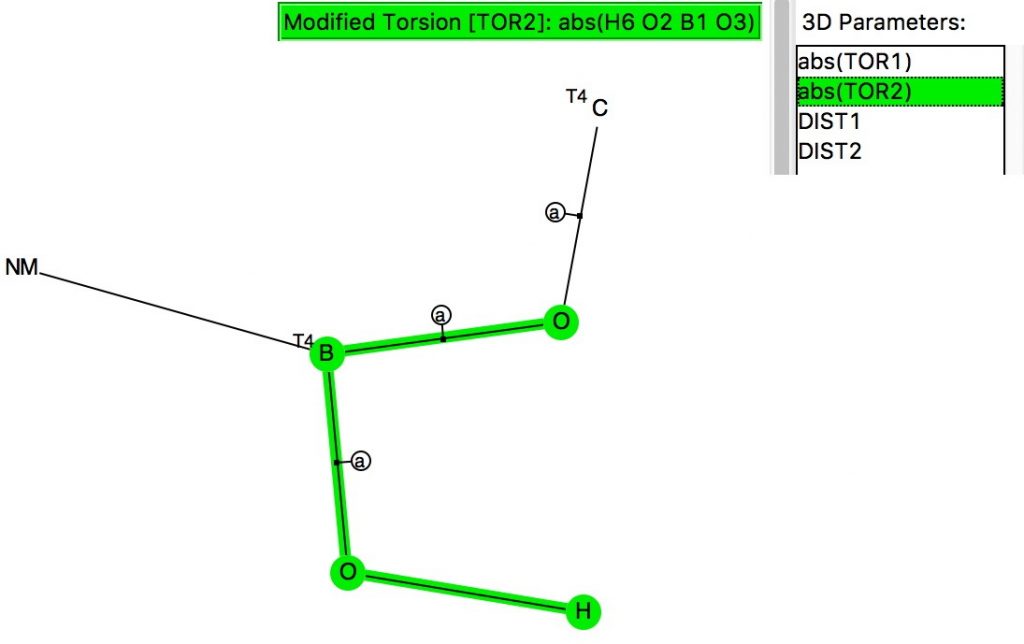
(more…)
References
- H. Rzepa, "Anomeric effects at boron, silicon and phosphorus.", 2016. https://doi.org/10.14469/hpc/696
Tags:Acetals, Alkane stereochemistry, Anomer, Anomeric effect, Bond length, Boron, Carbohydrate, Carbohydrate chemistry, Carbohydrates, crystal structure search definition, Ester, Physical organic chemistry, Stereochemistry
Posted in crystal_structure_mining | No Comments »
Wednesday, June 22nd, 2016
I previously used data mining of crystal structures to explore the directing influence of substituents on aromatic and heteroaromatic rings. Here I explore, quite literally, a different angle to the hydrogen bonding interactions between a benzene ring and OH or NH groups.
(more…)
Tags:10.1021, 10.1107, 10.5517, aromaticity, benzene, Centroid, chemical bonding, data mining, Functional groups, Hydrogen bond, Physical organic chemistry, Pyridine, Simple aromatic rings, Supramolecular chemistry
Posted in Chemical IT, crystal_structure_mining | 3 Comments »
Tuesday, June 21st, 2016
Tags:Asymmetric hydrogenation, benzene, benzo, Electrophile, Furan, Indole, Pyridine, Pyrrole, search query, Simple aromatic rings, Substitution reaction, Thiophene
Posted in crystal_structure_mining | No Comments »