In this earlier post, I described how the stereochemistry of π2+π2 cycloadditions occurs suprafacially if induced by light, and how one antarafacial component appears if the reaction is induced by heat alone. I also noted how Woodward and Hoffmann (WH) explained that violations to their rules were avoided by mandating a change in mechanism requiring stepwise pathways with intermediates along the route. Here I illustrate how the stereochemistry of a thermal π2+π2 cycloaddition can indeed avoid an antarafacial component by performing appropriate gymnastic contortions instead of a mechanistic change (a WH violation certainly in the letter of their law, if not their spirit).
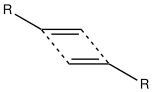 (more…)
Posts Tagged ‘Tutorial material’
Molecular gymnastics in 2+2 cycloadditions.
Wednesday, December 14th, 2011Mechanistic morphemes. Perisolvolysis of a cyclopropyl chloride.
Tuesday, December 13th, 2011There are many treasures in Woodward and Hoffmann’s (WH) classic monograph. One such is acetolysis of the endo chloride (green), which is much much faster than that of the exo isomer (red). The explanation given in their article (p 805) confines itself to succinctly stating that only loss of the endo halogen can be concerted with a required disrotatory ring opening of the cyclopropane. Demonstrating the truth of this statement by computational modelling turns out to be an interesting challenge. (more…)
Violations. There are none!
Sunday, December 11th, 2011Thus famously wrote Woodward and Hoffmann (WH) in their classic monograph about the conservation of orbital symmetry in pericyclic reactions. But they also note that the “fantastic” hydrocarbon (number 85 in their review) shown below presents a situation of great interest in having a half life of ~30 minutes at 353K (a free energy barrier of ~ 26.2 kcal/mol). Here I investigate if it might actually be such a violation. (more…)
Validating the chemical literature heritage. Eudesma-1,3-dien-6,13-olide.
Thursday, December 8th, 2011Previously, I had noted that Corey reported in 1963/65 the total synthesis of the sesquiterpene dihydrocostunolide. Compound 16, known as Eudesma-1,3-dien-6,13-olide was represented as shown below in black; the hydrogen shown in red was implicit in Corey’s representation, as was its stereochemistry. As of this instant, this compound is just one of 64,688,893 molecules recorded by Chemical Abstracts. How can we, in 2011, validate this particular entry, and resolve the stereochemical ambiguity? Here I discuss one approach (a vision if you like of the semantic web). (more…)
So near and yet so far. The story of the electrocyclic ring opening of a cyclohexadiene.
Tuesday, December 6th, 2011My previous three posts set out my take on three principle categories of pericyclic reaction. Here I tell a prequel to the understanding of these reactions. In 1965, Woodward and Hoffmann[1] in their theoretical analysis (submitted Nov 30, 1964) for which the Nobel prize (to Hoffmann only of the pair, Woodward having died) was later awarded. But in the same year, Elias Corey[2] reported the conclusion of a project started several years earlier (first reported (DOI: 10.1021/ja00907a030, Nov 1, 1963) to synthesize the sesquiterpene dihydrocostunolide.
References
- R.B. Woodward, and R. Hoffmann, "Stereochemistry of Electrocyclic Reactions", Journal of the American Chemical Society, vol. 87, pp. 395-397, 1965. https://doi.org/10.1021/ja01080a054
- E.J. Corey, and A.G. Hortmann, "The Total Synthesis of Dihydrocostunolide", Journal of the American Chemical Society, vol. 87, pp. 5736-5742, 1965. https://doi.org/10.1021/ja00952a037
A modern take on pericyclic sigmatropic migrations.
Tuesday, November 29th, 2011A modern take on pericyclic cycloaddition. Dimerisation of cis-butene
Monday, November 28th, 2011The π2 + π2 cyclodimerisation of cis-butene is the simplest cycloaddition reaction with stereochemical implications. I here give it the same treatment as I did previously for electrocyclic pericyclic reactions.
A modern take on the pericyclic electrocyclic ring opening of cyclobutene.
Saturday, November 26th, 2011Woodward and Hoffmann published their milestone article “Stereochemistry of Electrocyclic Reactions” in 1965. This brought maturity to the electronic theory of organic chemistry, arguably started by the proto-theory of Armstrong some 75 years earlier. Here, I take a modern look at the archetypal carrier of this insight, the ring opening of dimethylcyclobutene.
The peroxidation of alkynes: things are not always what they seem.
Wednesday, November 16th, 2011The epoxidation of an alkene to give an oxirane is taught in introductory organic chemistry. Formulating an analogous mechanism for such reaction of an alkyne sounds straightforward, but one gradually realises that it requires raiding knowledge from several other areas of (perhaps slightly more advanced) chemistry to achieve a joined up approach to the problem. I had indeed hinted in a previous post that the mechanism for oxidation of acetylene to ketene might be an interesting arrow pushing challenge to set a bright tutorial group, and it was that self-hint that has led me to here. I now explore how my “arrow pushing” intuition stands up to a computational examination.