Posts Tagged ‘free energy’
Sunday, October 16th, 2011
I asked a while back whether blogs could be considered a serious form of scholarly scientific communication (and so has Peter Murray-Rust more recently). A case for doing so might be my post of about a year ago, addressing why borane reduces a carboxylic acid, but not its ester, where I suggested a possible mechanism. Well, colleagues have raised some interesting questions, both on the blog itself and more silently by email to me. As a result, I have tried to address some of these questions, and accordingly my original scheme needs some revision! This sort of iterative process of getting to the truth with the help of the community (a kind of crowd-sourced chemistry) is where I feel blogs do have a genuine role to play.
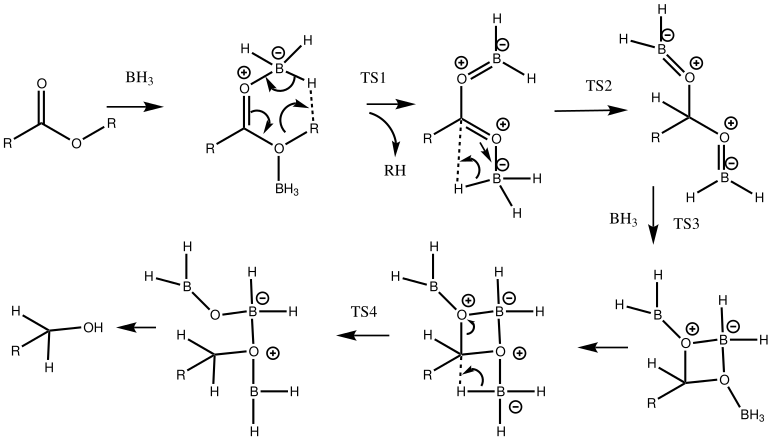
The reduction of a carboxylic acid by borane
(more…)
Tags:activation energy, animation, carboxylic acid, carboxylic ester, diborane, free energy, pericyclic, Peter Murray-Rust, Reaction Mechanism, reduction, Tutorial material
Posted in Interesting chemistry | 8 Comments »
Monday, September 26th, 2011
To (mis)quote Oscar Wilde again, ““To lose one methyl group may be regarded as a misfortune; to lose both looks like carelessness.” Here, I refer to the (past) tendency of molecular modellers to simplify molecular structures. Thus in 1977, quantum molecular modelling, even at the semi-empirical level, was beset by lost groups. One of my early efforts (DOI: 10.1021/ja00465a005) was selected for study because it had nothing left to lose; the mass spectrometric fragmentation of the radical cations of methane and ethane. Methyl, phenyl and other “large” groups were routinely replaced by hydrogen in order to enable the study. Cations indeed were always of interest to modellers; the relative lack of electrons almost always meant unusual or interesting structures and reactions (including this controversial species, DOI: 10.1021/ja00444a012). Inured to such functional loss, we modellers forgot that (unless in a mass spectrometer), cations have to have a counter anion. Here I explore one example of the model being complete(d).
(more…)
Tags:bonded systems, energy difference drops, free energy, model, Oscar, potential energy surface, Steve Bachrach, using perchlorate
Posted in Interesting chemistry | 7 Comments »
Sunday, September 18th, 2011
Organic chemistry has some no-go areas, where few molecules dare venture. One of them is described by a concept known as anti-aromaticity. Whereas aromatic molecules are favoured species, their anti-equivalent is avoided. I previously illustrated this (Hückel rule) with cyclopropenium anion. Now I take a look at cyclobutadiene, for which the π-system is said to be iso-electronic (where two electrons in a double bond have replaced the carbanion lone pair).
(more…)
Tags:cyclobutadiene, following model for this post, free energy, glycine, Tutorial material, zwitterion
Posted in Interesting chemistry | 3 Comments »
Saturday, September 3rd, 2011
The (hopefully tongue-in-cheek) title Mindless chemistry was given to an article reporting[1] an automated stochastic search procedure for locating all possible minima with a given composition using high-level quantum mechanical calculations. “Many new structures, often with nonintuitive geometries, were found”. Well, another approach is to follow unexpected hunches. One such was described in the previous post, and here I follow it to one logical conclusion.
(more…)
References
- P.P. Bera, K.W. Sattelmeyer, M. Saunders, H.F. Schaefer, and P.V.R. Schleyer, "Mindless Chemistry", The Journal of Physical Chemistry A, vol. 110, pp. 4287-4290, 2006. https://doi.org/10.1021/jp057107z
Tags:automated stochastic search procedure, free energy, metal, scientist, Tutorial material
Posted in Interesting chemistry | No Comments »
Thursday, September 1st, 2011
I have mentioned Lewis a number of times in these posts; his suggestion of the shared electron covalent bond still underpins much chemical thinking. Take for example mechanistic speculations on the course of a reaction, a very common indulgence in almost all articles reporting such, and largely based on informed arrow pushing. This process is bound to follow the rules of reasonable Lewis structures for any putative intermediates. Here, I suggest that we are now firmly in an era where such speculations must of necessity be backed up by quantum mechanical estimates of the energies and structures. I would propose that journals routinely encourage referees to insist on such (additional) checks. Let me give one specific example of the need to do this (part of a follow up to an earlier article I blogged on previously).
(more…)
Tags:3-dimethylcyclobutadiene, blog server, calixarene, chemical thinking, energy, free energy, Lewis, pericyclic, Petit, photolysis., square Me, suitable metal
Posted in Interesting chemistry | 2 Comments »
Monday, May 9th, 2011
Introductory organic chemistry invariably features the mechanism of haloalkane solvolysis, and introduces both the Sn1 two-step mechanism, and the Sn2 one step mechanism to students. They are taught to balance electronic effects (the stabilization of carbocations) against steric effects in order to predict which mechanism prevails. It was whilst preparing a tutorial on this topic that I came across what was described as the special case of neopentyl bromide, the bimolecular solvolysis of which has been identified (DOI: 10.1021/ja01182a117) as being as much as 3 million times slower than methyl bromide. This is attributed to a very strong steric effect on the reaction, greater even than that which might be experienced by t-butyl bromide! Time I thought, to take a look at what might make neopentyl bromide so special, and what those supposed electronic and steric effects were really up to.
(more…)
Tags:free energy, free energy barrier, Historical, potential energy surface, Tutorial material
Posted in Uncategorised | 1 Comment »
Saturday, December 11th, 2010
Janus was the mythological Roman god depicted as having two heads facing opposite directions, looking simultaneously into the past and the future. Some of the most ancient (i.e. 19th century) known reactions can be considered part of a chemical mythology; perhaps it is time for a Janus-like look into their future.
(more…)
Tags:activation free energy, benzonitrile product, chemical mythology, coloured solutions, cyano, diazo, diazonium, free energy, Henry Rzepa, Historical, Ion-Pair Mechanisms, L. A., nitrogen gas
Posted in Interesting chemistry | 3 Comments »
Tuesday, December 7th, 2010
More inspiration from tutorials. In a lecture on organic aromaticity, the 4n+2/4n Hückel rule was introduced (in fact, neither rule appears to have actually been coined in this form by Hückel himself!). The simplest examples are respectively the cyclopropenyl cation and anion. The former has 2 π-electrons exhibiting cyclic delocalisation, and the 4n+2 (n=0) rule predicts aromaticity. Accordingly, all three C-C distances are the same (1.363Å).
(more…)
Tags:energy, free energy, Huckel, Interesting chemistry, Pretty straight forward, Tutorial material
Posted in Interesting chemistry | 12 Comments »
Saturday, October 30th, 2010
Reactions in cavities can adopt quite different characteristics from those in solvents. Thus first example of the catalysis of the Diels-Alder reaction inside an organic scaffold was reported by Endo, Koike, Sawaki, Hayashida, Masuda, and Aoyama[1], where the reaction shown below is speeded up very greatly in the presence of a crystalline lattice of the anthracene derivative shown below.
(more…)
References
- K. Endo, T. Koike, T. Sawaki, O. Hayashida, H. Masuda, and Y. Aoyama, "Catalysis by Organic Solids. Stereoselective Diels−Alder Reactions Promoted by Microporous Molecular Crystals Having an Extensive Hydrogen-Bonded Network", Journal of the American Chemical Society, vol. 119, pp. 4117-4122, 1997. https://doi.org/10.1021/ja964198s
Tags:animation, catalysis, free energy, free energy barrier, G/RT, Interesting chemistry, Organic scaffold, pericyclic
Posted in Interesting chemistry | 7 Comments »