Previously[1] I looked at some of the properties of the mysterious dimer of nitric oxide 1 – not the known weak dimer but a higher energy form with a “triple” N≡N bond. This valence bond isomer of the weak dimer was some 24 kcal/mol higher in free energy than the two nitric oxide molecules it would be formed from. An energy decomposition analysis (NEDA) of 1 revealed an interaction energy[2] of +4.5 kcal/mol for the two radical fragments, compared to eg -27 kcal/mol for the equivalent analysis of the N=N double bond in nitrosobenzene dimer[3] So here I take a look at another property of N≡N bonds via their hydrogenation energy (Scheme), mindful that the dinitrogen molecule requires forcing conditions to hydrogenate, in part because of the unfavourable entropy terms (See Wiki and also here‡ for a calculation of ΔG298).
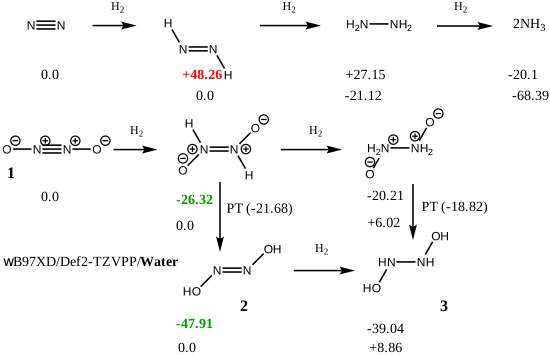
Calculations at the ωB97XD/Def2-TZVPP/SCRF=water level[4] that whilst hydrogenation of the triple bond in N2 is strongly endo-energic, the same process for molecule 1 is exo-energic (ΔΔG -26.32 kcal/mol). The direct product is a zwitterion, but presumed rapid proton transfer to a neutral form 2 increases exo-energicity. Whilst the second hydrogenation step of N2 is exo-energic, the equivalent second step for 1 to give 3 is now mildly endo-energic. Overall however, the thermodynamic energies of these two types of triple bond hydrogenation could not be more different.
So forming a N≡N triple bond by forcing two nitric oxide molecules to dimerise (using high pressure) in water produces a system where hydrogenation of that “difficult” N≡N bond is made very much easier thermodynamically. Time for an experiment?♥
‡This site reports a gas phase experimental value for ΔG -8.1 kcal/mol at 298K for this equilibrium, although the pressure is not given. The calculated value shown in the scheme above (-20.1 kcal/mol) is for 298K and 1 atm for a model using water as solvent – which might be expected to differentially solvate the product ammonia and hence promote the reaction. In the limit of low pressure (0.0001M)[5] this reduces to -13.0 kcal/mol, increases to -26.6 kcal/mol at 10M and becomes -14.3 kcal/mol at 10M/800K, illustrating how higher pressures make the reaction more exo-energic and higher temperatures less exo-energic. This was of course the problem solved in the Haber process of finding the sweet spot between pressure and temperature.
♥Perhaps not, given the report that at high pressures, nitric oxide can become explosive.[6]
Author

References
- H. Rzepa, "The even more mysterious N≡N triple bond in a nitric oxide dimer.", 2025. https://doi.org/10.59350/rzepa.29429
- H. Rzepa, "N2O2 as strong dimer? bent NEDA 0 1 0 2 0 -2 Total Interaction (E) : 4.520 Wiberg NN bond index 1.0072 NN stretch 2604 cm-1", 2025. https://doi.org/10.14469/hpc/15468
- H. Rzepa, "Nitrosobenzene dimer NEDA=2, 0,1 0,1 0,1 Total Interaction (E) : -27.564", 2025. https://doi.org/10.14469/hpc/15444
- H. Rzepa, "Hydrogenating the even more mysterious N≡N triple bond in a nitric oxide dimer.", 2025. https://doi.org/10.14469/hpc/15516
- G. Luchini, J.V. Alegre-Requena, I. Funes-Ardoiz, and R.S. Paton, "GoodVibes: automated thermochemistry for heterogeneous computational chemistry data", F1000Research, vol. 9, pp. 291, 2020. https://doi.org/10.12688/f1000research.22758.1
- T. Melia, "Decomposition of nitric oxide at elevated pressures", Journal of Inorganic and Nuclear Chemistry, vol. 27, pp. 95-98, 1965. https://doi.org/10.1016/0022-1902(65)80196-8