Janus was the mythological Roman god depicted as having two heads facing opposite directions, looking simultaneously into the past and the future. Some of the most ancient (i.e. 19th century) known reactions can be considered part of a chemical mythology; perhaps it is time for a Janus-like look into their future.
Posts Tagged ‘Historical’
Janus mechanisms (the past and the future): Reactions of the diazonium cation.
Saturday, December 11th, 2010A historical detective story: 120 year old crystals
Wednesday, November 17th, 2010In 1890, chemists had to work hard to find out what the structures of their molecules were, given they had no access to the plethora of modern techniques we are used to in 2010. For example, how could they be sure what the structure of naphthalene was? Well, two such chemists, William Henry Armstrong (1847-1937) and his student William Palmer Wynne (1861-1950; I might note that despite working with toxic chemicals for years, both made it to the ripe old age of ~90!) set out on an epic 11-year journey to synthesize all possible mono, di, tri and tetra-substituted naphthalenes. Tabulating how many isomers they could make (we will call them AW here) would establish beyond doubt the basic connectivity of the naphthalene ring system. This was in fact very important, since many industrial dyes were based on this ring system, and patents depended on getting it correct! Amazingly, their collection of naphthalenes survives to this day. With the passage of 120 years, we can go back and check their assignments. The catalogued collection (located at Imperial College) comprises 263 specimens. Here the focus is on just one, specimen number number 22, which bears an original label of trichloronaphthalene [2:3:1] and for which was claimed a melting point of 109.5°C. What caught our attention is that a search for this compound in modern databases (Reaxys if you are interested, what used to be called Beilstein) reveals the compound to have a melting point of ~84°C. So, are alarm bells ringing? Did AW make a big error? Were many of the patented dyes not what they seemed?
The oldest reaction mechanism: updated!
Tuesday, September 14th, 2010Unravelling reaction mechanisms is thought to be a 20th century phenomenon, coincident more or less with the development of electronic theories of chemistry. Hence electronic arrow pushing as a term. But here I argue that the true origin of this immensely powerful technique in chemistry goes back to the 19th century. In 1890, Henry Armstrong proposed what amounts to close to the modern mechanism for the process we now know as aromatic electrophilic substitution [1]. Beyond doubt, he invented what is now known as the Wheland Intermediate (about 50 years before Wheland wrote about it, and hence I argue here it should really be called the Armstrong/Wheland intermediate). This is illustrated (in modern style) along the top row of the diagram.
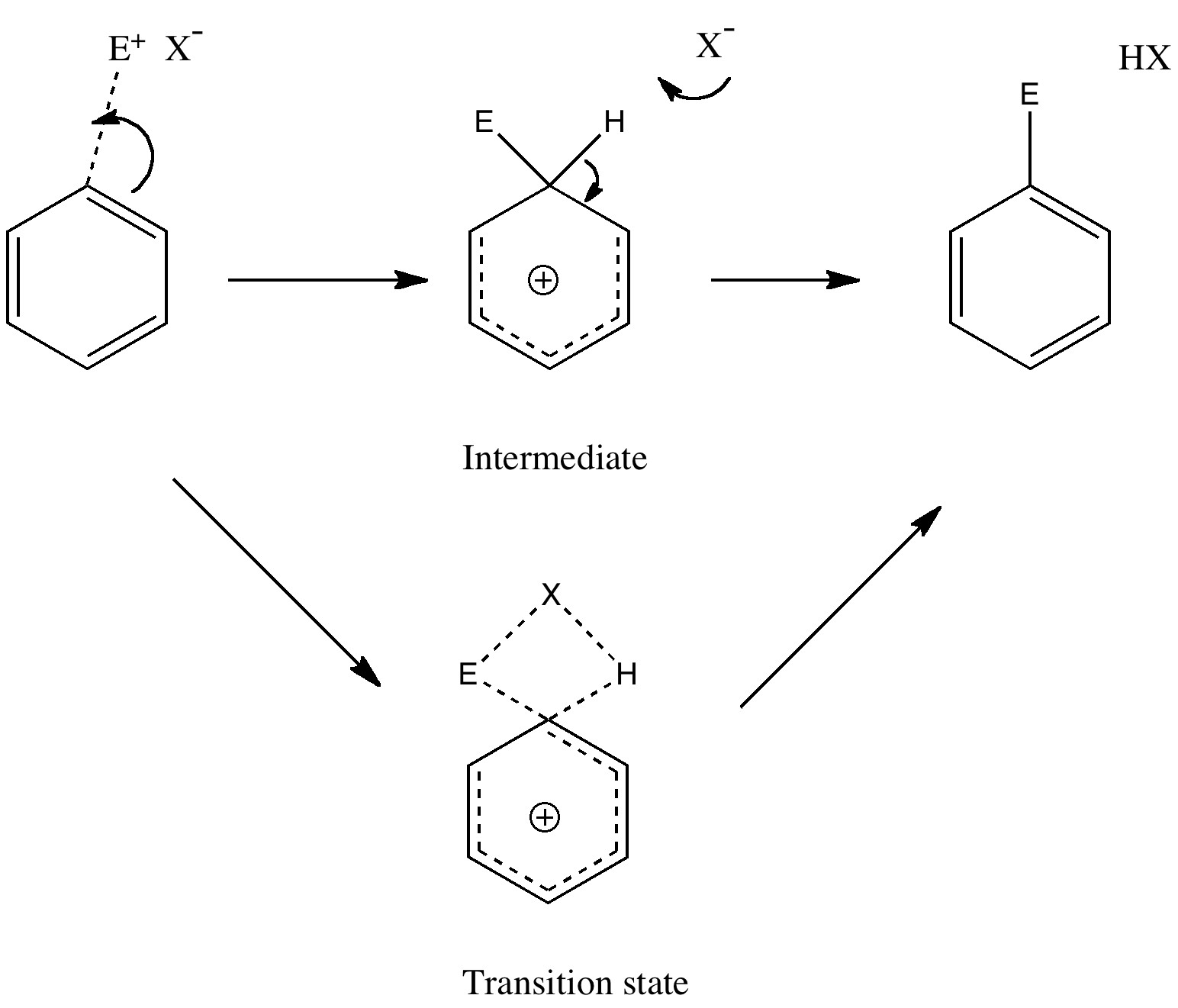
The mechanism of aromatic electrophilic substitution
References
- "Proceedings of the Chemical Society, Vol. 6, No. 85", Proceedings of the Chemical Society (London), vol. 6, pp. 95, 1890. https://doi.org/10.1039/pl8900600095
The SN1 Reaction- revisited
Wednesday, November 11th, 2009In an earlier post I wrote about the iconic SN1 solvolysis reaction, and presented a model for the transition state involving 13 water molecules. Here, I follow this up with an improved molecule containing 16 water molecules, and how the barrier for this model compares with experiment. This latter is nicely summarized in the following article: Solvolysis of t-butyl chloride in water-rich methanol + water mixtures, which (for pure water) cites the following activation parameters
(more…)
Aromatic electrophilic substitution: a different way of predicting regiospecificity
Saturday, April 4th, 2009
Every introductory course or text on aromatic electrophilic substitution contains an explanation along the lines of the resonance diagram shown below. With an o/p directing group such as NH2, it is argued that negative charge accumulates in those positions as a result of the resonance structures shown.