Posts Tagged ‘Chemistry’
Wednesday, June 3rd, 2015
My PhD thesis involved determining kinetic isotope effects (KIE) for aromatic electrophilic substitution reactions in an effort to learn more about the nature of the transition states involved.[1] I learnt relatively little, mostly because a transition state geometry is defined by 3N-6 variables (N = number of atoms) and its force constants by even more and you get only one or two measured KIE per reaction; a rather under-defined problem in terms of data! So I decided to spend a PostDoc learning how to invert the problem by computing the anticipated isotope effects using quantum mechanics and then comparing the predictions with measured KIE.[2] Although such computation allows access to ALL possible isotope effects, the problem is still under-defined because of the lack of measured KIE to compare the predictions with. In 1995 Dan Singleton and Allen Thomas reported an elegant strategy to this very problem by proposing a remarkably simple method for obtaining KIE using natural isotopic abundances.[3] It allows isotope effects to be measured for all the positions in one of the reactant molecules by running the reaction close to completion and then recovering unreacted reactant and measuring the changes in its isotope abundances using NMR. The method has since been widely applied[4],[5] and improved.[6] Here I explore how measured and calculated KIE can be reconciled.
(more…)
References
- B.C. Challis, and H.S. Rzepa, "The mechanism of diazo-coupling to indoles and the effect of steric hindrance on the rate-limiting step", Journal of the Chemical Society, Perkin Transactions 2, pp. 1209, 1975. https://doi.org/10.1039/p29750001209
- M.J.S. Dewar, S. Olivella, and H.S. Rzepa, "Ground states of molecules. 49. MINDO/3 study of the retro-Diels-Alder reaction of cyclohexene", Journal of the American Chemical Society, vol. 100, pp. 5650-5659, 1978. https://doi.org/10.1021/ja00486a013
- D.A. Singleton, and A.A. Thomas, "High-Precision Simultaneous Determination of Multiple Small Kinetic Isotope Effects at Natural Abundance", Journal of the American Chemical Society, vol. 117, pp. 9357-9358, 1995. https://doi.org/10.1021/ja00141a030
- Y. Wu, R.P. Singh, and L. Deng, "Asymmetric Olefin Isomerization of Butenolides via Proton Transfer Catalysis by an Organic Molecule", Journal of the American Chemical Society, vol. 133, pp. 12458-12461, 2011. https://doi.org/10.1021/ja205674x
- J. Chan, A.R. Lewis, M. Gilbert, M. Karwaski, and A.J. Bennet, "A direct NMR method for the measurement of competitive kinetic isotope effects", Nature Chemical Biology, vol. 6, pp. 405-407, 2010. https://doi.org/10.1038/nchembio.352
Tags:Allen Thomas, calculated activation free energy, Chemistry, Dan Singleton, Deuterium, Diels–Alder reaction, Isotope, Isotopes, Kinetic isotope effect, Nuclear physics, Physical organic chemistry, shell solutions
Posted in reaction mechanism | 6 Comments »
Saturday, May 30th, 2015
I am on a mission to persuade my colleagues that the statistical analysis of crystal structures is a useful teaching tool. One colleague asked for a demonstration and suggested exploring the classical Jahn-Teller effect (thanks Milo!). This is a geometrical distortion associated with certain molecular electronic configurations, of which the best example is illustrated by octahedral copper complexes which have a d9 electronic configuration. The eg level shown below is occupied by three electrons and which can therefore distort in one of two ways to eliminate the eg degeneracy by placing the odd electron into either a x2-y2 or a z2 orbital. Here I explore how this effect can be teased out of crystal structures.
(more…)
Tags:basic search, Chemical bond, chemical bonding, Chemistry, classical Jahn-Teller, clear Jahn-Teller, Coordination chemistry, Coordination complex, Copper(II) nitrate, dynamic Jahn-Teller, Edward Teller, Inorganic chemistry, Jahn-Teller, Jahn–Teller effect, Metal ions in aqueous solution, search criteria, Technology/Internet, Transition metals
Posted in Chemical IT, crystal_structure_mining | 1 Comment »
Friday, May 22nd, 2015
As I have noted elsewhere, Gilbert N. Lewis wrote a famous paper entitled “the atom and the molecule“, the centenary of which is coming up.[1] In a short and rarely commented upon remark, he speculates about the shared electron pair structure of acetylene, R-X≡X-R (R=H, X=C). It could, he suggests, take up three forms. H-C:::C-H and two more which I show as he drew them. The first of these would now be called a bis-carbene and the second a biradical.
(more…)
References
- G.N. Lewis, "THE ATOM AND THE MOLECULE.", Journal of the American Chemical Society, vol. 38, pp. 762-785, 1916. https://doi.org/10.1021/ja02261a002
Tags:Carbene, Carbenes, Chemistry, Cluster chemistry, food, Functional groups, Gilbert N. Lewis, Non-Kekulé molecule, Organic chemistry, Organic compounds
Posted in Chemical IT, Historical, Interesting chemistry | 1 Comment »
Tuesday, May 12th, 2015
The Bürgi–Dunitz angle is one of those memes that most students of organic chemistry remember. It hypothesizes the geometry of attack of a nucleophile on a trigonal unsaturated (sp2) carbon in a molecule such as ketone, aldehyde, ester, and amide carbonyl. Its value obviously depends on the exact system, but is generally taken to be in the range 105-107°. A very good test of this approach is to search the crystal structure database (this was how it was originally established[1]).
(more…)
References
- H. B:urgi, J. Dunitz, J. Lehn, and G. Wipff, "Stereochemistry of reaction paths at carbonyl centres", Tetrahedron, vol. 30, pp. 1563-1572, 1974. https://doi.org/10.1016/s0040-4020(01)90678-7
Tags:alkene, Bürgi–Dunitz angle, Carbonyl, Chemistry, Functional groups, Group of Eight, Ketone, Organic chemistry, Organic compounds, Stall
Posted in Chemical IT, crystal_structure_mining | 3 Comments »
Sunday, April 26th, 2015
Allotropes are differing structural forms of the elements. The best known example is that of carbon, which comes as diamond and graphite, along with the relatively recently discovered fullerenes and now graphenes. Here I ponder whether any of the halogens can have allotropes.
(more…)
Tags:Allotropy, Bromine, Carbon, Chemical elements, Chemistry, free energy barrier, Fullerene, Halogen, Hypobromite, Matter, Nonmetals, Oxidizing agents, Oxygen, pence
Posted in reaction mechanism | 9 Comments »
Friday, April 17th, 2015
The knowledge that substituents on a benzene ring direct an electrophile engaged in a ring substitution reaction according to whether they withdraw or donate electrons is very old.[1] Introductory organic chemistry tells us that electron donating substituents promote the ortho and para positions over the meta. Here I try to recover some of this information by searching crystal structures.
(more…)
References
- H.E. Armstrong, "XXVIII.—An explanation of the laws which govern substitution in the case of benzenoid compounds", J. Chem. Soc., Trans., vol. 51, pp. 258-268, 1887. https://doi.org/10.1039/ct8875100258
Tags:above search, Aromatic compounds, aromaticity, Birch reduction, Chemistry, electron donating, Electrophile, Electrophilic aromatic substitution, Ether, Functional groups, little search, Organic chemistry, Physical organic chemistry, Substitution reactions
Posted in Chemical IT, crystal_structure_mining | 1 Comment »
Sunday, April 12th, 2015
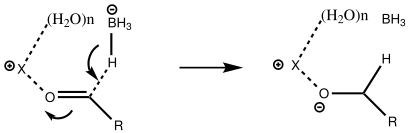
Sodium borohydride is the tamer cousin of lithium aluminium hydride (LAH). It is used in aqueous solution to e.g. reduce aldehydes and ketones, but it leaves acids, amides and esters alone. Here I start an exploration of why it is such a different reducing agent.
(more…)
Tags:aqueous solution, Chemical bond, chemical bonding, Chemistry, Electronic effect, energy, final product, free energy barrier, Hydride, Hydrogen bond, immediate product, Lithium aluminium hydride, reduction
Posted in reaction mechanism | 2 Comments »