August 11th, 2013
The ultimate reduction in size for an engineer is to a single molecule. It’s been done for a car; now it has been reported for the pixel (picture-element).[1]
Read the rest of this entry »
References
- J.E. Kwon, S. Park, and S.Y. Park, "Realizing Molecular Pixel System for Full-Color Fluorescence Reproduction: RGB-Emitting Molecular Mixture Free from Energy Transfer Crosstalk", Journal of the American Chemical Society, vol. 135, pp. 11239-11246, 2013. https://doi.org/10.1021/ja404256s
Tags: above energy diagram, energy, energy transfer, energy transfer occurring, energy transfers, engineer, free energy
Posted in Interesting chemistry | 1 Comment »
July 27th, 2013
Valence shell electron pair repulsion theory is a simple way of rationalising the shapes of many compounds in which a main group element is surrounded by ligands. ClF3 is a good illustration of this theory.
Read the rest of this entry »
Tags: 2-electron-3-centre
Posted in Hypervalency, Interesting chemistry | 5 Comments »
July 18th, 2013
This potential example of a molecule on the edge of chaos was suggested to me by a student (thanks Stephen!), originating from an inorganic tutorial. It represents a class of Mo-complex ligated by two dithiocarbamate ligands and two aryl nitrene ligands (Ar-N:).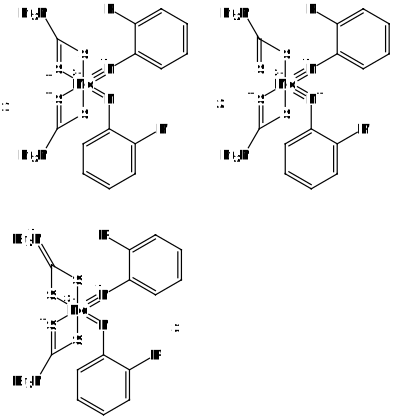
Read the rest of this entry »
Posted in Interesting chemistry | 2 Comments »
July 14th, 2013
I noted previously that some 8-ring cyclic compounds could exist in either a planar-aromatic or a non-planar-non-aromatic mode, the mode being determined by apparently quite small changes in a ring substituent. Hunting for other examples of such chemistry on the edge, I did a search of the Cambridge crystal database for metal sulfides.
Read the rest of this entry »
Tags: Cambridge, chemical reasons, metal, metal sulfides, neutral systems, transition metal series
Posted in Interesting chemistry | No Comments »
July 11th, 2013
The butterfly effect summarises how a small change to a system may result in very large and often unpredictable (chaotic) consequences. If the system is merely on the edge of chaos, the consequences are predictable, but nevertheless finely poised between e.g. two possible outcomes. Here I ask how a molecule might manifest such behaviour.
Read the rest of this entry »
Posted in Interesting chemistry | 5 Comments »
July 8th, 2013
A feature of a blog which is quite different from a journal article is how rapidly a topic might evolve. Thus I started a few days ago with the theme of dicarbon (C2), identifying a metal carbide that showed C2 as a ligand, but which also entrapped a single carbon in hexa-coordinated mode. A comment was posted bringing attention to the origins of the discovery of hexacoordinated carbon, and we moved on to exploring the valency in one such species (CLi6). Here I ask if hydrogen itself might exhibit such coordination.
Read the rest of this entry »
Tags: chemical shift, metal atoms, metal carbide
Posted in Hypervalency, Interesting chemistry | 2 Comments »
July 5th, 2013
The title of this post summarises the contents of a new molecular database: www.molecularspace.org[1] and I picked up on it by following the post by Jan Jensen at www.compchemhighlights.org (a wonderful overlay journal that tracks recent interesting articles). The molecularspace project more formally is called “The Harvard Clean Energy Project: Large-scale computational screening and design of organic photovoltaics on the world community grid“. It reminds of a 2005 project by Peter Murray-Rust et al at the same sort of concept[2] (the World-Wide-Molecular-Matrix, or WWMM[3]), although the new scale is certainly impressive. Here I report my initial experiences looking through molecularspace.org
Read the rest of this entry »
References
- J. Hachmann, R. Olivares-Amaya, S. Atahan-Evrenk, C. Amador-Bedolla, R.S. Sánchez-Carrera, A. Gold-Parker, L. Vogt, A.M. Brockway, and A. Aspuru-Guzik, "The Harvard Clean Energy Project: Large-Scale Computational Screening and Design of Organic Photovoltaics on the World Community Grid", The Journal of Physical Chemistry Letters, vol. 2, pp. 2241-2251, 2011. https://doi.org/10.1021/jz200866s
- P. Murray-Rust, H.S. Rzepa, J.J.P. Stewart, and Y. Zhang, "A global resource for computational chemistry", Journal of Molecular Modeling, vol. 11, pp. 532-541, 2005. https://doi.org/10.1007/s00894-005-0278-1
- P. Murray-Rust, S.E. Adams, J. Downing, J.A. Townsend, and Y. Zhang, "The semantic architecture of the World-Wide Molecular Matrix (WWMM)", Journal of Cheminformatics, vol. 3, 2011. https://doi.org/10.1186/1758-2946-3-42
Tags: energy gap, energy levels, Google, Harvard, Jan Jensen, molecularspace site, opendata, Peter Murray-Rust, software agent acting, www.compchemhighlights.org, www.molecularspace.org
Posted in Chemical IT | 7 Comments »
July 5th, 2013
A comment made on the previous post on the topic of hexa-coordinate carbon cited an article entitled “Observation of hypervalent CLi6 by Knudsen-effusion mass spectrometry“[1] by Kudo as a amongst the earliest of evidence that such species can exist (in the gas phase). It was a spectacular vindication of the earlier theoretical prediction[2],[3] that such 6-coordinate species are stable with respect to dissociation to CLi4 and Li2.
Read the rest of this entry »
References
- H. Kudo, "Observation of hypervalent CLi6 by Knudsen-effusion mass spectrometry", Nature, vol. 355, pp. 432-434, 1992. https://doi.org/10.1038/355432a0
- E.D. Jemmis, J. Chandrasekhar, E.U. Wuerthwein, P.V.R. Schleyer, J.W. Chinn, F.J. Landro, R.J. Lagow, B. Luke, and J.A. Pople, "Lithiated carbocations. The generation, structure, and stability of CLi5+", Journal of the American Chemical Society, vol. 104, pp. 4275-4276, 1982. https://doi.org/10.1021/ja00379a051
- P.V.R. Schleyer, E.U. Wuerthwein, E. Kaufmann, T. Clark, and J.A. Pople, "Effectively hypervalent molecules. 2. Lithium carbide (CLi5), lithium carbide (CLi6), and the related effectively hypervalent first row molecules, CLi5-nHn and CLi6-nHn", Journal of the American Chemical Society, vol. 105, pp. 5930-5932, 1983. https://doi.org/10.1021/ja00356a045
Tags: energy, gas phase, Knudsen, low energy 2s/2p carbon, metal-metal bonding, pence
Posted in Hypervalency, Interesting chemistry | 7 Comments »
July 3rd, 2013
C2 (dicarbon) is certainly interesting from a theoretical point of view. Whether or not it can be described as having a quadruple bond has induced much passionate discussion[1],[2],[3],[4]. Its occurrence in space and in flames is also well-known. But does it have what might be called a conventional chemistry? Other highly reactive species (cyclobutadiene is a well-known example) can often be tamed by trapping as a ligand coordinated to a metal and so one might speculate upon how C2 responds to the proximity of a metal. As is noted here[2], dicarbon as a ligand has been known a long time as part of what is referred to as carbide chemistry. In this regard it is thought of as the di-anion, C22- (and isoelectronic therefore with dinitrogen). Thus calcium carbide, but in fact the degree to which the dicarbon can absorb electrons is thought to be wide (as judged by the resulting C-C bond length, see[2]). Here I take a look at just one metal carbide[5] that caught my eye (there are hundreds of others, many no doubt equally interesting!).
Read the rest of this entry »
References
- S. Shaik, D. Danovich, W. Wu, P. Su, H.S. Rzepa, and P.C. Hiberty, "Quadruple bonding in C2 and analogous eight-valence electron species", Nature Chemistry, vol. 4, pp. 195-200, 2012. https://doi.org/10.1038/nchem.1263
- S. Shaik, H.S. Rzepa, and R. Hoffmann, "One Molecule, Two Atoms, Three Views, Four Bonds?", Angewandte Chemie International Edition, vol. 52, pp. 3020-3033, 2013. https://doi.org/10.1002/anie.201208206
- G. Frenking, and M. Hermann, "Critical Comments on “One Molecule, Two Atoms, Three Views, Four Bonds?”", Angewandte Chemie International Edition, vol. 52, pp. 5922-5925, 2013. https://doi.org/10.1002/anie.201301485
- D. Danovich, S. Shaik, H.S. Rzepa, and R. Hoffmann, "A Response to the Critical Comments on “One Molecule, Two Atoms, Three Views, Four Bonds?”", Angewandte Chemie International Edition, vol. 52, pp. 5926-5928, 2013. https://doi.org/10.1002/anie.201302350
- E. Dashjav, Y. Prots, G. Kreiner, W. Schnelle, F.R. Wagner, and R. Kniep, "Chemical bonding analysis and properties of La7Os4C9—A new structure type containing C- and C2-units as Os-coordinating ligands", Journal of Solid State Chemistry, vol. 181, pp. 3121-3130, 2008. https://doi.org/10.1016/j.jssc.2008.08.005
Tags: metal, metal coordinating, Os-C
Posted in Interesting chemistry | 6 Comments »