Archive for the ‘Interesting chemistry’ Category
Saturday, October 30th, 2010
Reactions in cavities can adopt quite different characteristics from those in solvents. Thus first example of the catalysis of the Diels-Alder reaction inside an organic scaffold was reported by Endo, Koike, Sawaki, Hayashida, Masuda, and Aoyama[1], where the reaction shown below is speeded up very greatly in the presence of a crystalline lattice of the anthracene derivative shown below.
(more…)
References
- K. Endo, T. Koike, T. Sawaki, O. Hayashida, H. Masuda, and Y. Aoyama, "Catalysis by Organic Solids. Stereoselective Diels−Alder Reactions Promoted by Microporous Molecular Crystals Having an Extensive Hydrogen-Bonded Network", Journal of the American Chemical Society, vol. 119, pp. 4117-4122, 1997. https://doi.org/10.1021/ja964198s
Tags:animation, catalysis, free energy, free energy barrier, G/RT, Interesting chemistry, Organic scaffold, pericyclic
Posted in Interesting chemistry | 7 Comments »
Monday, September 27th, 2010
The molecule below was characterised in 1996[1] and given the name tris(dithiolene)vanadium (IV). No attempt was made in the original article to give this molecule a [2] Lewis structure using Lewis electron pair bonds. This blog will explore some of the issues that arise when this is attempted.1
(more…)
References
- M. Kondo, S. Minakoshi, K. Iwata, T. Shimizu, H. Matsuzaka, N. Kamigata, and S. Kitagawa, "Crystal Structure of a Tris(dithiolene) Vanadium(IV) Complex Having Unprecedented <i>D</i>3<i>h</i> Symmetry", Chemistry Letters, vol. 25, pp. 489-490, 1996. https://doi.org/10.1246/cl.1996.489
- G.N. Lewis, "THE ATOM AND THE MOLECULE.", Journal of the American Chemical Society, vol. 38, pp. 762-785, 1916. https://doi.org/10.1021/ja02261a002
Tags:Cambridge, chemical name, Historical, Interesting chemistry, metal, V
Posted in Interesting chemistry | 9 Comments »
Sunday, September 19th, 2010
Many university chemistry departments, and mine is no exception, like to invite applicants to our courses to show them around. Part of the activities on the day is an “interview” in which the candidate is given a chance to shine. Over the years, I have evolved questions about chemistry which can form the basis of discussion, and I thought I would share one such question here. It starts by my drawing on the blackboard (yes, I really still use one!) the following molecular structure.
(more…)
Tags:energy, free energy, Interesting chemistry, trimer energy
Posted in Interesting chemistry | 3 Comments »
Friday, September 17th, 2010
Carbon dioxide is much in the news, not least because its atmospheric concentration is on the increase. How to sequester it and save the planet is a hot topic. Here I ponder its solid state structure, as a hint to its possible reactivity, and hence perhaps for clues as to how it might be captured. The structure was determined (DOI 10.1103/PhysRevB.65.104103) as shown below.
(more…)
Tags:13-dimethylcyclobutadiene, Borboiu, Cambridge, carbon dioxide, CBD and CO, CCDC, CDS, crystal structure, crystalline calixarene network, guest, host, Hypervalency, Interesting chemistry, often controversial head, van der Lee
Posted in Hypervalency, Interesting chemistry | 5 Comments »
Tuesday, September 14th, 2010
Unravelling reaction mechanisms is thought to be a 20th century phenomenon, coincident more or less with the development of electronic theories of chemistry. Hence electronic arrow pushing as a term. But here I argue that the true origin of this immensely powerful technique in chemistry goes back to the 19th century. In 1890, Henry Armstrong proposed what amounts to close to the modern mechanism for the process we now know as aromatic electrophilic substitution [1]. Beyond doubt, he invented what is now known as the Wheland Intermediate (about 50 years before Wheland wrote about it, and hence I argue here it should really be called the Armstrong/Wheland intermediate). This is illustrated (in modern style) along the top row of the diagram.
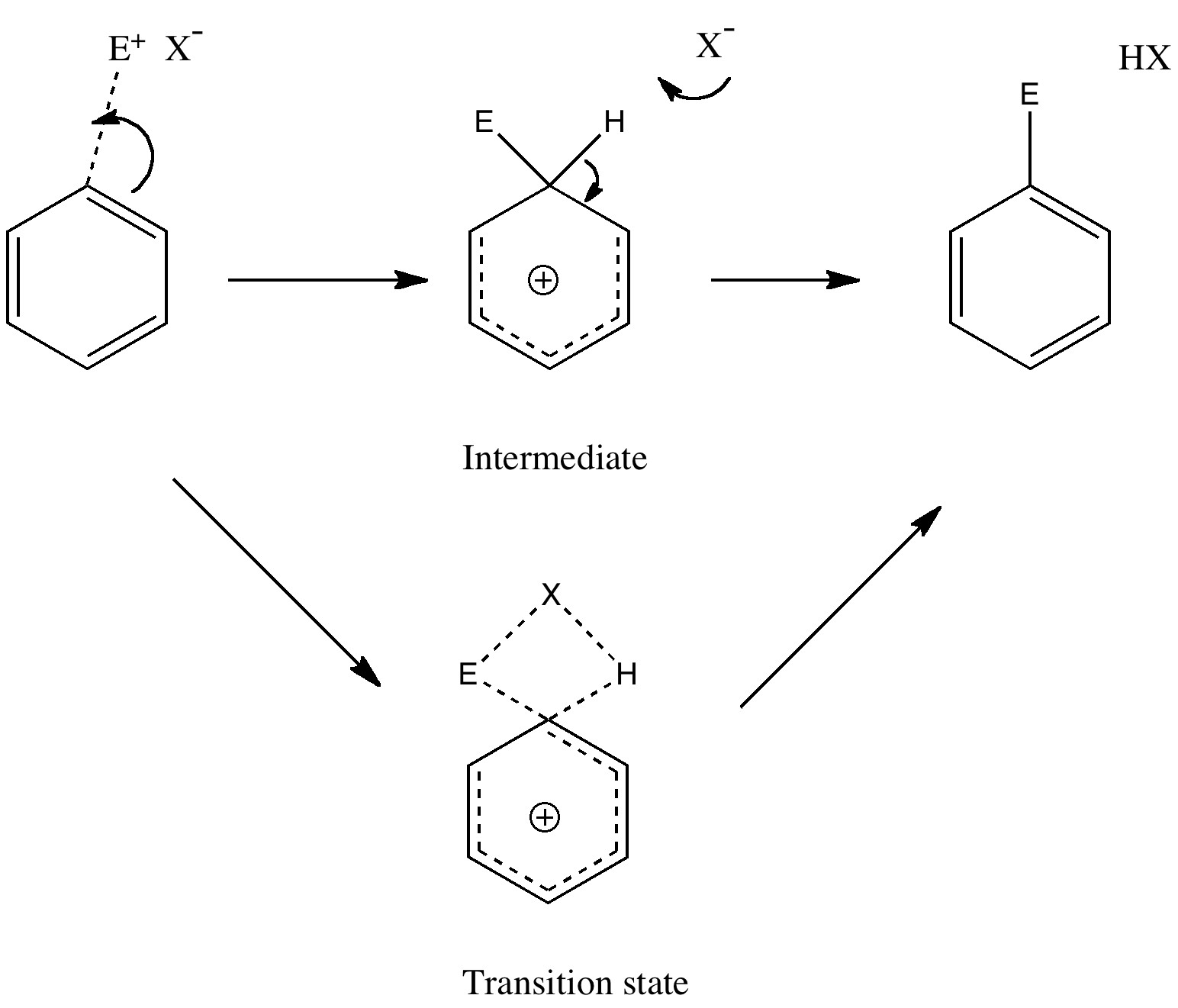
The mechanism of aromatic electrophilic substitution
(more…)
References
- "Proceedings of the Chemical Society, Vol. 6, No. 85", Proceedings of the Chemical Society (London), vol. 6, pp. 95, 1890. https://doi.org/10.1039/pl8900600095
Tags:acetic acid, animation, aromaticity, chemical, free energy, Henry Armstrong, Historical, Interesting chemistry, Wheland intermediate
Posted in Interesting chemistry | 7 Comments »
Sunday, August 8th, 2010
Cavities promote reactions, and they can also trap the products of reactions. Such (supramolecular) chemistry is used to provide models for how enzymes work, but it also allows un-natural reactions to be undertaken. A famous example is the preparation of P4 (see blog post here), an otherwise highly reactive species which, when trapped in the cavity is now sufficiently protected from the ravages of oxygen for its X-ray structure to be determined. A colleague recently alerted me to a just-published article by Legrand, van der Lee and Barboiu (DOI: 10.1126/science.1188002) who report the use of cavities to trap and stabilize the notoriously (self)reactive 1,3-dimethylcyclobutadiene (3/4 in the scheme below). Again sequestration by the host allowed an x-ray determination of the captured species!
(more…)
Tags:author, Barboiu, catalysis, cavity, crystalline calixarene network, cyclobutadiene, Diels Alder, free energy, free energy barrier, gas phase calculation, host/guest, Interesting chemistry, Legrand, pericyclic, Prins, supramolecular, van der Lee, watoc11, X-ray
Posted in Interesting chemistry | 8 Comments »
Saturday, July 24th, 2010
Lactide is a small molecule made from lactic acid, which is itself available in large quantities by harvesting plants rather than drilling for oil. Lactide can be turned into polymers with remarkable properties, which in turn degrade down easily back to lactic acid. A perfect bio-renewable material!
(more…)
Tags:3g, animation, catalysis, chiroptical, dispersion energy corrections, E. L. Marshall, energy, gas phase, General, H. S. Rzepa, Interesting chemistry, Julia Contreras-Garcia, lowest energy pathway, oil, polymerisation, ring opening, V, V. C. Gibson
Posted in General, Interesting chemistry | 3 Comments »
Wednesday, July 21st, 2010
In this post, I will take a look at what must be the most extraordinary small molecule ever made (especially given that it is merely a hydrocarbon). Its peculiarity is the region indicated by the dashed line below. Is it a bond? If so, what kind, given that it would exist sandwiched between two inverted carbon atoms?
(more…)
Tags:electronic energy, energy, energy density, excess kinetic energy, Hiberty and co, Hypervalency, Interesting chemistry, kinetic energy density, potential energy density, representative, X-ray
Posted in Hypervalency, Interesting chemistry | 4 Comments »
Thursday, July 15th, 2010
NCI (non-covalent interactions) is the name of a fascinating new technique for identifying exactly these. Published[1]recently by Johnson, Keinan, Mori-Snchez, Contreras-Garca, Cohen and Yang, it came to my attention at a conference to celebrate the 20th birthday of ELF when Julia Contreras-Garcia talked about the procedure. It is one of those methods which may seem as if it merely teases out the obvious about a molecule, but it is surprising how difficult seeing the obvious can be sometimes. I have blogged about this previously, in discussing the so-called Pirkle reagent. On that occasion, I used the QTAIM technique to identify so-called critical points in the electron density. NCI goes one stage further in identifying surfaces of interaction rather than just single points, the idea being that this focuses attention on regions in molecules which are primarily responsible for binding, stereoselection and other aspects of molecular selectivity.
(more…)
References
- E.R. Johnson, S. Keinan, P. Mori-Sánchez, J. Contreras-García, A.J. Cohen, and W. Yang, "Revealing Noncovalent Interactions", Journal of the American Chemical Society, vol. 132, pp. 6498-6506, 2010. https://doi.org/10.1021/ja100936w
Tags:Interesting chemistry, Julia Contreras-Garcia, watoc11
Posted in Interesting chemistry | 3 Comments »