Archive for the ‘Interesting chemistry’ Category
Tuesday, April 6th, 2010
Here I offer another spin-off from writing a lecture course on conformational analysis. This is the famous example of why 1,2-difluoroethane adopts a gauche rather than antiperiplanar conformation.
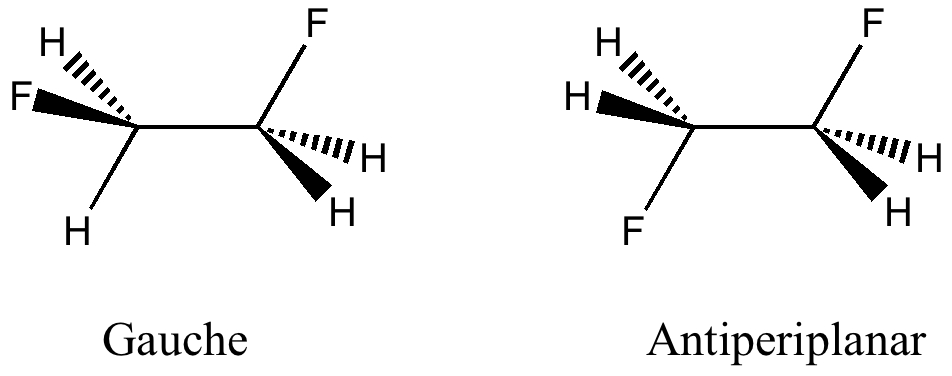
The gauche and antiperiplanar conformations of 1,2-difluoroethane
(more…)
Tags:appropriate algorithms, conformational analysis, energy gap, Here I, interaction energy, Interesting chemistry, spin-off
Posted in Interesting chemistry | 14 Comments »
Friday, April 2nd, 2010
One of the (not a few) pleasures of working in a university is the occasional opportunity that arises to give a new lecture course to students. New is not quite the correct word, since the topic I have acquired is Conformational analysis. The original course at Imperial College was delivered by Derek Barton himself about 50 years ago (for articles written by him on the topic[1] or the original[2] and so I have had an opportunity to see how the topic has evolved since then, and perhaps apply some quantitative quantum mechanical interpretations unavailable to Barton himself.
(more…)
References
- D.H.R. Barton, "The Principles of Conformational Analysis", Science, vol. 169, pp. 539-544, 1970. https://doi.org/10.1126/science.169.3945.539
- D.H.R. Barton, and R.C. Cookson, "The principles of conformational analysis", Quarterly Reviews, Chemical Society, vol. 10, pp. 44, 1956. https://doi.org/10.1039/qr9561000044
Tags:10.1021, conformational analysis, Derek Barton, energy maxima, Imperial College, Interesting chemistry, lower energy, overall energy, potential energy surface, Tutorial material
Posted in Interesting chemistry | 11 Comments »
Saturday, March 13th, 2010
One future vision for chemistry over the next 20 years or so is the concept of having machines into which one dials a molecule, and as if by magic, the required specimen is ejected some time later. This is in some ways an extrapolation of the existing peptide and nucleotide synthesizer technologies and sciences. A pretty significant extrapolation, suitable no doubt for a grand future challenge in chemistry (although the concept of tumbling a defined collection of atoms in a computer model and seeing what interesting molecules emerge, dubbed with some sense of humour as mindless chemistry, is already being done; see DOI: 10.1021/jp057107z).
(more…)
Tags:free energy, free energy barrier, Interesting chemistry, metal catalysts, nucleotide synthesizer technologies, similar energy
Posted in Interesting chemistry | No Comments »
Sunday, February 21st, 2010
Stoyanov, Stoyanova and Reed recently published on the structure of the hydrogen ion in water. Their model was H(H2O)n+, where n=6[1] This suggestion was picked up by Steve Bachrach on his blog, where he added a further three structures to the proposed list, and noted of course that with this type of system there must be a fair chance that the true structure consists of a well-distributed Boltzmann population of a number of almost iso-energetic forms.
(more…)
References
Tags:animation, gas phase model, General, Interesting chemistry, Steve Bachrach
Posted in General, Interesting chemistry | 1 Comment »
Thursday, January 28th, 2010
Like benzene, its fully saturated version cyclohexane represents an icon of organic chemistry. By 1890, the structure of planar benzene was pretty much understood, but organic chemistry was still struggling somewhat to fully embrace three rather than two dimensions. A grand-old-man of organic chemistry at the time, Adolf von Baeyer, believed that cyclohexane too was flat, and what he said went. So when a young upstart named Hermann Sachse suggested it was not flat, and furthermore could exist in two forms, which we now call chair and boat, no-one believed him. His was a trigonometric proof, deriving from the tetrahedral angle of 109.47 at carbon, and producing what he termed strainless rings.
(more…)
Tags:Adolf von Baeyer, animation, C, chair, conformational analysis, energy, General, Hermann Sachse, higher energy form, Interesting chemistry, Jonathan Goodman, minimum energy reaction path, model for cyclohexane, potential energy surface, symmetry breaking, Tutorial material
Posted in General, Interesting chemistry | 17 Comments »
Saturday, January 23rd, 2010
So ingrained is the habit to think of a bond as a simple straight line connecting two atoms, that we rarely ask ourselves if they are bent, and if so, by how much (and indeed, does it matter?). Well Hursthouse, Malik, and Sales, as long ago as 1978, asked just such a question about the unlikeliest of bonds, a quadruple Cr-Cr bond, found in the compound di-μ-trimethylsilylmethyl-bis-[(tri-methylphosphine) (trimethylsilylmethyI)chromium(II)[1]. They arrived at this conclusion by looking very carefully at how the overlaps with the Cr d-orbitals might be achieved.
(more…)
References
- M.B. Hursthouse, K.M.A. Malik, and K.D. Sales, "Crystal and molecular structure of di-µ-trimethylsilylmethyl-bis[(tri-methylphosphine)(trimethylsilylmethyl)chromium(
<scp>II</scp>
)](4 Cr–Cr)", J. Chem. Soc., Dalton Trans., pp. 1314-1318, 1978. https://doi.org/10.1039/dt9780001314
Tags:bond, Hypervalency, Interesting chemistry, quadruple
Posted in Hypervalency, Interesting chemistry | No Comments »
Monday, January 11th, 2010
The scheme below illustrates one of the iconic reactions in organic chemistry. It is a modern representation of Meerwein’s famous experiment from which he inferred a carbocation intermediate, deduced from studying the rate of enantiomerization of isobornyl chloride when treated with the Lewis acid SnCl4.
(more…)
Tags:animation, catalytic systems, Chemical intimacy, energy, free energy, gas phase model, Interesting chemistry, Meerwein, solvation free energy terms, watoc11
Posted in Interesting chemistry | No Comments »
Friday, January 1st, 2010
In the previous post, the molecule F3S-C≡SF3 was found to exhibit a valence bond isomerism, one of the S-C bonds being single, the other triple, and with a large barrier (~31 kcal/mol, ν 284i cm-1) to interconversion of the two valence-bond forms. So an interesting extension of this phenomenon is shown below:
(more…)
Tags:aromaticity, Hypervalency, Interesting chemistry, pericyclic, South Carolina
Posted in Hypervalency, Interesting chemistry | 1 Comment »
Wednesday, December 30th, 2009
A previous post posed the question; during the transformation of one molecule to another, what is the maximum number of electron pairs that can simultaneously move either to or from any one atom-pair bond as part of the reaction? A rather artificial example (atom-swapping between three nitrosonium cations) was used to illustrate the concept, in which three electron pairs would all move from a triple bond to a region not previously containing any electrons to form new triple bonds and destroy the old. Here is a slightly more realistic example of the phenomenon, illustrated by the (narcisistic) reaction below of a bis(sulfur trifluoride) carbene. Close relatives of this molecule are actually known, with either one SF3 of the units replaced by a CF3 group or a SF5 replacing the SF3[1]
(more…)
References
- B. Poetter, K. Seppelt, A. Simon, E.M. Peters, and B. Hettich, "Trifluoroethylidynesulfur trifluoride, CF3C.tplbond.SF3, and its dimer", Journal of the American Chemical Society, vol. 107, pp. 980-985, 1985. https://doi.org/10.1021/ja00290a038
Tags:animation, calculated free energy barrier, Hypervalency, inorganic chemist, Interesting chemistry
Posted in Hypervalency, Interesting chemistry | 3 Comments »