Around 100 tons of the potent antimalarial artemisinin is produced annually; a remarkable quantity given its very unusual and fragile looking molecular structure (below). When I looked at this, I was immediately struck by a thought: surely this is a classic molecule for analyzing stereoelectronic effects (anomeric and gauche). Here this aspect is explored.
Archive for the ‘Interesting chemistry’ Category
Artemisinin: are stereo-electronics at the core of its (re)activity?
Sunday, April 13th, 2014A connected world (journals and blogs): The benzene dication.
Thursday, April 10th, 2014Science is rarely about a totally new observation or rationalisation, it is much more about making connections between known facts, and perhaps using these connections to extrapolate to new areas (building on the shoulders of giants, etc). So here I chart one example of such connectivity over a period of six years.
A congruence of concepts: conformations, configurations, amides and enzymes
Sunday, February 9th, 2014This is the time of year when I deliver two back-2-back lecture courses, and yes I do update and revise the content! I am always on the look-out for nice new examples that illustrate how concepts and patterns in chemistry can be joined up to tell a good story. My attention is currently on conformational analysis; and here is an interesting new story to tell about it.
Three-for-one: a pericyclic brain teaser.
Sunday, January 12th, 2014A game one can play with pericyclic reactions is to ask students to identify what type a given example is. So take for example the reaction below.
Does forming a Wheland intermediate disrupt all aromaticity?
Friday, December 6th, 2013Text books will announce that during aromatic electrophilic substitution, aromaticity is lost by the formation of a Wheland intermediate (and regained by eliminating a proton). Is that entirely true?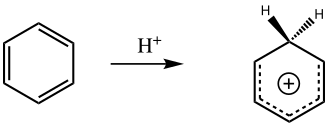
Multiple personalities of Magnesium.
Tuesday, November 5th, 2013The following is a short question in a problem sheet associated with introductory organic chemistry.
The world ash tree of the computer hardware industry… crystalline silicon from 1854.
Thursday, October 31st, 2013The element silicon best represents the digital era of the mid 20th century to the present; without its crystalline form, there would be no computers (or this blog). Although it was first prepared in pure amorphous (powder) form around 1823[1] by Berzelius, it was not until 1854 that Henri Sainte-Claire Deville made it in crystalline form, using metallic aluminium to isolate it. He described it [1] as having a “metallic luster”.