The topic of open citations was presented at the PIDapalooza conference and represents a third component in the increasing corpus of open scientific information.
Author Archive
Multispectral Chiral Imaging with a Metalens.
Saturday, January 6th, 2018The title here is from an article on metalenses[1] which caught my eye.
References
- M. Khorasaninejad, W.T. Chen, A.Y. Zhu, J. Oh, R.C. Devlin, D. Rousso, and F. Capasso, "Multispectral Chiral Imaging with a Metalens", Nano Letters, vol. 16, pp. 4595-4600, 2016. https://doi.org/10.1021/acs.nanolett.6b01897
Are diazomethanes hypervalent molecules? An attempt into more insight by more “tuning” with substituents.
Tuesday, December 26th, 2017Recollect the suggestion that diazomethane has hypervalent character[1]. When I looked into this, I came to the conclusion that it probably was mildly hypervalent, but on carbon and not nitrogen. Here I try some variations with substituents to see what light if any this casts.
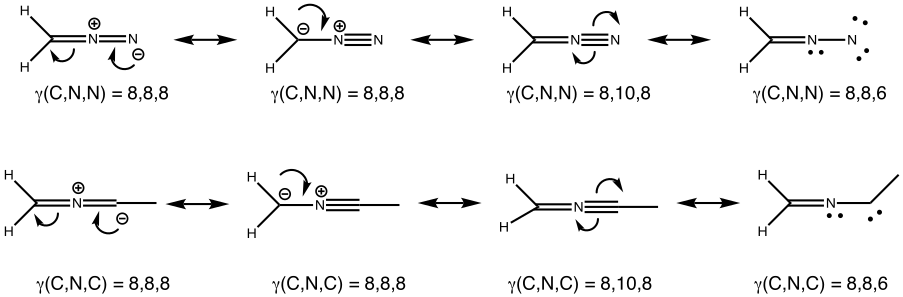
References
- M.C. Durrant, "A quantitative definition of hypervalency", Chemical Science, vol. 6, pp. 6614-6623, 2015. https://doi.org/10.1039/c5sc02076j
Can any hypervalence in diazomethanes be amplified?
Saturday, December 23rd, 2017In the previous post, I referred to a recently published review on hypervalency[1] which introduced a very simple way (the valence electron equivalent γ) of quantifying the effect. Diazomethane was cited as one example of a small molecule exhibiting hypervalency (on nitrogen) by this measure. Here I explore the effect of substituting diazomethane with cyano and nitro groups.‡
References
- M.C. Durrant, "A quantitative definition of hypervalency", Chemical Science, vol. 6, pp. 6614-6623, 2015. https://doi.org/10.1039/c5sc02076j
Are diazomethanes hypervalent molecules? Probably, but in an unexpected way!
Saturday, December 23rd, 2017A recently published review on hypervalency[1] introduced a very simple way of quantifying the effect. One of the molecules which was suggested to be hypervalent using this method was diazomethane. Here I take a closer look.
References
- M.C. Durrant, "A quantitative definition of hypervalency", Chemical Science, vol. 6, pp. 6614-6623, 2015. https://doi.org/10.1039/c5sc02076j
Ammonide: an alkalide formed from ammonia and resembling an electride.
Sunday, December 17th, 2017Alkalides are anionic alkali compounds containing e.g. sodide (Na–), kalide (K–), rubidide (Rb–) or caeside (Cs–). Around 90 examples can be found in the Cambridge structure database (see DOI: 10.14469/hpc/3453 for the search query and results). So what about the ammonium analogue, ammonide (NH4–)? A quick search of Scifinder drew a blank! So here I take a look at this intriguingly simple little molecule.‡
Identification of a simplest hypervalent hydrogen fluoride anion.
Friday, December 8th, 2017An article with the title shown above in part recently appeared.[1] Given the apparent similarity of HF1- to CH3F1- and CH3F2-, the latter of which I introduced on this blog previously, I thought it of interest to apply my analysis to HF1-.
References
- M. Liu, H. Chen, C. Chin, T. Huang, Y. Chen, and Y. Wu, "Identification of a Simplest Hypervalent Hydrogen Fluoride Anion in Solid Argon", Scientific Reports, vol. 7, 2017. https://doi.org/10.1038/s41598-017-02687-z