Author Archive
Friday, January 29th, 2021
In a recent post, I told the story of how in the early 1960s, Robert Woodward had encountered an unexpected stereochemical outcome to the reaction of a hexatriene, part of his grand synthesis of vitamin B12. He had constructed a model of the reaction he wanted to undertake, perhaps with the help of a physical model, concluding that the most favourable of the two he had built was not matched by the actual outcome of the reaction. He was thus driven to systematise such (Pericyclic) reactions by developing rules for them with Roald Hoffmann. This involved a classification scheme of “allowed” and “forbidden” pericyclic reactions and his original favoured model in fact corresponded to the latter type. When physical model building in the 1960s was gradually replaced by models based on quantum mechanical calculations from the 1970s onwards, the term “allowed” morphed into “a relatively low energy transition state for the reaction can be located” and very often “no transition state exists for a forbidden reaction”. The famous quote “there are no exceptions” (to this rule) was often interpreted that if a “forbidden reaction” did apparently proceed, its mechanism was NOT that of a pericyclic reaction. Inspired by all of this, I recollected a famous “exception” to the rules which is often explained by such non-pericyclic character, the Stevens rearrangement[1],[2],[3] by a 1,2-shift. 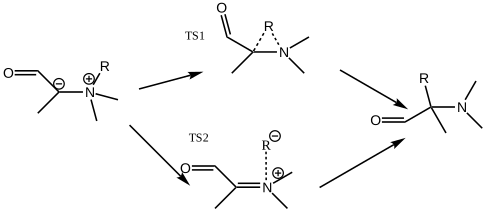
(more…)
References
- T.S. Stevens, E.M. Creighton, A.B. Gordon, and M. MacNicol, "CCCCXXIII.—Degradation of quaternary ammonium salts. Part I", J. Chem. Soc., vol. 0, pp. 3193-3197, 1928. https://doi.org/10.1039/jr9280003193
- T.S. Stevens, "CCLXX.—Degradation of quaternary ammonium salts. Part II", J. Chem. Soc., vol. 0, pp. 2107-2119, 1930. https://doi.org/10.1039/jr9300002107
- T.S. Stevens, W.W. Snedden, E.T. Stiller, and T. Thomson, "CCLXXI.—Degradation of quaternary ammonium salts. Part III", J. Chem. Soc., vol. 0, pp. 2119-2125, 1930. https://doi.org/10.1039/jr9300002119
Posted in Historical, reaction mechanism | No Comments »
Wednesday, January 20th, 2021
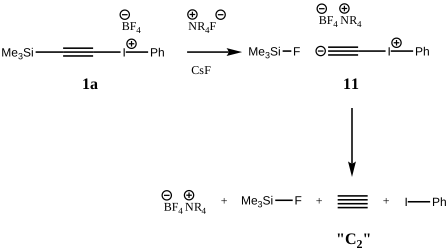
Last May, I wrote an update to the story sparked by the report of the chemical synthesis of C2.[1] This species has a long history of spectroscopic observation in the gas phase, resulting from its generation at high temperatures.[2] The chemical synthesis however was done in solution at ambient or low temperatures, a game-changer as they say. Here I give another update to this unfolding story.
(more…)
References
- K. Miyamoto, S. Narita, Y. Masumoto, T. Hashishin, T. Osawa, M. Kimura, M. Ochiai, and M. Uchiyama, "Room-temperature chemical synthesis of C2", Nature Communications, vol. 11, 2020. https://doi.org/10.1038/s41467-020-16025-x
- T.W. Schmidt, "The Spectroscopy of C<sub>2</sub>: A Cosmic Beacon", Accounts of Chemical Research, vol. 54, pp. 481-489, 2021. https://doi.org/10.1021/acs.accounts.0c00703
Posted in Interesting chemistry | No Comments »
Wednesday, January 20th, 2021
The quote of the post title comes from R. B. Woodward explaining the genesis of the discovery of what are now known as the Woodward-Hoffmann rules for pericyclic reactions.[1] I first wrote about this in 2012, noting that “for (that) blog, I do not want to investigate the transition states”. Here I take a closer look at this aspect.
(more…)
References
- R.B. Woodward, and R. Hoffmann, "Stereochemistry of Electrocyclic Reactions", Journal of the American Chemical Society, vol. 87, pp. 395-397, 1965. https://doi.org/10.1021/ja01080a054
Posted in crystal_structure_mining, Historical, Interesting chemistry, pericyclic | No Comments »
Friday, January 1st, 2021
In the previous post, I showed the geometries of three large cyclic porphyrins, as part of an article[1] on exploring the aromaticity of large 4n+2 cyclic rings. One of them had been induced into a “figure-eight” or lemniscular conformation, as shown below.
(more…)
References
- M. Rickhaus, M. Jirasek, L. Tejerina, H. Gotfredsen, M.D. Peeks, R. Haver, H. Jiang, T.D.W. Claridge, and H.L. Anderson, "Global aromaticity at the nanoscale", Nature Chemistry, vol. 12, pp. 236-241, 2020. https://doi.org/10.1038/s41557-019-0398-3
Posted in Interesting chemistry | 1 Comment »
Thursday, December 31st, 2020
Here is another of the “large” molecules in the c&e news shortlist for molecule-of-the-year, 2020. This one is testing the Hückel 4n+2 rule out to a value never before seen (n = 40, or 162 π-electrons).[1] The take-home message is that this rule seems to behave well in predicting global aromaticity even at this sort of scale!
(more…)
References
- M. Rickhaus, M. Jirasek, L. Tejerina, H. Gotfredsen, M.D. Peeks, R. Haver, H. Jiang, T.D.W. Claridge, and H.L. Anderson, "Global aromaticity at the nanoscale", Nature Chemistry, vol. 12, pp. 236-241, 2020. https://doi.org/10.1038/s41557-019-0398-3
Posted in Interesting chemistry | No Comments »
Wednesday, December 30th, 2020
The title derives from an article[1] which was shortlisted for the annual c&en molecule of the year 2020 awards (and which I occasionally cover here). In fact this year’s overall theme is certainly large molecules, the one exception being a smaller molecule with a quadruple bond to boron, a theme I have already covered here.
(more…)
References
- D.A. Leigh, F. Schaufelberger, L. Pirvu, J.H. Stenlid, D.P. August, and J. Segard, "Tying different knots in a molecular strand", Nature, vol. 584, pp. 562-568, 2020. https://doi.org/10.1038/s41586-020-2614-0
Posted in Interesting chemistry | No Comments »
Friday, December 4th, 2020
I asked the question in my previous post. A computational mechanism revealed that AlCl3 or its dimer Al2Cl6 could catalyse a concerted 1,1-substitution reaction at the carbon of Cl-C≡N, with benzene displacing chloride which is in turn captured by the Al. Unfortunately the calculated barrier for this simple process was too high for a reaction apparently occuring at ~room temperatures. Comments on the post suggested using either a second AlCl3 or a proton to activate the carbon of the C≡N group by coordination on to nitrogen. A second suggestion was to involve di-cationic electrophiles. Here I report the result of implementing the N-coordinated model below.
(more…)
Posted in reaction mechanism | 5 Comments »
Saturday, November 7th, 2020
Cyclopropenylidene must be the smallest molecule to be aromatic due to π-electrons, with just three carbon atoms and two hydrogen atoms. It has now been detected in the atmosphere of Titan, one of Saturn’s moons[1] and joins benzene, another aromatic molecule together with the protonated version of cyclopropenylidene, C3H3+ also found there.
(more…)
References
- C.A. Nixon, A.E. Thelen, M.A. Cordiner, Z. Kisiel, S.B. Charnley, E.M. Molter, J. Serigano, P.G.J. Irwin, N.A. Teanby, and Y. Kuan, "Detection of Cyclopropenylidene on Titan with ALMA", The Astronomical Journal, vol. 160, pp. 205, 2020. https://doi.org/10.3847/1538-3881/abb679
Posted in Interesting chemistry | 2 Comments »
Saturday, November 7th, 2020
Way back in 2010, I was writing about an experience I had just had during an organic chemistry tutorial, which morphed into speculation as to whether a carbon atom might sustain a quadruple bond to nitrogen. A decade on, and possibly approaching 100 articles by many authors on the topic, quadruple bonds to carbon continue to fascinate. Now an article as appeared[1] repeating this speculation for a carbon to iron quadruple bond,‡ in the very simple species C⩸Fe(CO)3 (see also a Rh-B equivalent[2]). This is particularly exciting because of the very real prospect of synthesising this species and perchance getting a crystal structure (something not possible with most of the other quadruply bonded carbon systems studied to date).
(more…)
References
- A.J. Kalita, S.S. Rohman, C. Kashyap, S.S. Ullah, and A.K. Guha, "Transition metal carbon quadruple bond: viability through single electron transmutation", Physical Chemistry Chemical Physics, vol. 22, pp. 24178-24180, 2020. https://doi.org/10.1039/d0cp03436c
- L.F. Cheung, T. Chen, G.S. Kocheril, W. Chen, J. Czekner, and L. Wang, "Observation of Four-Fold Boron–Metal Bonds in RhB(BO
<sup>–</sup>
) and RhB", The Journal of Physical Chemistry Letters, vol. 11, pp. 659-663, 2020. https://doi.org/10.1021/acs.jpclett.9b03484
Posted in Interesting chemistry | 1 Comment »