April 12th, 2009
The diagram below summarizes an interesting result recently reported by Hanson and co-workers.[1] At ~neutral pH, compound 13 hydrolyses with a half life of 21 minutes, whereas 14 takes 840 minutes. Understanding this difference in reactivity may allow us to understand why some enzymes can catalyze the hydrolysis of peptides with an acceleration of up to twelve orders of magnitude.
Read the rest of this entry »
References
- N.M. Fernandes, F. Fache, M. Rosen, P. Nguyen, and D.E. Hansen, "Rapid Cleavage of Unactivated, Unstrained Amide Bonds at Neutral pH", The Journal of Organic Chemistry, vol. 73, pp. 6413-6416, 2008. https://doi.org/10.1021/jo800706y
Tags: chair, conformational analysis, Derek Barton, energy, Hanson, Interesting chemistry, molecular mechanics energy, stable lactone product, stable product
Posted in Interesting chemistry | 1 Comment »
April 12th, 2009
Understanding how molecules interact (bind) with each other when in close proximity is essential in all areas of chemistry. One specific example of this need is for the molecule shown below.
Read the rest of this entry »
Tags: energy, free energy, interaction energy, Interesting chemistry, X-ray
Posted in Interesting chemistry | 8 Comments »
April 4th, 2009
Every introductory course or text on aromatic electrophilic substitution contains an explanation along the lines of the resonance diagram shown below. With an o/p directing group such as NH2, it is argued that negative charge accumulates in those positions as a result of the resonance structures shown.
Read the rest of this entry »
Tags: aromatic, Historical, Interesting chemistry, MEP
Posted in Interesting chemistry | No Comments »
April 3rd, 2009
We recently developed a new computational chemistry practical laboratory here at Imperial College. I gave a talk about it at the recent ACS meeting in Salt Lake City. If you want to see the details of the lab, do go here. The talk itself contains further links and examples. Perhaps here I can quote only the final remark, namely that computational chemistry can now provide chemical accuracy for many problems, including spectroscopy and mechanism, and that the basic tools for doing it can easily be carried around in a backpack! Or, perhaps in the not to distant future, an iPhone!
Tags: ACS, basic tools, chemical accuracy, Chemical IT, computational chemistry, Imperial College, Interesting chemistry, iPhone, Salt Lake City, spectroscopy
Posted in Chemical IT, Interesting chemistry | No Comments »
April 3rd, 2009
The preceeding blog entries contain stories about chemical behaviour. If you have clicked on the diagrams, you may even have gotten a Jmol view of the relevant molecules popping up. But if you are truly curious, you may even have the urge to acquire the relevant 3D information about the molecule, and play with it yourself. Even after 15 years of the (chemical) Web, this can be distressingly difficult to achieve (or can it be that it is only myself who wishes to view molecules in their native mode?). Thus the standard mechanism is to seek out on journal pages that disarming little entry entitled supporting information and to hope that you might find something useful embedded there. Embedded is the correct description, since the information is often found within the confines of an Acrobat file, and has to be extracted from there. Indeed, that is what I had to resort to in order to write one of the blog entries below. I ground my teeth whilst doing so.
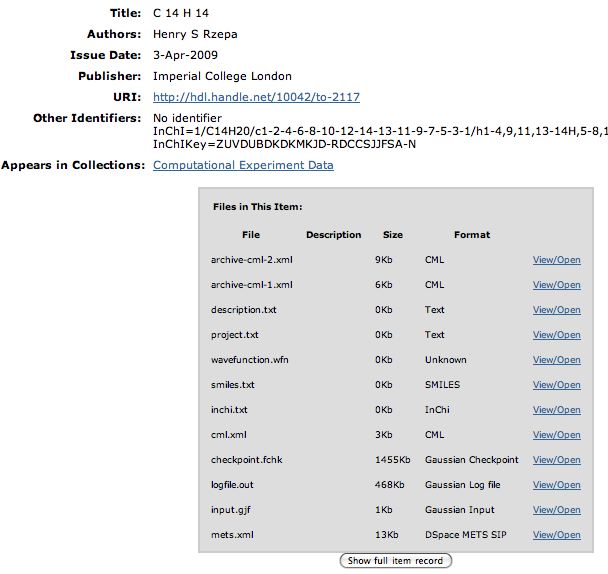
So is there a better way? We think so! The digital repository. If you click on this you should see the entry directly. What can you do there? Well, if you have suitable programs, you can download eg a Checkpoint file of the calculation that created the molecule model and re-activate it there. Or you can download just the CML file for viewing in any CML-compliant program (such as e.g. Jmol). Or you can check up on the InCHi string or the InChI Key of the molecule.
Read the rest of this entry »
Tags: Acrobat, Checkpoint, chemical, chemical behaviour, Chemical IT, editor in chief, opendata, Peter Murray-Rust, Web-enhanced tables
Posted in Chemical IT | No Comments »
April 2nd, 2009
Mauksch and Tsogoeva have recently published an article illustrating how a thermal electrocyclic reaction can proceed with distoratory ring closure, whilst simultaneously also exhibiting 4n electron Möbius-aromatic character[1]. Why is this remarkable? Because the simple Woodward-Hoffmann rules state that a disrotatory thermal electrocyclic reaction should proceed via a Hückel-aromatic 4n+2 electron transition state. Famously, Woodward and Hoffmann stated there were no exceptions to this rule. Yet here we apparently have one! So what is the more fundamental? The disrotatory character, or the 4n/Möbius character in the example above? Mauksch and Tsogoeva are in no doubt; it is the former that gives, and the latter is correct.
Read the rest of this entry »
References
- M. Mauksch, and S. Tsogoeva, "A Preferred Disrotatory 4<i>n</i> Electron Möbius Aromatic Transition State for a Thermal Electrocyclic Reaction", Angewandte Chemie International Edition, vol. 48, pp. 2959-2963, 2009. https://doi.org/10.1002/anie.200806009
Tags: Hoffmann, Interesting chemistry, jmol, NICS, pericyclic, Reaction Mechanism, Steve Bachrach
Posted in pericyclic | 1 Comment »
April 12th, 2008
Tags: animation, Chemical IT, editor, http, Interesting chemistry, jmol, php, Tutorial material, www.ch.imperial.ac.uk/rzepa/blog/wp-content/uploads/2008/04/14-knot.jpg
Posted in Chemical IT, Interesting chemistry | 8 Comments »
October 5th, 2006
Tags: Chemical IT, RSS
Posted in Chemical IT | No Comments »