This candidate[1] for “MOTY 2026” has the unusual feature of containing both a trialkyl oxonium cation and an alkoxide counterion present in the same species (11z below).
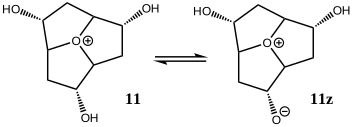
Evidence for the presence of 11z came from the 1 NMR spectra of 11 in the presence of the non-nucleophilic base t-butyl tetramethylguanidine (Barton’s base or BB) which showed shifts in the base consistent with its protonation and smaller but significant shifts (as well as changes in the coupling constants) in the oxatriquinane component, commensurate with the formation of the zwitterion 11z. These effects were not observed when 11 was methylated (preventing deprotonation). The zwitterion 11z was however very unstable, decomposing at temperatures of above -60C.
My interest in these species originates in the report of a “concerted triple H-tunneling mechanism”[2] in which three protons move in concert as part of a cyclic transition state, or a related question of mine posed in 2011 – “Do electrons prefer to move in packs of 4, 6 or 8 during proton exchange in a calixarene?”[3] This latter example has a set of four OH groups, exchanging protons in a cyclic manner and I found that in the very non-polar benzene as a solvent, the synchronous exchange of the four protons was comuted to not be a genuine transition state, (one negative force constant) but a higher order stationary point with three negative force constants. Not noted at the time but worth pointing out now is the cyclic exchange of four protons is an 8-electron process which might be expected to be a σ-antiaromatic system, and hence disfavoured.
So what of the proton exchange in the smaller ring 11. This is now a 6-electron process, nominally σ-aromatic and hence more favoured? An ωB97XD/Def2-TZVPP/CPCM=thf calculation[4] shows that in contracts to the 8-electron homologue, this is a true concerted synchronous process (Figure 1, ν 1875i cm-1) as illustrated by an IRC (Figure 2).[5]
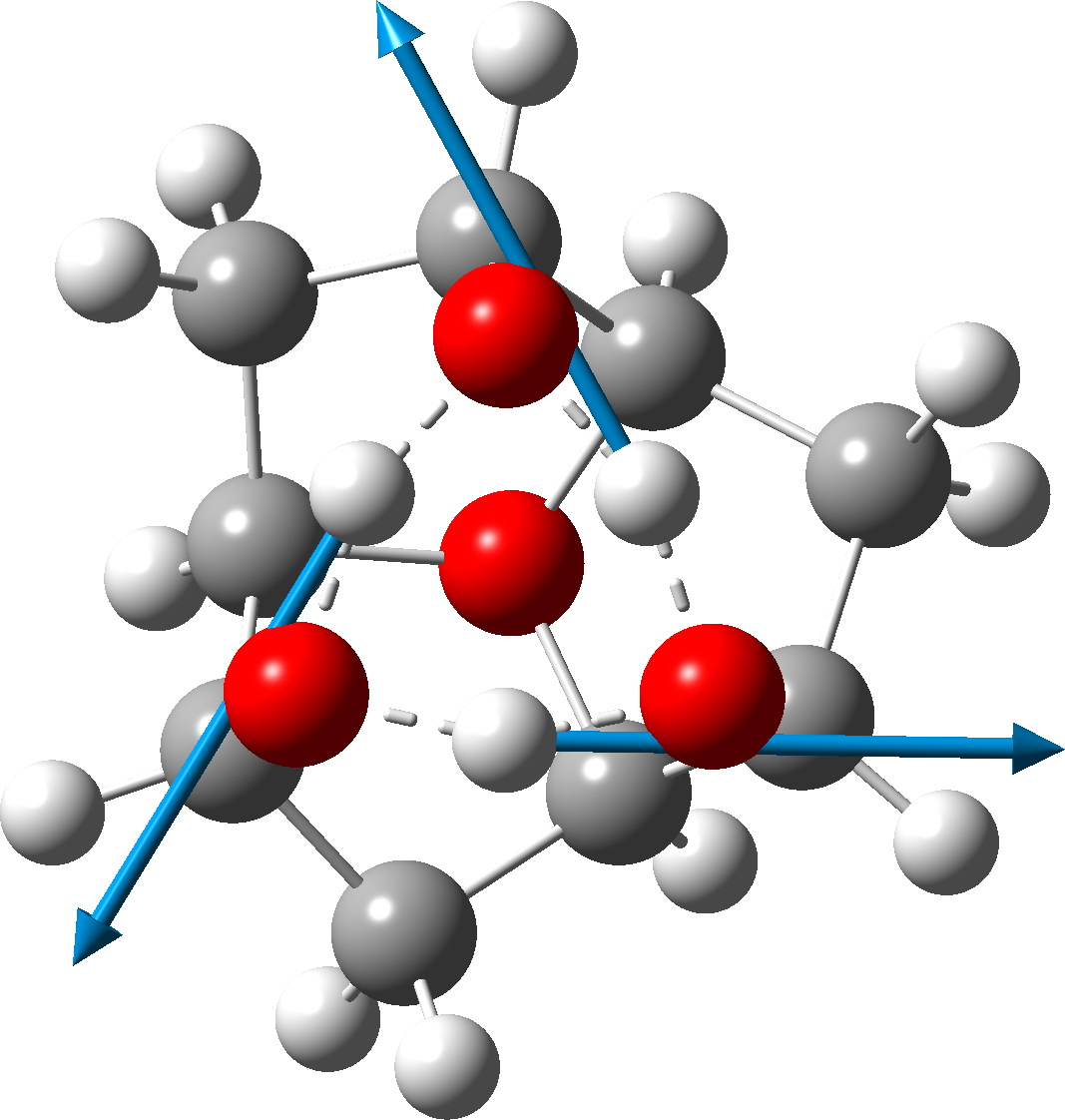
Figure 1.
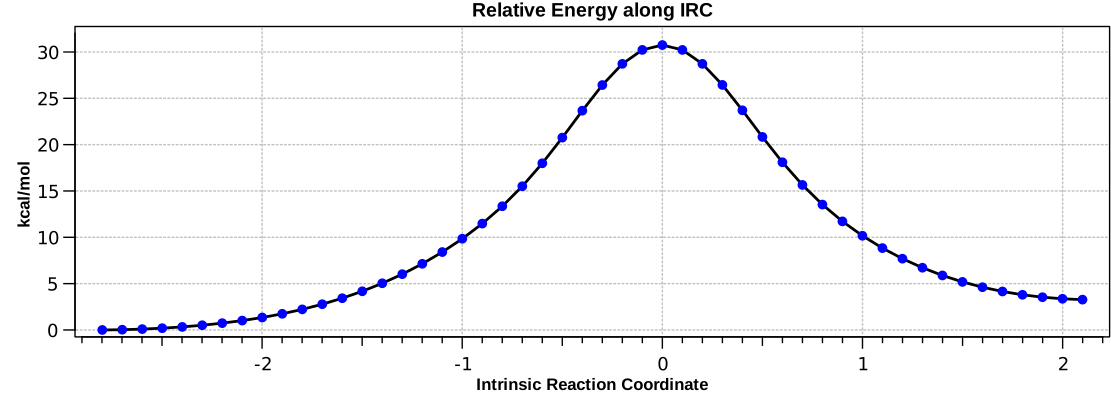
Figure 2.
One major difference between the tetradiol calixarene[6] and the present tri-diol triquinane is the barrier to proton exchange, the latter being significantly higher (ΔG 24.88 kcal/mol[7]) than the former (ΔG ~14 kcal/mol). This is probably due to the smaller and hence unfavourable H-O-H angles (83.8°) and non-linear O-H-O angles (154°) induced by the smaller ring size. One interesting aspect of this transition state is revealed by an NCI (non-covalent-interaction) analysis (Figure 3, click on image to get 3D interactive model) showing weak dispersion-like stabilisations between the transferring protons and C-H hydrogens of the cage, as well as a mysterious attractive dispersion feature in the centre of the cage.
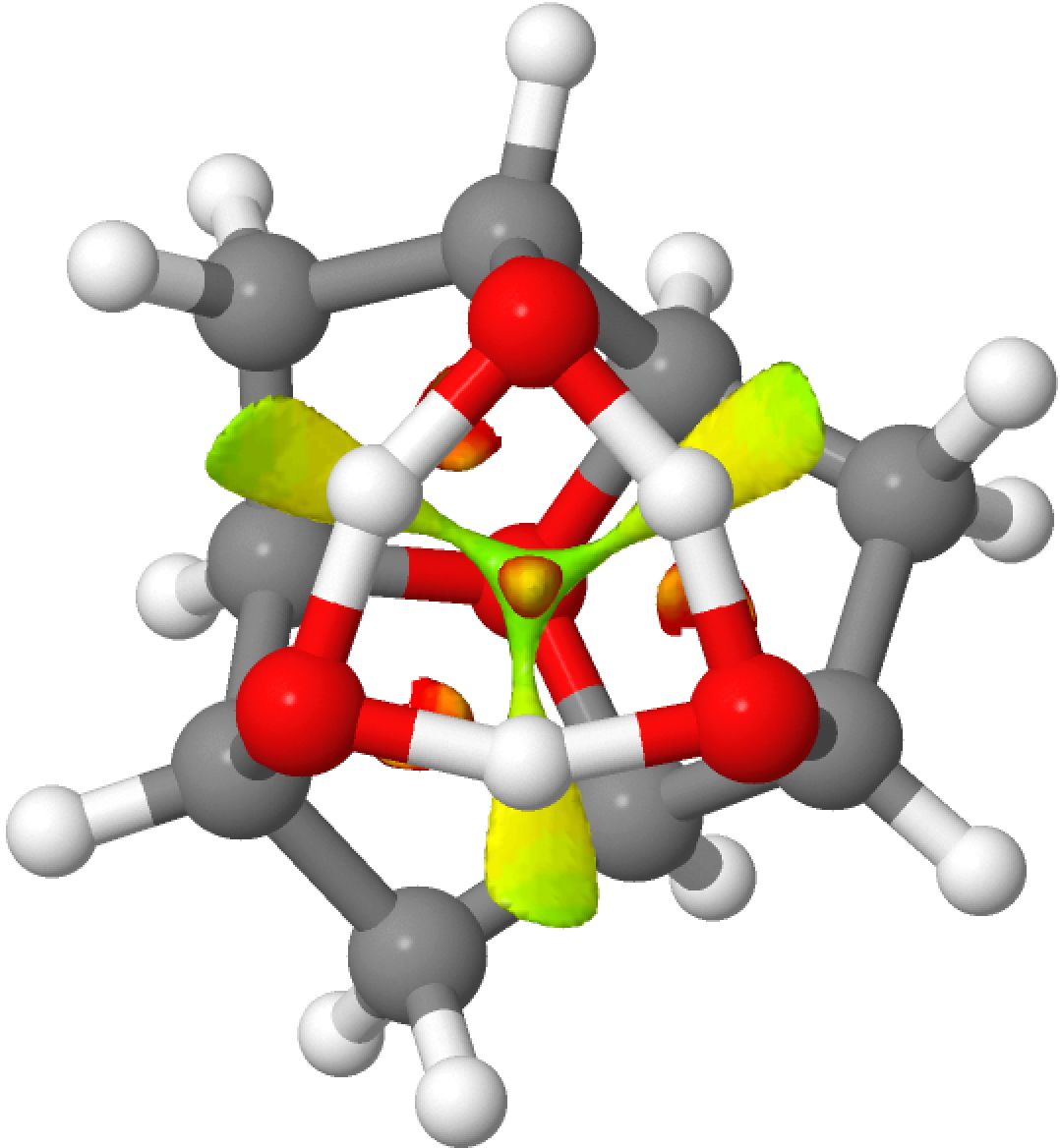
Figure 3.
What is needed is some experimental verification of the above prediction, perhaps using a desymmetrised oxatriquinane 11 and perchance use of isotope effects to investigate any concerted nature for the process.
Author

References
- A.L. Otsuki, G.A. Alkan, S. Manabe, W.T. Shewa, G. Gunbas, J.C. Fettinger, M. Mascal, and N. Hafezi, "A Hydroxy‐Substituted Trialkyloxonium Ion and Its Oxonium Alkoxide Zwitterion", Angewandte Chemie International Edition, vol. 65, 2026. https://doi.org/10.1002/anie.2727232
- H. Rzepa, "Reinvestigating the reported transition state structure of a concerted triple H-tunneling mechanism.", 2025. https://doi.org/10.59350/qgwfn-rsc92
- H. Rzepa, "Do electrons prefer to move in packs of 4, 6 or 8 during proton exchange in a calixarene?", 2011. https://doi.org/10.59350/9xed3-sy403
- H. Rzepa, "Oxonium cation, 11 G = -652.500883", 2026. https://doi.org/10.5281/zenodo.23921575
- H. Rzepa, "Oxonium cation, 11 IRC", 2026. https://doi.org/10.5281/zenodo.23919051
- H. Rzepa, "Oxonium cation, 11 IRC => starting state G = -652.540534", 2026. https://doi.org/10.5281/zenodo.24086130