A recent theme here has been to subject to scrutiny well-known mechanisms supposedly involving intermediates. These transients can often involve the creation/annihilation of charge separation resulting from proton transfers, something that a cyclic mechanism can avoid. Here I revisit the formation of an oxime from hydroxylamine and propanone, but with one change. In the earlier post, I used two molecules of water to achieve the desired proton transfer. Now I look to see what effect replacing those two water molecules by a guanidine has.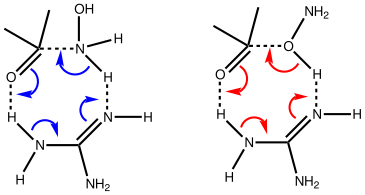
Intermediates in oxime formation from hydroxylamine and propanone: now you see them, now you don’t.
April 14th, 2013Feist’s acid. Stereochemistry galore.
April 4th, 2013Back in the days (1893) when few compounds were known, new ones could end up being named after the discoverer. Thus Feist is known for the compound bearing his name; the 2,3 carboxylic acid of methylenecyclopropane (1, with Me replaced by CO2H). Compound 1 itself nowadays is used to calibrate chiroptical calculations[1], which is what brought it to my attention. But about four decades ago, and now largely forgotten, both 1 and the dicarboxylic acid were famous for the following rearrangement that gives a mixture of 2 and 3[2]. I thought I might here unpick some of the wonderfully subtle stereochemical analysis that this little molecule became subjected to.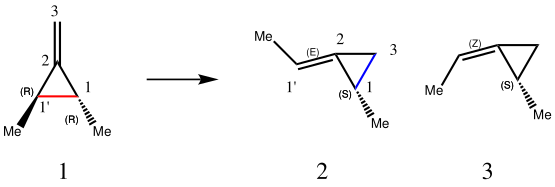
References
- E.D. Hedegård, F. Jensen, and J. Kongsted, "Basis Set Recommendations for DFT Calculations of Gas-Phase Optical Rotation at Different Wavelengths", Journal of Chemical Theory and Computation, vol. 8, pp. 4425-4433, 2012. https://doi.org/10.1021/ct300359s
- J.J. Gajewski, "Hydrocarbon thermal degenerate rearrangements. IV. Stereochemistry of the methylenecyclopropane self-interconversion. Chiral and achiral intermediates", Journal of the American Chemical Society, vol. 93, pp. 4450-4458, 1971. https://doi.org/10.1021/ja00747a019
The mechanism of ester hydrolysis via alkyl oxygen cleavage under a quantum microscope
April 2nd, 2013My previous dissection of the mechanism for ester hydrolysis dealt with the acyl-oxygen cleavage route (red bond). There is a much rarer[1] alternative: alkyl-oxygen cleavage (green bond) which I now place under the microscope.
References
- C.A. Bunton, and J.L. Wood, "Tracer studies on ester hydrolysis. Part II. The acid hydrolysis of tert.-butyl acetate", Journal of the Chemical Society (Resumed), pp. 1522, 1955. https://doi.org/10.1039/jr9550001522
A sideways look at the mechanism of ester hydrolysis.
March 29th, 2013The mechanism of ester hydrolysis is a staple of examination questions in organic chemistry. To get a good grade, one might have to reproduce something like the below. Here, I subject that answer to a reality check.
A (very) short history of shared-electron bonds.
March 26th, 2013The concept of a shared electron bond and its property of an order is almost 100 years old in modern form, when G. N. Lewis suggested a model for single and double bonds that involved sharing either 2 or 4 electrons between a pair of atoms[1]. We tend to think of such (even electron) bonds in terms of their formal bond order (an integer), recognising that the actual bond order (however defined) may not fulfil this value. I thought I would very (very) briefly review the history of such bonds.
References
- G.N. Lewis, "THE ATOM AND THE MOLECULE.", Journal of the American Chemical Society, vol. 38, pp. 762-785, 1916. https://doi.org/10.1021/ja02261a002
Concerted vs stepwise (Meisenheimer) mechanisms for aromatic nucleophilic substitution.
March 25th, 2013My two previous explorations of aromatic substitutions have involved an electrophile (NO+ or Li+). Time now to look at a nucleophile, representing nucleophilic aromatic substitution. The mechanism of this is thought to pass through an intermediate analogous to the Wheland for an electrophile, this time known as the Meisenheimer complex[1]. I ask the same question as before; are there any circumstances under which the mechanism could instead be concerted, by-passing this intermediate?
References
- J. Meisenheimer, "Ueber Reactionen aromatischer Nitrokörper", Justus Liebigs Annalen der Chemie, vol. 323, pp. 205-246, 1902. https://doi.org/10.1002/jlac.19023230205
To be cyclobutadiene, or not to be, that is the question? You decide.
March 21st, 2013A quartet of articles has recently appeared on the topic of cyclobutadiene.[1],[2],[3],[4]. You will find a great deal discussed there, but I can boil it down to this essence. Do the following coordinates (obtained from a (disordered) previously published[5] x-ray refinement) correspond to a van der Waals complex of 1,3-dimethyl cyclobutadiene and carbon dioxide, or do they instead represent a covalent interaction between these two components resulting in a compound with the chemical name 2-oxabicyclo[2.2.0]hex-5-en-3-one (i.e. not a cyclobutadiene)?
References
- H.S. Rzepa, "A Computational Evaluation of the Evidence for the Synthesis of 1,3‐Dimethylcyclobutadiene in the Solid State and Aqueous Solution", Chemistry – A European Journal, vol. 19, pp. 4932-4937, 2013. https://doi.org/10.1002/chem.201102942
- M. Shatruk, and I.V. Alabugin, "Reinvestigation of “Single‐Crystal X‐ray Structure of 1,3‐dimethylcyclobutadiene”", Chemistry – A European Journal, vol. 19, pp. 4942-4945, 2013. https://doi.org/10.1002/chem.201103017
- Y. Legrand, D. Dumitrescu, A. Gilles, E. Petit, A. van der Lee, and M. Barboiu, "A Constrained Disorder Refinement: “Reinvestigation of “Single‐Crystal X‐ray Structure of 1,3‐Dimethylcyclobutadiene” by M. Shatruk and I. V. Alabugin”", Chemistry – A European Journal, vol. 19, pp. 4946-4950, 2013. https://doi.org/10.1002/chem.201203234
- Y. Legrand, D. Dumitrescu, A. Gilles, E. Petit, A. van der Lee, and M. Barboiu, "Reply to A Computational Evaluation of the Evidence for the Synthesis of 1,3‐Dimethylcyclobutadiene in Solid State and Aqueous Solution—Beyond the Experimental Reality", Chemistry – A European Journal, vol. 19, pp. 4938-4941, 2013. https://doi.org/10.1002/chem.201203235
- Y. Legrand, A. van der Lee, and M. Barboiu, "Single-Crystal X-ray Structure of 1,3-Dimethylcyclobutadiene by Confinement in a Crystalline Matrix", Science, vol. 329, pp. 299-302, 2010. https://doi.org/10.1126/science.1188002
The mysterious (aromatic) structure of n-Butyl lithium.
March 17th, 2013n-Butyl lithium is hexameric in the solid state[1] and in cyclohexane solutions. Why? Here I try to find out some of its secrets.
References
- T. Kottke, and D. Stalke, "Structures of Classical Reagents in Chemical Synthesis: (<i>n</i>BuLi)<sub>6</sub>, (<i>t</i>BuLi)<sub>4</sub>, and the Metastable (<i>t</i>BuLi · Et<sub>2</sub>O)<sub>2</sub>", Angewandte Chemie International Edition in English, vol. 32, pp. 580-582, 1993. https://doi.org/10.1002/anie.199305801
William Henry Perkin: The site of the factory and the grave.
March 11th, 2013William Henry Perkin is a local chemical hero of mine. The factory where he founded the British (nay, the World) fine organic chemicals industry is in Greenford, just up the road from where we live. The factory used to be close to the Black Horse pub (see below) on the banks of the grand union canal. It is now commemorated merely by a blue plaque placed on the wall of the modern joinery building occupying the location (circled in red on the photo).