December 19th, 2016
I am completing my survey of the vote for molecule of the year candidates, which this year seems focused on chemical records of one type or another.
Read the rest of this entry »
Tags: chemical publishing, chemical records, human chemical perception, Matter, metal, Molecule, Nature, search query, search software, Voting
Posted in crystal_structure_mining, Interesting chemistry | 2 Comments »
December 18th, 2016
This, the fourth candidate provided by C&EN for a vote for the molecule of the year as discussed here, lays claim to the World’s most polar neutral molecule (system 1 shown below).[1] Here I explore a strategy for extending that record.
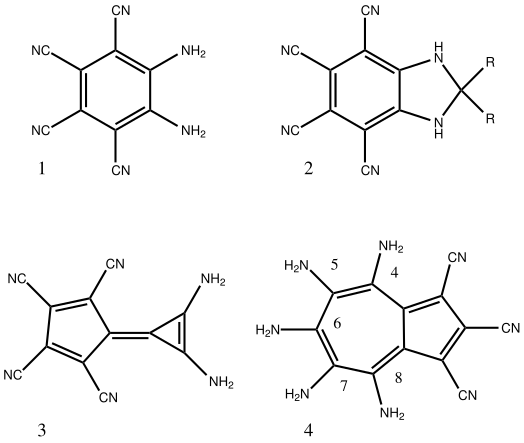
Read the rest of this entry »
References
- J. Wudarczyk, G. Papamokos, V. Margaritis, D. Schollmeyer, F. Hinkel, M. Baumgarten, G. Floudas, and K. Müllen, "Hexasubstituted Benzenes with Ultrastrong Dipole Moments", Angewandte Chemie International Edition, vol. 55, pp. 3220-3223, 2016. https://doi.org/10.1002/anie.201508249
Tags: Approval voting, Voting
Posted in Interesting chemistry | 14 Comments »
December 16th, 2016
Here is a third candidate for the C&EN “molecule of the year” vote. This one was shortlisted because it is the first example of a metal-nitrogen complex exhibiting single, double and triple bonds from different nitrogens to the same metal[1] (XUZLUB has a 3D display available at DOI: 10.5517/CC1JYY6M). Since no calculation of its molecular properties was reported, I annotate some here.
Read the rest of this entry »
References
- E.P. Beaumier, B.S. Billow, A.K. Singh, S.M. Biros, and A.L. Odom, "A complex with nitrogen single, double, and triple bonds to the same chromium atom: synthesis, structure, and reactivity", Chemical Science, vol. 7, pp. 2532-2536, 2016. https://doi.org/10.1039/c5sc04608d
Tags: 10.14469, chemical shifts, expert chemical knowledge, metal, metal-nitrogen complex exhibiting single, search query
Posted in crystal_structure_mining, Interesting chemistry | 10 Comments »
December 12th, 2016
Chemical and engineering news (C&EN) is asking people to vote for their molecule of the year from six highlighted candidates. This reminded me of the history of internet-based “molecules of the moment“. It is thought that the concept originated in December 1995 here at Imperial and in January 1996 at Bristol University by Paul May and we were joined by Karl Harrison at Oxford shortly thereafter. Quite a few more such sites followed this concept, differentiated by their time intervals of weeks, months or years. The genre is well suited for internet display because of plugins or “helpers” such as Rasmol, Chime, Jmol and now JSmol which allow the three dimensions of molecular structures to be explored by the reader. Here I discuss a second candidate from the C&EN list; a ferrocene-based Ferris wheel[1],[2] (DOI for 3D model: 10.5517/CCDC.CSD.CC1JPKYQ) originating from research carried out at Imperial by Tim Albrecht, Nick Long and colleagues.
Read the rest of this entry »
References
- M.S. Inkpen, S. Scheerer, M. Linseis, A.J.P. White, R.F. Winter, T. Albrecht, and N.J. Long, "Oligomeric ferrocene rings", Nature Chemistry, vol. 8, pp. 825-830, 2016. https://doi.org/10.1038/nchem.2553
- Inkpen, Michael S.., Scheerer, Stefan., Linseis, Michael., White, Andrew J.P.., Winter, Rainer F.., Albrecht, Tim., and Long, Nicholas J.., "CCDC 1420914: Experimental Crystal Structure Determination", 2016. https://doi.org/10.5517/ccdc.csd.cc1jpkyq
Tags: American Chemical Society, Bristol University, Chemical & Engineering News, Chemistry, Engineering, internet display, Karl Harrison, metal centres, Nick Long, Paul May, Tim Albrecht
Posted in crystal_structure_mining, Interesting chemistry | 2 Comments »
December 1st, 2016
Tags: Chemical bond, chemical bonding, Chemical nomenclature, Chemistry, Conjugated system, double bond, energy, Nature, Nonmetal, Organic chemistry, Physical organic chemistry, search query, Substituent
Posted in crystal_structure_mining, Interesting chemistry | 2 Comments »
November 30th, 2016
In an earlier post, I searched for small C-C-C angles, finding one example that was also accompanied by an apparently exceptionally long C-C bond (2.18Å). But this arose from highly unusual bonding giving rise not to a single bond order but one closer to one half! How long can a “normal” (i.e single) C-C bond get, a question which has long fascinated chemists.
Read the rest of this entry »
Tags: Aviation, Bond order, Carbon–carbon bond, Chemical bond, chemical bonding, naive search, search query, single bond
Posted in crystal_structure_mining, Interesting chemistry | No Comments »
November 25th, 2016
Another conference, a Cambridge satellite meeting of OpenCon, and I quote here its mission: “OpenCon is a platform for the next generation to learn about Open Access, Open Education, and Open Data, develop critical skills, and catalyze action toward a more open system of research and education” targeted at students and early career academic professionals. But they do allow a few “late career” professionals to attend as well!
Read the rest of this entry »
Tags: Academia, author, chemist, City: Cambridge, Company: Twitter, ELife, Erin McKiernan, keynote speaker, Max Planck Society, programmer, Simon Deakin, Social Media & Networking, speaker, Technology/Internet, Wellcome Trust
Posted in Chemical IT, General | 3 Comments »
November 14th, 2016
Chloroform, often in the deuterated form CDCl3, is a very common solvent for NMR and other types of spectroscopy. Quantum mechanics is increasingly used to calculate such spectra to aid assignment and the solvent is here normally simulated as a continuum rather than by explicit inclusion of one or more chloroform molecules. But what are the features of the hydrogen bonds that form from chloroform to other acceptors? Here I do a quick search for the common characteristics of such interactions.
Read the rest of this entry »
Tags: chemical shifts, Chloroform, Deuterated chloroform, Deuterated methanol, Hydrogen bond, Nuclear magnetic resonance, spectroscopy
Posted in crystal_structure_mining | 5 Comments »
November 10th, 2016
This is sent from the Pidapalooza event in Reykjavik, Iceland, and is a short collection of notable things I learnt or which attracted my attention.
Read the rest of this entry »
Tags: active site, Bill Gates, City: Reykjavik, Country: Iceland, scientist, social media, Technology/Internet
Posted in Chemical IT | 1 Comment »
November 1st, 2016
I am now inverting the previous question by asking what is the largest angle subtended at a chain of three connected 4-coordinate carbon atoms? Let’s see if further interesting chemistry can be unearthed.
Read the rest of this entry »
Tags: Angle, metal, Subtended angle
Posted in crystal_structure_mining, Interesting chemistry | 1 Comment »