September 22nd, 2016
Compounds with O-O bonds often have weird properties. For example, artemisinin, which has some fascinating stereoelectronics. Here is another such, recently in the news and known as HMTD (hexamethylene triperoxide diamine). The crystal structure was reported some time ago[1] and the article included an inspection of the computed wavefunction. However this did not look at the potential stereoelectronics in this species, which I now address here.
Read the rest of this entry »
References
- A. Wierzbicki, E.A. Salter, E.A. Cioffi, and E.D. Stevens, "Density Functional Theory and X-ray Investigations of P- and M-Hexamethylene Triperoxide Diamine and Its Dialdehyde Derivative", The Journal of Physical Chemistry A, vol. 105, pp. 8763-8768, 2001. https://doi.org/10.1021/jp0123841
Tags: Amines, Artemisinin, Chemistry, Functional groups, Hexamethylene triperoxide diamine, Organic chemistry, Organic peroxides, Peroxide, perturbation energy interaction, Stereoelectronics
Posted in Interesting chemistry | 1 Comment »
September 21st, 2016
Nucleophiles are species that seek to react with an electron deficient centre by donating a lone or a π-bond pair of electrons. The ambident variety has two or more such possible sources in the same molecule, an example of which might be hydroxylamine or H2NOH. I previously discussed how for this example, the energetics allow the nitrogen lone pair (Lp) to win out over the O Lp. Here, I play a similar game, but this time setting an NLp up against a π-pair.
Read the rest of this entry »
Posted in crystal_structure_mining, reaction mechanism | No Comments »
September 19th, 2016
I previously explored stabilized “carbenes” with the formal structures (R2N)2C:, concluding that perhaps the alternative ionic representation R2N+=C–NR2 might reflect their structures better. Here I take a broader look at the “carbene” landscape before asking the question “what about nitrenes?”
Read the rest of this entry »
Posted in crystal_structure_mining | 1 Comment »
September 11th, 2016
To quote from Wikipedia: in chemistry, a carbene is a molecule containing a neutral carbon atom with a valence of two and two unshared valence electrons. The most ubiquitous type of carbene of recent times is the one shown below as 1, often referred to as a resonance stabilised or persistent carbene. This type is of interest because of its ability to act as a ligand to an astonishingly wide variety of metals, with many of the resulting complexes being important catalysts. The Wiki page on persistent carbenes shows them throughout in form 1 below, thus reinforcing the belief that they have a valence of two and by implication six (2×2 shared + 2 unshared) electrons in the valence shell of carbon. Here I consider whether this name is really appropriate.
Read the rest of this entry »
Tags: Carbenes, chemical bonding, energy barrier, free energy, Functional groups, Ligand, Mesoionic carbene, Organometallic chemistry, Persistent carbene, quantum mechanical solution, Reactive intermediates, Transition metal carbene complex, Valence, Valence electron
Posted in crystal_structure_mining, General | 2 Comments »
September 1st, 2016
Bromoallene is a pretty simple molecule, with two non-equivalent double bonds. How might it react with an electrophile, say dimethyldioxirane (DMDO) to form an epoxide?[1] Here I explore the difference between two different and very simple approaches to predicting its reactivity. 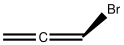
Read the rest of this entry »
References
- D. Christopher Braddock, A. Mahtey, H.S. Rzepa, and A.J.P. White, "Stable bromoallene oxides", Chemical Communications, vol. 52, pp. 11219-11222, 2016. https://doi.org/10.1039/c6cc06395k
Tags: chemical bonding, chemical reaction, Chemistry, Delocalized electron, double bond, energy, energy difference, HOMO/LUMO, lowest energy, Molecular orbital, Natural bond orbital, Nature, Physics, Quantum chemistry, stable HOMO-1
Posted in reaction mechanism | No Comments »
August 17th, 2016
In the previous post, I noted that a chemistry publisher is about to repeat an earlier experiment in serving pre-prints of journal articles. It would be fair to suggest that following the first great period of journal innovation, the boom in rapid publication “camera-ready” articles in the 1960s, the next period of rapid innovation started around 1994 driven by the uptake of the World-Wide-Web. The CLIC project[1] aimed to embed additional data-based components into the online presentation of the journal Chem Communications, taking the form of pop-up interactive 3D molecular models and spectra. The Internet Journal of Chemistry was designed from scratch to take advantage of this new medium.[2] Here I take a look at one recent experiment in innovation which incorporates “augmented reality”.[3]
Read the rest of this entry »
References
- D. James, B.J. Whitaker, C. Hildyard, H.S. Rzepa, O. Casher, J.M. Goodman, D. Riddick, and P. Murray‐Rust, "The case for content integrity in electronic chemistry journals: The CLIC project", New Review of Information Networking, vol. 1, pp. 61-69, 1995. https://doi.org/10.1080/13614579509516846
- S.M. Bachrach, and S.R. Heller, "The<i>Internet Journal of Chemistry:</i>A Case Study of an Electronic Chemistry Journal", Serials Review, vol. 26, pp. 3-14, 2000. https://doi.org/10.1080/00987913.2000.10764578
- S. Ley, B. Musio, F. Mariani, E. Śliwiński, M. Kabeshov, and H. Odajima, "Combination of Enabling Technologies to Improve and Describe the Stereoselectivity of Wolff–Staudinger Cascade Reaction", Synthesis, vol. 48, pp. 3515-3526, 2016. https://doi.org/10.1055/s-0035-1562579
Tags: Academia, Academic publishing, Boom, Design, Design Services, Innovation, Internet Journal, online presentation, Preprint, Publishing, reaction energy profile, technology helps, Web browser, web-based molecular viewer
Posted in General | 1 Comment »
August 16th, 2016
This week the ACS announced its intention to establish a “ChemRxiv preprint server to promote early research sharing“. This was first tried quite a few years ago, following the example of especially the physicists. As I recollect the experiment lasted about a year, attracted few submissions and even fewer of high quality. Will the concept succeed this time, in particular as promoted by a commercial publisher rather than a community of scientists (as was the original physicists model)?
Read the rest of this entry »
Tags: Academia, Academic publishing, article processing charge, author, Data publishing, Data sharing, food, Grey literature, Open access, Open science, PDF, Peter Murray-Rust, pre-print server, Preprint, preprint server, Public sphere, Publishing, Scholarly communication, Technology/Internet
Posted in Chemical IT | 1 Comment »
August 8th, 2016
The previous post contained an exploration of the anomeric effect as it occurs at an atom centre X for which the effect is manifest in crystal structures. Here I quantify the effect, by selecting the test molecule MeO-X-OMe, where X is of two types:
Read the rest of this entry »
Tags: Anomer, Anomeric effect, Atomic orbital, Carbohydrate chemistry, Carbohydrates, Chemical bond, chemical bonding, Chemistry, Hydrogen bond, interaction energy, Lone pair, Physical organic chemistry, Quantum chemistry
Posted in Interesting chemistry | No Comments »
August 6th, 2016
In the last few posts, I have explored the anomeric effect as it occurs at an atom centre X. Here I try to summarise the atoms for which the effect is manifest in crystal structures.
Read the rest of this entry »
Tags: Acetals, Alkane stereochemistry, Anomer, Anomeric effect, Atomic orbital, Carbohydrate chemistry, Carbohydrates, Chemical bond, Chemistry, interaction energy, Lone pair, Physical organic chemistry, Stereochemistry
Posted in crystal_structure_mining, Interesting chemistry | No Comments »
August 4th, 2016
Here is a little molecule that can be said to be pretty electron rich. There are lots of lone pairs present, and not a few electron-deficient σ-bonds. I thought it might be fun to look at the stereoelectronic interactions set up in this little system.
Read the rest of this entry »
Tags: chemical bonding, Sigma bond, Stereoelectronic effect, X-ray
Posted in crystal_structure_mining, Interesting chemistry | No Comments »