An attosecond is 10-18s. The chemistry that takes place on this timescale is called electron dynamics. For example, it is the time taken for an electron to traverse the 1s orbit in a hydrogen atom. And chemists are starting to manipulate electrons (and hence chemistry) on this timescale; for example a recent article (DOI: 10.1021/ja206193t) describes how to control the electrons in benzene using attosecond laser pulses.
Archive for the ‘Interesting chemistry’ Category
Atropisomerism in Taxol. An apparently simple bond rotation?
Tuesday, November 1st, 2011My previous post introduced the interesting guts of taxol. Two different isomers can exist, and these are called atropisomers; one has the carbonyl group pointing up, the other down. The barrier to their interconversion in this case is generated by a rotation about the two single bonds connecting the carbonyl group to the rest of the molecule. Introductory chemistry tells us that the barrier for rotation about such single bonds is low (i.e. fast at room temperature). But is that true here?
Computers 1967-2011: a personal perspective. Part 4. Moore’s Law and Molecules.
Friday, October 28th, 2011Moore’s law describes a long-term trend in the evolution of computing hardware, and it is often interpreted in terms of processing speed. Here I chart this rise in terms of the size of computable molecules. By computable I mean specifically how long it takes to predict the geometry of a given molecule using a quantum mechanical procedure.
Historical detective stories: colourful crystals.
Friday, October 21st, 2011Organic chemists have been making (more or less pure) molecules for the best part of 180 years. Occasionally, these ancient samples are unearthed in cupboards, and then the hunt for their origin starts. I have previously described tracking down the structure of a 120 year-old sample of a naphthalene derivative. But I visited a colleague's office today, and recollected having seen a well-made wooden display cabinet there on a previous visit. Today I took a photo of one of the samples:
Mechanism of the reduction of a carboxylic acid by borane: revisited and revised.
Sunday, October 16th, 2011I asked a while back whether blogs could be considered a serious form of scholarly scientific communication (and so has Peter Murray-Rust more recently). A case for doing so might be my post of about a year ago, addressing why borane reduces a carboxylic acid, but not its ester, where I suggested a possible mechanism. Well, colleagues have raised some interesting questions, both on the blog itself and more silently by email to me. As a result, I have tried to address some of these questions, and accordingly my original scheme needs some revision! This sort of iterative process of getting to the truth with the help of the community (a kind of crowd-sourced chemistry) is where I feel blogs do have a genuine role to play.
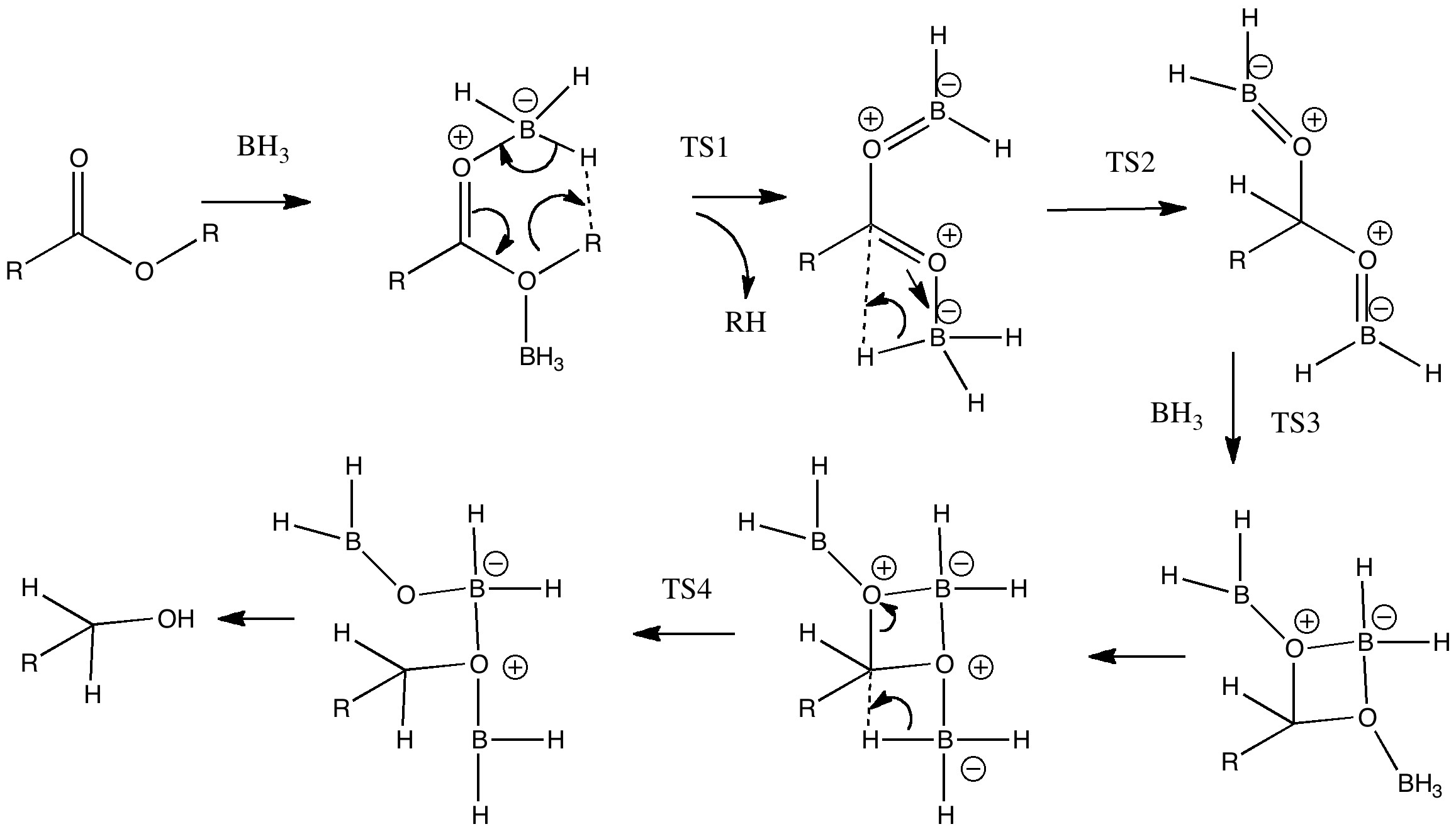
The reduction of a carboxylic acid by borane
cis-Butene: a reaction coordinate dissected and methyl flags.
Wednesday, October 12th, 2011In two previous posts, I have looked at why cis-butene adopts conformation (a) rather than (b). I suggested it boiled down to electronic interactions between the methyl groups and the central alkene resulting in the formation of a H…H “topological” bond, rather than attraction between the H…H region to form a weak chemical “bond“. Here I take a look at what happens when that central C=C bond is gradually removed.
Are close H…H contacts bonds? The dénouement!
Monday, October 10th, 2011I wrote earlier about the strangely close contact between two hydrogen atoms in cis-butene. The topology of the electron density showed characteristics of a bond, but is it a consensual union? The two hydrogens approach closer than their van der Waals radii would suggest is normal, so something is happening, but that something need not be what chemists might choose to call a “bond“. An NCI (non-covalent analysis) hinted that any stability due to the electron topologic characteristics of a bond (the BCP) might be more than offset by the repulsive nature of the adjacent ring critical point (RCP). Here I offer an alternative explanation for why the two hydrogens approach so closely.
Are close H…H contacts bonds?
Friday, October 7th, 2011The properties of electrons are studied by both chemists and physicists. At the boundaries of these two disciplines, sometimes interesting differences in interpretation emerge. One of the most controversial is that due to Bader (for a recent review, see DOI: 10.1021/jp102748b) a physicist who brought the mathematical rigor of electronic topology to bear upon molecules. The title of his review is revealing: “Definition of Molecular Structure: By Choice or by Appeal to Observation?”. He argues that electron density is observable, and that what chemists call a bond should be defined by that observable (with the implication that chemists instead often resort to arbitrary choice). Here I explore one molecule which could be said to be the focus of the differences between physics and chemistry; cis-but-2-ene.
The importance of being complete.
Monday, September 26th, 2011To (mis)quote Oscar Wilde again, ““To lose one methyl group may be regarded as a misfortune; to lose both looks like carelessness.” Here, I refer to the (past) tendency of molecular modellers to simplify molecular structures. Thus in 1977, quantum molecular modelling, even at the semi-empirical level, was beset by lost groups. One of my early efforts (DOI: 10.1021/ja00465a005) was selected for study because it had nothing left to lose; the mass spectrometric fragmentation of the radical cations of methane and ethane. Methyl, phenyl and other “large” groups were routinely replaced by hydrogen in order to enable the study. Cations indeed were always of interest to modellers; the relative lack of electrons almost always meant unusual or interesting structures and reactions (including this controversial species, DOI: 10.1021/ja00444a012). Inured to such functional loss, we modellers forgot that (unless in a mass spectrometer), cations have to have a counter anion. Here I explore one example of the model being complete(d).
Molecular Matryoshka dolls
Tuesday, September 20th, 2011A Matryoshka doll is better known as a Russian nesting doll. They can have up to eight layers. Molecules can only emulate two layers, although see here for a good candidate for making a three-layered example (the inside layer is C60, which itself might encapsulate a small molecule. See also DOI: 10.1021/ja991747w). These molecular dolls can be created out of quite simple molecules. Here I explore just one, and focus on what is happening inside!