Archive for the ‘Interesting chemistry’ Category
Saturday, August 25th, 2018
Symbiosis between computation and experiment is increasingly evident in pedagogic journals such as J. Chemical Education. Thus an example of original laboratory experiments[1],[2] that later became twinned with a computational counterpart.[3] So when I spotted this recent lab experiment[4] I felt another twinning approaching.
(more…)
References
- A. Burke, P. Dillon, K. Martin, and T.W. Hanks, "Catalytic Asymmetric Epoxidation Using a Fructose-Derived Catalyst", Journal of Chemical Education, vol. 77, pp. 271, 2000. https://doi.org/10.1021/ed077p271
- J. Hanson, "Synthesis and Use of Jacobsen's Catalyst: Enantioselective Epoxidation in the Introductory Organic Laboratory", Journal of Chemical Education, vol. 78, pp. 1266, 2001. https://doi.org/10.1021/ed078p1266
- K.K.(. Hii, H.S. Rzepa, and E.H. Smith, "Asymmetric Epoxidation: A Twinned Laboratory and Molecular Modeling Experiment for Upper-Level Organic Chemistry Students", Journal of Chemical Education, vol. 92, pp. 1385-1389, 2015. https://doi.org/10.1021/ed500398e
- M. Meazza, A. Kowalczuk, S. Watkins, S. Holland, T.A. Logothetis, and R. Rios, "Organocatalytic Cyclopropanation of (<i>E</i>)-Dec-2-enal: Synthesis, Spectral Analysis and Mechanistic Understanding", Journal of Chemical Education, vol. 95, pp. 1832-1839, 2018. https://doi.org/10.1021/acs.jchemed.7b00566
Tags:Ammonium, Benzyl group, Cations, chemical diagrams, Chemistry, condensation, final product, Functional groups, Iminium, Methyl group, Name reactions, Organic chemistry, possible diastereomeric products, relative energy, Vector Graphics, web browsers
Posted in Interesting chemistry | 9 Comments »
Wednesday, August 22nd, 2018
Following the general recognition of carbon as being tetrahedrally tetravalent in 1869 (Paterno) and 1874 (Van’t Hoff and Le Bell), an early seminal exploitation of this to the conformation of cyclohexane was by Hermann Sachse in 1890.[1] This was verified when the Braggs in 1913[2], followed by an oft-cited article by Mohr in 1918,[3] established the crystal structure of diamond as comprising repeating rings in the chair conformation.† So by 1926, you might imagine that the shape (or conformation as we would now call it) of cyclohexane would be well-known. No quite so for everyone!
(more…)
References
- H. Sachse, "Ueber die geometrischen Isomerien der Hexamethylenderivate", Berichte der deutschen chemischen Gesellschaft, vol. 23, pp. 1363-1370, 1890. https://doi.org/10.1002/cber.189002301216
- W.H. Bragg, and W.L. Bragg, "The structure of the diamond", Proceedings of the Royal Society of London. Series A, Containing Papers of a Mathematical and Physical Character, vol. 89, pp. 277-291, 1913. https://doi.org/10.1098/rspa.1913.0084
- E. Mohr, "Die Baeyersche Spannungstheorie und die Struktur des Diamanten", Journal für Praktische Chemie, vol. 98, pp. 315-353, 1918. https://doi.org/10.1002/prac.19180980123
Tags:Carbon, chair, Chemistry, Conformation, Cycloalkanes, cyclohexane, Cyclohexane conformation, Derek Barton, Hermann Sachse, Hoff, Imperial College Chemical Society, Isomerism, Physical organic chemistry, R. F Hunter, Stereochemistry, Van 't Hof
Posted in Interesting chemistry | 1 Comment »
Wednesday, August 22nd, 2018
In 2012, I wrote a story of the first ever reaction curly arrows, attributed to Robert Robinson in 1924. At the time there was a great rivalry between him and another UK chemist, Christopher Ingold, with the latter also asserting his claim for their use. As part of the move to White City a lot of bookshelves were cleared out from the old buildings in South Kensington, with the result that yesterday a colleague brought me a slim volume they had found entitled The Journal of the Imperial College Chemical Society (Volume 6).‡
(more…)
Tags:arrow pushing, chemical reaction, Chemical Society, chemist, Chemistry, Christopher Ingold, Christopher Kelk Ingold, College of Science, Country: United Kingdom, Fellows of the Royal Society, Henry Armstrong, Imperial College Chemical Society, Imperial College London, Ingold, Knights Bachelor, Person Career, Robert Robinson, Royal College of Science, The Scientific Journal
Posted in Interesting chemistry | No Comments »
Wednesday, August 8th, 2018
White City is a small area in west london created as an exhibition site in 1908, morphing over the years into an Olympic games venue, a greyhound track, the home nearby of the BBC (British Broadcasting Corporation) and most recently the new western campus for Imperial College London.♣ The first Imperial department to move into the MSRH (Molecular Sciences Research Hub) building is chemistry. As a personal celebration of this occasion, I here dedicate three transition states located during my first week of occupancy there, naming them the White City trio following earlier inspiration by a string trio and their own instruments.
(more…)
Tags:acetic acid, Acid, Amide, Amine, carboxylic acid, Chemistry, Company: BBC, Company: British Broadcasting Corporation, energy, Ester, exhibition site, free energy barrier, Functional groups, Hydrogen bond, Imperial College, Imperial College London, Ionic product, Newspaper & Magazine Printing Services, Non-ionic product, Olympic games, Organic chemistry, White City Trio
Posted in Interesting chemistry | 6 Comments »
Tuesday, August 7th, 2018
Harnessing FAIR data is an event being held in London on September 3rd; no doubt all the speakers will espouse its virtues and speculate about how to realize its potential.♥ Admirable aspirations indeed. Capturing hearts and minds also needs lots of real life applications! Whilst assembling a forthcoming post on this blog, I realized I might have one nice application which also pushes the envelope a bit further, in a manner that I describe below.
(more…)
Tags:Academic publishing, chemical context, Code, data, DataCite, energy, free energy activation barrier, Identifiers, Information, ISO/IEC 11179, ORCiD, quantum chemical calculations, real life applications, Technical communication
Posted in Interesting chemistry | 9 Comments »
Wednesday, July 25th, 2018
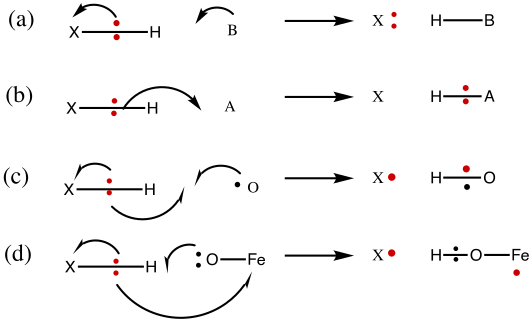
Consider the four reactions. The first two are taught in introductory organic chemistry as (a) a proton transfer, often abbreviated PT, from X to B (a base) and (b) a hydride transfer from X to A (an acid). The third example is taught as a hydrogen atom transfer or HAT from X to (in this example) O. Recently an article has appeared[1] citing an example of a fourth fundamental type (d), which is given the acronym cPCET which I will expand later. Here I explore this last type a bit further, in the context that X-H bond activations are currently a very active area of research.
(more…)
References
- J.E.M.N. Klein, and G. Knizia, "cPCET versus HAT: A Direct Theoretical Method for Distinguishing X–H Bond‐Activation Mechanisms", Angewandte Chemie International Edition, vol. 57, pp. 11913-11917, 2018. https://doi.org/10.1002/anie.201805511
Tags:chemical reactions, Chemistry, Deprotonation, Hydride, Hydrogen, Hydrogen atom abstraction, Proton, proton travel, Proton-coupled electron transfer, Technology/Internet
Posted in Interesting chemistry | No Comments »
Wednesday, July 18th, 2018
FAIR is one of those acronyms that spreads rapidly, acquires a life of its own and can mean many things to different groups. A two-day event has just been held in Amsterdam to bring some of those groups from the chemical sciences together to better understand FAIR. Here I note a few items that caught my attention.
(more…)
Tags:Acronym, Amsterdam, chemical sciences, City: Amsterdam, Queen Mary University of London, spectroscopy, Technology/Internet, text editor, University of London, visualisation tools
Posted in Interesting chemistry | 3 Comments »
Thursday, July 12th, 2018
This last month, as a follow-up to the preceding post on the colour of flowers, I have been moonlighting by blogging elsewhere. Do go visit my “guerrilla blog” at perivalepark.london. Part of this project involves visiting two “physic or botanic” gardens, which originate from early 17th century explorations of herbs and other botanicals as medicines. Both are very old and their chemistry is indeed fascinating; more of which later.
(more…)
Tags:Botany, Herb
Posted in Interesting chemistry | No Comments »
Monday, June 18th, 2018
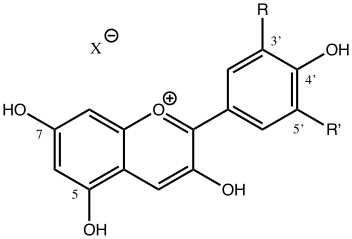
It was about a year ago that I came across a profusion of colour in my local Park. Although colour in fact was the topic that sparked my interest in chemistry many years ago (the fantastic reds produced by diazocoupling reactions), I had never really tracked down the origin of colours in many flowers. It is of course a vast field. Here I take a look at just one class of molecule responsible for many flower colours, anthocyanidin, this being the sugar-free counterpart of the anthocyanins found in nature.
(more…)
Tags:Anthocyanidin, Anthocyanin, Chemistry, Delphinidin, HOMO/LUMO, Major, Molecular electronic transition, Molecule, Nature, PH indicators, Quantum chemistry, spectroscopy, Ultraviolet–visible spectroscopy
Posted in Interesting chemistry | 4 Comments »
Wednesday, May 16th, 2018
Ten years are a long time when it comes to (recent) technologies. The first post on this blog was on the topic of how to present chemistry with three intact dimensions. I had in mind molecular models, molecular isosurfaces and molecular vibrations (arguably a further dimension). Here I reflect on how ten years of progress in technology has required changes and the challenge of how any necessary changes might be kept “under the hood” of this blog.
(more…)
Tags:Ajax, Computer programming, computing, Cross-platform software, HTML, Java, Java applet, Java technology, JavaScript, JavaScript libraries, jmol, JQuery, NPAPI, Scientific Journal, Software engineering, Technology/Internet, web browser behaviour, web browsers, Web-page security
Posted in Interesting chemistry | 6 Comments »