Archive for the ‘Interesting chemistry’ Category
Sunday, September 15th, 2013
I do go on rather a lot about enabling or hyper-activating[1] data. So do others[2]. Why is sharing data important?
(more…)
References
- O. Casher, G.K. Chandramohan, M.J. Hargreaves, C. Leach, P. Murray-Rust, H.S. Rzepa, R. Sayle, and B.J. Whitaker, "Hyperactive molecules and the World-Wide-Web information system", Journal of the Chemical Society, Perkin Transactions 2, pp. 7, 1995. https://doi.org/10.1039/p29950000007
- R. Van Noorden, "Data-sharing: Everything on display", Nature, vol. 500, pp. 243-245, 2013. https://doi.org/10.1038/nj7461-243a
Tags:chemical tagger, data mining, datument, David Scheschkewitz, e-notebook, Google, opendata, Peter Murray-Rust, pre-processor, researcher, scientific tool, supervisor, United Kingdom
Posted in Chemical IT, Interesting chemistry | 9 Comments »
Thursday, September 12th, 2013
Andy Extance at the Chemistry World blog has picked up on a fascinating article[1] on the dimer of SF2. This molecule has three F atoms on one S, and only one on the other; FSSF3. But all four S-F bonds are of different length. Lindquist and Dunning claim that the minimum energy pathway to dissociation to two SF2 molecules does not involve breaking either the longest or the weakest SF bond. This was too much for me to resist investigating further!
(more…)
References
- B.A. Lindquist, and T.H. Dunning, "Bonding in FSSF<sub>3</sub>: Breakdown in Bond Length-Strength Correlations and Implications for SF<sub>2</sub> Dimerization", The Journal of Physical Chemistry Letters, vol. 4, pp. 3139-3143, 2013. https://doi.org/10.1021/jz401578h
Tags:Andy Extance, minimum energy pathway
Posted in Interesting chemistry, reaction mechanism | 6 Comments »
Sunday, August 11th, 2013
The ultimate reduction in size for an engineer is to a single molecule. It’s been done for a car; now it has been reported for the pixel (picture-element).[1]
(more…)
References
- J.E. Kwon, S. Park, and S.Y. Park, "Realizing Molecular Pixel System for Full-Color Fluorescence Reproduction: RGB-Emitting Molecular Mixture Free from Energy Transfer Crosstalk", Journal of the American Chemical Society, vol. 135, pp. 11239-11246, 2013. https://doi.org/10.1021/ja404256s
Tags:above energy diagram, energy, energy transfer, energy transfer occurring, energy transfers, engineer, free energy
Posted in Interesting chemistry | 1 Comment »
Thursday, July 18th, 2013
This potential example of a molecule on the edge of chaos was suggested to me by a student (thanks Stephen!), originating from an inorganic tutorial. It represents a class of Mo-complex ligated by two dithiocarbamate ligands and two aryl nitrene ligands (Ar-N:).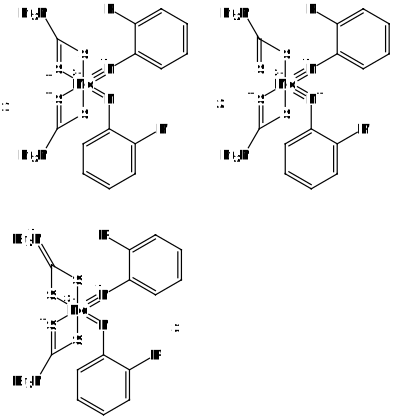
(more…)
Posted in Interesting chemistry | 2 Comments »
Thursday, July 11th, 2013
The butterfly effect summarises how a small change to a system may result in very large and often unpredictable (chaotic) consequences. If the system is merely on the edge of chaos, the consequences are predictable, but nevertheless finely poised between e.g. two possible outcomes. Here I ask how a molecule might manifest such behaviour.
(more…)
Posted in Interesting chemistry | 5 Comments »
Monday, July 8th, 2013
A feature of a blog which is quite different from a journal article is how rapidly a topic might evolve. Thus I started a few days ago with the theme of dicarbon (C2), identifying a metal carbide that showed C2 as a ligand, but which also entrapped a single carbon in hexa-coordinated mode. A comment was posted bringing attention to the origins of the discovery of hexacoordinated carbon, and we moved on to exploring the valency in one such species (CLi6). Here I ask if hydrogen itself might exhibit such coordination.
(more…)
Tags:chemical shift, metal atoms, metal carbide
Posted in Hypervalency, Interesting chemistry | 2 Comments »
Friday, July 5th, 2013
A comment made on the previous post on the topic of hexa-coordinate carbon cited an article entitled “Observation of hypervalent CLi6 by Knudsen-effusion mass spectrometry“[1] by Kudo as a amongst the earliest of evidence that such species can exist (in the gas phase). It was a spectacular vindication of the earlier theoretical prediction[2],[3] that such 6-coordinate species are stable with respect to dissociation to CLi4 and Li2.
(more…)
References
- H. Kudo, "Observation of hypervalent CLi6 by Knudsen-effusion mass spectrometry", Nature, vol. 355, pp. 432-434, 1992. https://doi.org/10.1038/355432a0
- E.D. Jemmis, J. Chandrasekhar, E.U. Wuerthwein, P.V.R. Schleyer, J.W. Chinn, F.J. Landro, R.J. Lagow, B. Luke, and J.A. Pople, "Lithiated carbocations. The generation, structure, and stability of CLi5+", Journal of the American Chemical Society, vol. 104, pp. 4275-4276, 1982. https://doi.org/10.1021/ja00379a051
- P.V.R. Schleyer, E.U. Wuerthwein, E. Kaufmann, T. Clark, and J.A. Pople, "Effectively hypervalent molecules. 2. Lithium carbide (CLi5), lithium carbide (CLi6), and the related effectively hypervalent first row molecules, CLi5-nHn and CLi6-nHn", Journal of the American Chemical Society, vol. 105, pp. 5930-5932, 1983. https://doi.org/10.1021/ja00356a045
Tags:energy, gas phase, Knudsen, low energy 2s/2p carbon, metal-metal bonding, pence
Posted in Hypervalency, Interesting chemistry | 7 Comments »