Archive for the ‘Interesting chemistry’ Category
Monday, April 25th, 2011
In discussing ferrocene in the previous post, I mentioned Irving Langmuir’s 1921 postulate that filled valence shells in what he called complete molecules would have magic numbers of 2, 8, 18 or 32 electrons (deriving from the sum of terms in 2[1+3+5+7]). The first two dominate organic chemistry of course, whilst the third is illustrated by the transition series, ferrocene being an example of such. The fourth case is very much rarer, only one example ever having been suggested[1], it deriving from the actinides. In this post, I thought I would augment ferrocene (an 18-electron example) with beryllocene (an 8-electron example) and then speculate about 32-electron metallocenes.
(more…)
References
- J. Dognon, C. Clavaguéra, and P. Pyykkö, "Towards a 32‐Electron Principle: Pu@Pb<sub>12</sub> and Related Systems", Angewandte Chemie International Edition, vol. 46, pp. 1427-1430, 2007. https://doi.org/10.1002/anie.200604198
Tags:8-electron rule, beryllocene, Cambridge, Irving Langmuir, metal, pence, uranocene
Posted in Interesting chemistry | 11 Comments »
Sunday, April 17th, 2011
The structure of ferrocene was famously analysed by Woodward and Wilkinson in 1952[1],[2], symmetrically straddled in history by Pauling (1951) and Watson and Crick (1953). Quite a trio of Nobel-prize winning molecular structural analyses, all based on a large dose of intuition. The structures of both proteins and DNA succumbed to models built from simple Lewis-type molecules with covalent (and hydrogen) bonds; ferrocene is intriguingly similar and yet different. Similar because e.g. carbon via four electron pair bonds. He did not (in 1916) realise that 8 = 2(1 + 3), and that the next in sequence would be 18 = 2(1 + 3 + 5). That would have to wait for quantum mechanics, and of course inorganic chemists now call it the 18-electron rule (for an example of the 32-electron rule, or 2+6+10+14, as first suggested by Langmuir in 1921[3] (see also here[4]).
(more…)
References
- G. Wilkinson, M. Rosenblum, M.C. Whiting, and R.B. Woodward, "THE STRUCTURE OF IRON BIS-CYCLOPENTADIENYL", Journal of the American Chemical Society, vol. 74, pp. 2125-2126, 1952. https://doi.org/10.1021/ja01128a527
- G. Wilkinson, "The iron sandwich. A recollection of the first four months", Journal of Organometallic Chemistry, vol. 100, pp. 273-278, 1975. https://doi.org/10.1016/s0022-328x(00)88947-0
- I. Langmuir, "Types of Valence", Science, vol. 54, pp. 59-67, 1921. https://doi.org/10.1126/science.54.1386.59
- J. Dognon, C. Clavaguéra, and P. Pyykkö, "Towards a 32‐Electron Principle: Pu@Pb<sub>12</sub> and Related Systems", Angewandte Chemie International Edition, vol. 46, pp. 1427-1430, 2007. https://doi.org/10.1002/anie.200604198
Tags:10.1126, 18-electron rule, 54.1386.59, Ferrocene, Historical, normal solution, pence, Tutorial material, valid search query
Posted in Interesting chemistry | 8 Comments »
Saturday, April 9th, 2011
Understanding why and how proteins fold continues to be a grand challenge in science. I have described how Wrinch in 1936 made a bold proposal for the mechanism, which however flew in the face of much of then known chemistry. Linus Pauling took most of the credit (and a Nobel prize) when in a famous paper[1] in 1951 he suggested a mechanism that involved (inter alia) the formation of what he termed α-helices. Jack Dunitz in 2001[2] wrote a must-read article[3] on the topic of “Pauling’s Left-handed α-helix” (it is now known to be right handed). I thought I would revisit this famous example with a calculation of my own and here I have used the ωB97XD/6-311G(d,p) DFT procedure[4] to calculate some of the energy components of a small helix comprising (ala)6 in both left and right handed form.
(more…)
References
- L. Pauling, R.B. Corey, and H.R. Branson, "The structure of proteins: Two hydrogen-bonded helical configurations of the polypeptide chain", Proceedings of the National Academy of Sciences, vol. 37, pp. 205-211, 1951. https://doi.org/10.1073/pnas.37.4.205
- J.D. Dunitz, "Pauling's Left-Handed α-Helix", Angewandte Chemie International Edition, vol. 40, pp. 4167-4173, 2001. https://doi.org/10.1002/1521-3773(20011119)40:22<4167::aid-anie4167>3.0.co;2-q
- https://doi.org/
- K.S. Thanthiriwatte, E.G. Hohenstein, L.A. Burns, and C.D. Sherrill, "Assessment of the Performance of DFT and DFT-D Methods for Describing Distance Dependence of Hydrogen-Bonded Interactions", Journal of Chemical Theory and Computation, vol. 7, pp. 88-96, 2010. https://doi.org/10.1021/ct100469b
Tags:alpha-helix, aqueous solutions, chiroptical, conformational analysis, dielectric, energy, energy components, high energy species, Historical, Jack Dunitz, Julia Contreras-Garcia, protein, solvation algorithms, Tutorial material, watoc11
Posted in Interesting chemistry | 4 Comments »
Monday, April 4th, 2011
Andy Mclean posted a comment to my story of copper phthalocyanine (Monastral blue). The issue was its colour, and more specifically why this pigment has two peaks λmax 610 and 710nm making it blue. The first was accurately reproduced by calculation on the monomer, but the second was absent with such a model. Andy suggested this latter was due to stacking. Here, the calculated spectrum of a stacked dimer is explored.
(more…)
Tags:Andy Mclean, copper phthalocyanine, energy, Historical, TD-DFT, X-ray
Posted in Interesting chemistry | No Comments »
Monday, April 4th, 2011
Most scientific theories emerge slowly, over decades, but others emerge fully formed virtually overnight as it were (think Einstein in 1905). A third category is the supernova type, burning brightly for a short while, but then vanishing (almost) without trace shortly thereafter. The structure of DNA (of which I have blogged elsewhere) belongs to the second class, whilst one of the brightest (and now entirely forgotten) examples of the supernova type concerns the structure of proteins. In 1936, it must have seemed a sure bet that the first person to come up with a successful theory of the origins of the (non-random) relatively rigid structure of proteins would inevitably win a Nobel prize. Of course this did happen for that other biologically important system, DNA, some 17 years later. Compelling structures for larger molecules providing reliable atom-atom distances based on crystallography were still in the future in 1936, and so structural theories contained a fair element of speculation and hopefully inspired guesswork (much as cosmological theories appear to have nowadays!).
(more…)
Tags:Cambridge, chair, Derek Barton, Dorothy Wrinch, energy, high energy species, Historical, mathematician, organic chemist, Patrick Coffey, relative free energy, thermodynamics, Tutorial material
Posted in Interesting chemistry | 2 Comments »
Wednesday, March 9th, 2011
In the previous post I pondered the colour of Monastral blue (copper phthalocyanine). Something did not quite fit, and so I speculated that perhaps some oxidation of the pigment might give a new species. This species (Cambridge code FEGJOQ) comprises two parts of copper phthalocyanine, 1 part of the corresponding cation, and 1 part of triodide anion. Looking at the packing of this system, I spotted something I had seen some time ago in NaI2.Acetone, namely an infinitely long and absolutely straight chain of iodine atoms, a molecular wire if you like.
(more…)
Tags:Cambridge, molecular wire, phthalocyanine
Posted in Interesting chemistry | 2 Comments »
Tuesday, March 8th, 2011
The story of Monastral is not about a character in the Magic flute, but is a classic of chemical serendipity, collaboration between industry and university, theoretical influence, and of much else. Fortunately, much of that story is actually recorded on film (itself a unique archive dating from 1933 and being one of the very first colour films in existence!). Patrick Linstead, a young chemist then (he eventually rose to become rector of Imperial College) tells the story himself here. It is well worth watching, if only for its innocent social commentary on the English class system (and an attitude to laboratory safety that should not be copied nowadays). Here I will comment only on its colour and its aromaticity.
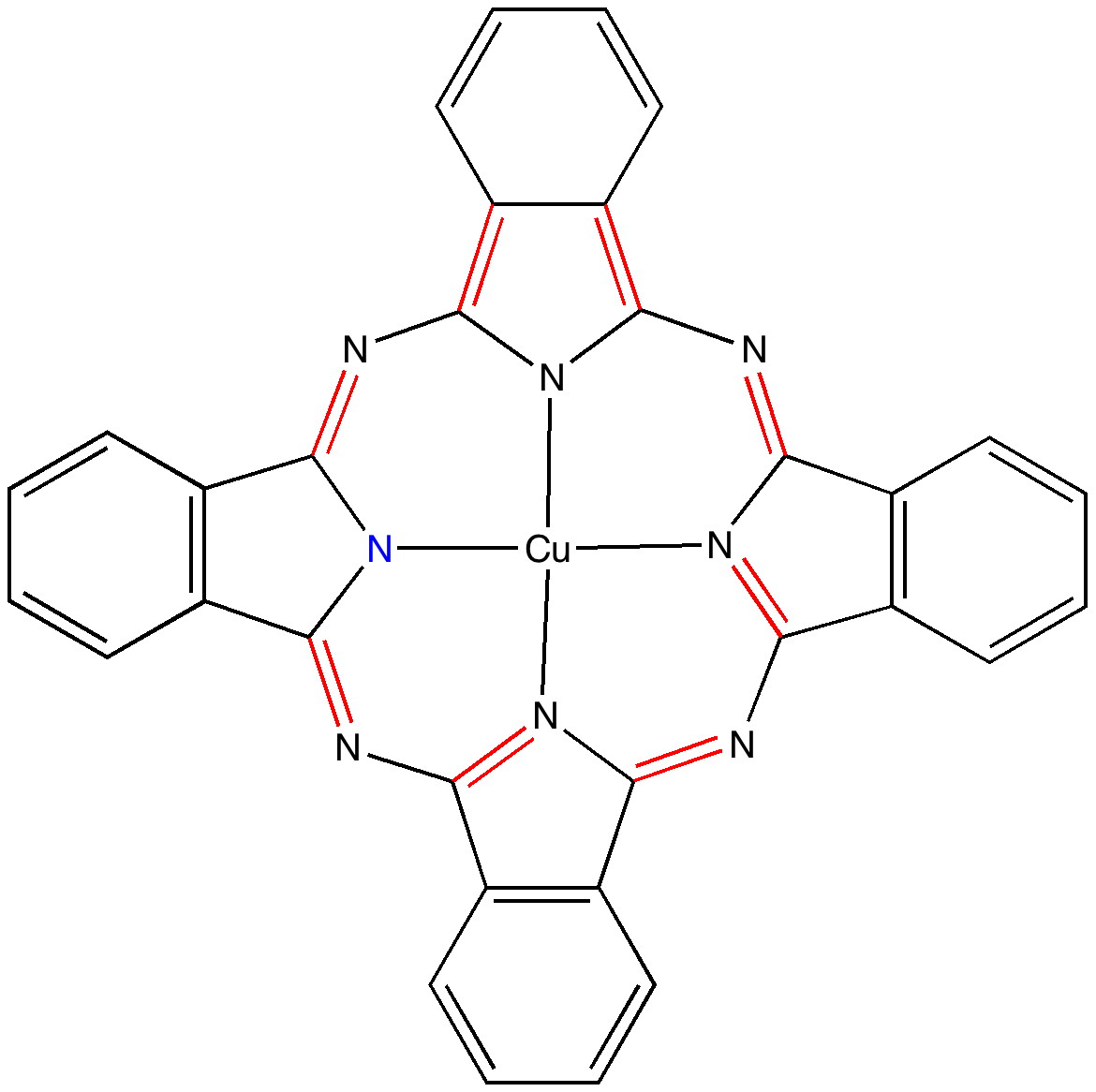
Copper phthalocyanine
(more…)
Tags:18 electron aromaticity, chemical serendipity, Historical, HTML, HTML element, Imperial College, Missouri, Monastral blue, Patrick Linstead, phthalocyanine, Phthalocyanine Blue BN, Phthalocyanines, Pigments, rector, young chemist
Posted in Interesting chemistry | 6 Comments »
Saturday, March 5th, 2011
In this earlier post, I noted some aspects of the calculated structures of both Z- and B-DNA duplexes. These calculations involved optimising the positions of around 250-254 atoms, for d(CGCG)2 and d(ATAT)2, an undertaking which has taken about two months of computer time! The geometries are finally optimised to the point where 2nd derivatives can be calculated, and which reveal up to 756 all-positive force constants and 6 translations and rotations which are close to zero! This now lets one compute the thermodynamic relative energies using ωB97XD/6-31G(d) (for 2nd derivatives) and 6-31G(d,p) (for dispersion terms). All geometries are optimized using a continuum solvent field (water), and are calculated, without a counterion, as hexa-anions. (more…)
Tags:6-31G(d), ATAT duplex, B-DNA, CGCG duplex, dispersion energy corrections, energy, thermodynamic stability, Tutorial material, watoc11, wB97XD, Z-DNA
Posted in Interesting chemistry | 4 Comments »
Thursday, February 24th, 2011
One of my chemical heroes is William Perkin, who in 1856 famously (and accidentally) made the dye mauveine as an 18 year old whilst a student of August von Hofmann, the founder of the Royal College of Chemistry (at what is now Imperial College London). Perkin went on to found the British synthetic dyestuffs and perfumeries industries. The photo below shows Charles Rees, who was for many years the Hofmann professor of organic chemistry at the very same institute as Perkin and Hofmann himself, wearing his mauveine tie. A colleague, who is about to give a talk on mauveine, asked if I knew why it was, well so very mauve. It is a tad bright for today’s tastes!
(more…)
Tags:August von Hofmann, Charles Rees, chemical heroes, chiroptical, colour, founder, Historical, Hofmann, HOMO, Imperial College, Imperial College London, LUMO, Mauveine, Perkin, professor of organic chemistry, purple, Rees, Royal College of Chemistry, William Perkin
Posted in General, Interesting chemistry | 16 Comments »