Archive for the ‘Interesting chemistry’ Category
Wednesday, June 26th, 2013
A reader asked me about the mechanism of the reaction of 2-picoline N-oxide with acetic anhydride to give 2-acetoxymethylpyridine (the Boekelheide Rearrangement[1]). He wrote ” I don’t understand why the system should prefer to go via fragmentation-recombination (… the evidence being that oxygen labelling shows scrambling) when there is an easy concerted pathway available (… a [3,3]sigmatropic shift). Furthermore, is it possible for two pathways to co-exist?” Here is how computation might enlighten us.
(more…)
References
- A. Massaro, A. Mordini, A. Mingardi, J. Klein, and D. Andreotti, "A New Sequential Intramolecular Cyclization Based on the Boekelheide Rearrangement", European Journal of Organic Chemistry, vol. 2011, pp. 271-279, 2010. https://doi.org/10.1002/ejoc.201000936
Tags:ATM, CF 3 CO, CH 3 CO, extraneous product, free energy, free energy barrier, recombination
Posted in Interesting chemistry, pericyclic, reaction mechanism | 3 Comments »
Friday, May 24th, 2013
The title of this post comes from a comment posted by Ryan, who asks about isocyanide’s role (in the form of the anion of tosyl isocyanide, or TosMIC) in two named reactions, Van Leusen and Ugi FCR. “In Van Leusen, it (the isocyanide) acts as an electrophile: however, in Ugi, it acts as a nucleophile”. Here are some valence bond forms for this species;
(more…)
Tags:Ugi, Van Leusen
Posted in Interesting chemistry | 2 Comments »
Wednesday, May 15th, 2013
In the preceding post, I introduced Dewar’s π-complex theory for alkene-metal compounds, outlining the molecular orbital analysis he presented, in which the filled π-MO of the alkene donates into a Ag+ empty metal orbital and back-donation occurs from a filled metal orbital into the alkene π* MO. Here I play a little “what if” game with this scenario to see what one can learn from doing so.
(more…)
Tags:African Union, alkene-metal compounds, empty metal orbital, energy, filled metal orbital, free energy, Historical, lower energy form, metal
Posted in Hypervalency, Interesting chemistry | 1 Comment »
Monday, May 13th, 2013
The period 1951–1954 was a golden one for structural chemistry; proteins, DNA, Ferrocene (1952) and the one I discuss here, a bonding model for Zeise’s salt (3).
(more…)
Tags:alkene-metal interaction, alkene-metal π-complex, cation Ag, Dewar, Dewar's Ag, Historical, metal, metal d-orbitals, naked metal cations, ZTE C79 Cellular Phone
Posted in Interesting chemistry | 1 Comment »
Saturday, May 11th, 2013
Lukas, who occasionally comments on this blog, sent me the following challenge. In a recent article[1] he had proposed that the stereochemical outcome (Z) of reaction between a butenal and thioacetic acid as shown below arose by an unusual concerted cycloaddtion involving an S-H bond. He wrote in the article “…this scheme … recommends itself for evaluation by in silico methods“. I asked if the answer could be posted here, and he agreed. So here it is.
(more…)
References
- L. Hintermann, and A. Turočkin, "Reversible Generation of Metastable Enols in the 1,4-Addition of Thioacetic Acid to α,β-Unsaturated Carbonyl Compounds", The Journal of Organic Chemistry, vol. 77, pp. 11345-11348, 2012. https://doi.org/10.1021/jo3021709
Tags:Reaction Mechanism
Posted in Interesting chemistry | 3 Comments »
Monday, May 6th, 2013
In a previous post on the topic, I remarked how the regiospecific ethanolysis of propene epoxide[1] could be quickly and simply rationalised by inspecting the localized NBO orbital calculated for either the neutral or the protonated epoxide. This is an application of Hammond’s postulate[[2] in extrapolating the properties of a reactant to its reaction transition state. This approach implies that for acid-catalysed hydrolysis, the fully protonated epoxide is a good model for the subsequent transition state. But is this true? Can this postulate be tested? Here goes.
(more…)
References
- H.C. Chitwood, and B.T. Freure, "The Reaction of Propylene Oxide with Alcohols", Journal of the American Chemical Society, vol. 68, pp. 680-683, 1946. https://doi.org/10.1021/ja01208a047
- G.S. Hammond, "A Correlation of Reaction Rates", Journal of the American Chemical Society, vol. 77, pp. 334-338, 1955. https://doi.org/10.1021/ja01607a027
Tags:CF 3 CO, free energy, good model for the subsequent transition state, lower free energy barrier, Reaction Mechanism
Posted in Interesting chemistry | 1 Comment »
Monday, April 29th, 2013
A few posts back, I explored the “benzidine rearrangement” of diphenyl hydrazine. This reaction requires diprotonation to proceed readily, but we then discovered that replacing one NH by an O as in N,O-diphenyl hydroxylamine required only monoprotonation to undergo an equivalent facile rearrangement. So replacing both NHs by O to form diphenyl peroxide (Ph-O-O-Ph) completes this homologous series. I had speculated that PhNHOPh might exist if all traces of catalytic acid were removed, but could the same be done to PhOOPh? Not if it continues the trend and requires no prior protonation at all!
(more…)
Tags:actual initial product, energy, energy transition state, Michael Dewar, New Hampshire, Reaction Mechanism
Posted in Interesting chemistry | 4 Comments »
Sunday, April 28th, 2013
I recently got an email from a student asking about the best way of rationalising epoxide ring opening using some form of molecule orbitals. This reminded me of the famous experiment involving propene epoxide.[1]
(more…)
References
- H.C. Chitwood, and B.T. Freure, "The Reaction of Propylene Oxide with Alcohols", Journal of the American Chemical Society, vol. 68, pp. 680-683, 1946. https://doi.org/10.1021/ja01208a047
Tags:10.1021, energy, lowest energy, predominant product, Reaction Mechanism, Tutorial material
Posted in Interesting chemistry | No Comments »
Wednesday, April 17th, 2013
This is another in the occasional series of “what a neat molecule”. In this case, more of a “what a neat idea”. The s-triazine below, when coordinated to eg ZnI2, forms what is called a metal-organic-framework, or MOF. A recent article[1] shows how such frameworks can be used to help solve a long-standing problem in structure determination, how to get a crystal structure on a compound that does not crystallise on its own.
(more…)
References
- Y. Inokuma, S. Yoshioka, J. Ariyoshi, T. Arai, Y. Hitora, K. Takada, S. Matsunaga, K. Rissanen, and M. Fujita, "X-ray analysis on the nanogram to microgram scale using porous complexes", Nature, vol. 495, pp. 461-466, 2013. https://doi.org/10.1038/nature11990
Tags:chair, marine natural product, metal, radiation, X-ray
Posted in Interesting chemistry | 2 Comments »
Sunday, April 14th, 2013
A recent theme here has been to subject to scrutiny well-known mechanisms supposedly involving intermediates. These transients can often involve the creation/annihilation of charge separation resulting from proton transfers, something that a cyclic mechanism can avoid. Here I revisit the formation of an oxime from hydroxylamine and propanone, but with one change. In the earlier post, I used two molecules of water to achieve the desired proton transfer. Now I look to see what effect replacing those two water molecules by a guanidine has.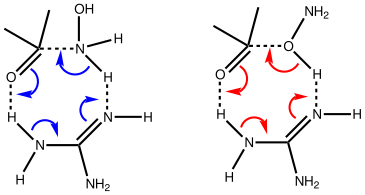
(more…)
Tags:Reaction Mechanism
Posted in Interesting chemistry | No Comments »