Archive for the ‘Interesting chemistry’ Category
Friday, October 2nd, 2009
The previous post talked about making links or connections. And part of the purpose for presenting this chemistry as a blog is to expose how these connections are made, or or less as it happens in real time (and not the chronologically sanitized version of discovery that most research papers are). So each post represents an evolution or mutation from the previous one. To recapitulate, we have seen how the idea of cyclopentadienyl anion as a ligand for a dipositive carbon atom has evolved. Let us move in yet another direction; the cyclobutadienyl dianion. This ligand has recently been shown to bind Mg2+ (DOI: 10.1002/ejic.200800066), so why not He2+? And picking up again the previous theme, we will then protonate the bound complex. The result now is a monocation, and it has the C4v-symmetric structure shown below (DOI: 10042/to-2438). This bears some resemblance to pyramidane, a neutral C5H4 compound with hemispherical carbon reported in 2001[1] which is also a stable minimum in the potential energy surface.
(more…)
References
- J.P. Kenny, K.M. Krueger, J.C. Rienstra-Kiracofe, and H.F. Schaefer, "C<sub>5</sub>H<sub>4</sub>: Pyramidane and Its Low-Lying Isomers", The Journal of Physical Chemistry A, vol. 105, pp. 7745-7750, 2001. https://doi.org/10.1021/jp011642r
Tags:Hypervalency, Interesting chemistry, potential energy surface, pseudo
Posted in Hypervalency, Interesting chemistry | No Comments »
Friday, October 2nd, 2009
Science is about making connections. And these can often be made between the most unlikely concepts. Thus in the posts I have made about pentavalent carbon, one can identify a series of conceptual connections. The first, by Matthias Bickelhaupt and co, resulted in the suggestion of a possible frozen SN2 transition state. They used astatine, and this enabled a connection to be made between another good nucleophile/nucleofuge, cyclopentadienyl anion. This too seems to lead to a frozen Sn2 transition state. The cyclopentadienyl theme then asks whether this anion can coordinate a much simpler unit, a C2+ dication (rather than Bickelhaupt’s suggestion of a (NC)3C+ cation/radical) and indeed that complex is also frozen, again with 5-coordinate carbon, and this time with five equal C-C bonds. So here, the perhaps inevitable progression of ideas moves on to examining the properties of this complex, the outcome being a quite counter-intuitive suggestion which moves us into new territory.
(more…)
Tags:CHs, Hypervalency, Interesting chemistry, Matthias Bickelhaupt
Posted in Hypervalency, Interesting chemistry | 6 Comments »
Wednesday, September 30th, 2009
In the previous two posts, I noted the recent suggestion of how a stable frozen SN2 transition state might be made. This is characterised by a central carbon with five coordinated ligands. The original suggestion included two astatine atoms as ligands (X=At), but in my post I suggested an alternative which would have five carbon ligands instead (X=cyclopentadienyl anion).
(more…)
Tags:Ge, Hypervalency, Interesting chemistry
Posted in Hypervalency, Interesting chemistry | 3 Comments »
Tuesday, September 22nd, 2009
The bimolecular nucleophilic substitution reaction at saturated carbon is an icon of organic chemistry, and is better known by its mechanistic label, SN2. It is normally a slow reaction, with half lives often measured in hours. This implies a significant barrier to reaction (~15-20 kcal/mol) for the transition state, shown below (X is normally both a good nucleophile and a good nucleofuge/leaving group, such as halide, cyanide, etc. Y can have a wide variety of forms).
(more…)
Tags:ACS, computational chemist, Ethan L. Fisher, Hypervalency, Interesting chemistry, potential systems, Salt Lake City, Steve Bachrach, Tristan H. Lambert, United States
Posted in Hypervalency, Interesting chemistry | 3 Comments »
Friday, September 18th, 2009
Chemistry can be very focussed nowadays. This especially applies to target-driven synthesis, where the objective is to make a specified molecule, in perhaps as an original manner as possible. A welcome, but not always essential aspect of such syntheses is the discovery of new chemistry. In this blog, I will suggest that the focus on the target can mean that interesting chemistry can get over-looked (or if observed, not fully exploited in subsequent publications). Taking a synthesis-oriented publication at (almost) random entitled Synthesis of 1-Oxadecalins from Anisole Promoted by Tungsten (DOI: 10.1021/ja803605m) which appeared in 2008, the following molecule appears as one of the (many) intermediates.
(more…)
Tags:Chemical IT, conformational analysis, Interesting chemistry, pseudo
Posted in Chemical IT, Interesting chemistry | 7 Comments »
Monday, September 7th, 2009
The science journal is generally acknowledged as first appearing around 1665 with the Philosophical Transactions of the Royal Society in London and (simultaneously) the French Academy of Sciences in Paris. By the turn of the millennium, around 10,000 science and medical journals were estimated to exist. By then, the Web had been around for a decade, and most journals had responded to this new medium by re-inventing themselves for it. For most part, they adopted a format which emulated paper (Acrobat), with a few embellishments (such as making the text fully searchable) and then used the Web to deliver this new reformulation of the journal. Otherwise, Robert Hooke would have easily recognized the medium he helped found in the 17th century.
(more…)
Tags:A. I. Magee, A. Jana, A. P. Dove, Acrobat, American Chemical Society, aqueous solution, Balasundaram Lavan, C. S. M Allan, C. Wentrup, Chemical IT, chemical plugin, Chemoinformatics, Colorado, D. A. Widdowson, D. C. Braddock, D. J. Williams, D. R. Carbery, D. Scheschkewitz, Dalton Trans, digital Acrobat, E. H. Smith, E. M. Barreiro, E. W. Tate, Enhance Chemical Electronic Publishing, Extrusion Reactions, F. Diederich, F. Santoro, French Academy, G. Siligardi, G. Stammler, Ge, H. S. Rzepa, HTML, I. Omlor, I. Pavlakos, Interchange Apical, Interesting chemistry, Ion-Pair Mechanisms, β-diketiminate metal alkoxides, J. Clarke, J. Jana, J. L. Arbour, J. Lorenzo Alonso-Gómez, J. P. White, J. R. Arendorf, journal editor, K. K. (Mimi) Hii, K. P. Tellmann, King, Kuok Hii, L. A. Adrio, L. Johannissen, Lewis Base Catalyst, M. E. Cass, M. Hii, M. J. Cowley, M. J. Fuchter, M. J. Harvey, M. J. Humphries, M. J. Porter, M. Jakt, M. R. Crittall, M. Ritzefeld, M. Weimar, Marshall, Michael Wright, N. Berova, N. Harada, N. J. Mason, N. Mason, N. Masumoto, O. Casher, opendata, P. G. Pringle, P. Jutzi, P. Lo, P. Seiler, Paris, Peter Murray-Rust, polymerization, Porter, printing, R. B. Moreno, R. M. Williams, R. Schleyer, R. Wilhelm, Rappaport, RDF, representative, Robert Hooke, Royal Society in London, S. Díez-González, S. Lai, S. M. Allan, S. Martin-Santamaria, Sonsoles Martên-Santamarêa, Square Pyramidal Molecules, T. Lanyon-Hogg, the Philosophical Transactions of the Royal Society, V, V(III) Co, V. C. Gibson, V. Huch, V. W. Pike, W. B. Motherwell, Web Application, Web Table, XML, XSLT, Ya-Pei Lo
Posted in Chemical IT, Interesting chemistry | 6 Comments »
Monday, August 24th, 2009
The 100th anniversary of G. N. Lewis’ famous electron pair theory of bonding is rapidly approaching in 2016 (DOI: 10.1021/ja02261a002). He set out a theory of bond types ranging from 1-6 electrons. The strongest bond recognized by this theory was the 6-electron triple bond, a good example of which occurs in dinitrogen, N2. In terms of valence electrons, nitrogen has an atomic configuration of 2s2, 2p3. Each atom has five electrons in total, some or all of which in principle could be used for forming bonds. An exploration of this motif across the entire periodic table is presented in part one of this blog.
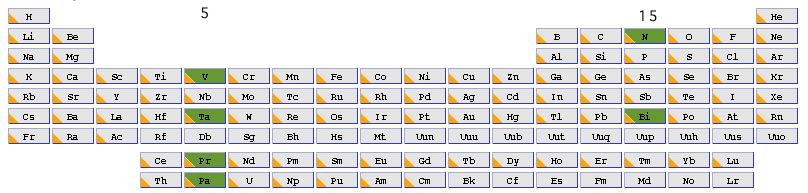
Nitrogen is in the main group 15, and the element at the bottom of this group is Bismuth (also with the same atomic configuration). We can then move to the corresponding column of the transition series, this time occupying group 5. The first examplar in this set, Vanadium has an atomic configuration of 3d3, 4s2, again five valence electrons, but now utilizing the d- rather than the p-shell of valence atomic orbitals (AOs). The final forage across the period table would land us with Pr and Pa, which occupy the lanthanide and actinide series respectively, and which have atomic configurations of 4f3, 6s2 and 5f2, 6d1 and 7s2 respectively. You can now see the theme developing; how does the bonding develop between two atoms that between them have ten valence electrons occupying molecular orbitals constructed from s, and then either p, d or f atomic orbitals. The next in that series, g atomic orbitals, are thought unlikely to have any chemical significance in the presently known periodic table.
(more…)
Tags:chemical significance, diatomic nitrogen gas, energy, Interesting chemistry, pence, stable MO, The 100th anniversary of G. N. Lewis' famous electron pair theory of bonding, Vanadium
Posted in Interesting chemistry | 3 Comments »
Saturday, July 4th, 2009
An earlier post described how a (spherical) halide anion fitted snugly into a cavity generated by the simple molecule propanone, itself assembled by sodium cations coordinating to the oxygen. A recent elaboration of this theme, reminiscent of the children’s toys where objects have to be fitted into the only cavity that matches their shape, Nitschke and co-workers report the creation of a molecule with a tetrahedral rather than a spherical cavity (DOI: 10.1126/science.1175313 ), into which another but much smaller tetrahedral molecule is fitted. The small molecule is P4, in which each of the three valencies of the P atom is directed to a corner of the tetrahedron. The large molecule comprises four Fe atoms. These are each octahedrally coordinated with six ligand sites, three of which mimic the P atoms in also being directed towards the remaining three vertices of a tetrahedron.
(more…)
Tags:cavity, Interesting chemistry, pence, tetrahedral
Posted in Interesting chemistry | 1 Comment »
Saturday, June 6th, 2009
The iconic diagram below represents a cornerstone of organic chemistry. Generations of chemists have learnt early on in their studies of the subject that these two representations of where the electron pairs in benzene might be located (formally called electronic resonance or valence bond forms) each contribute ~50% to the overall wavefunction, and that the real electronic description is in effect an average of these two (that is the implied meaning of the double headed arrow). This means that the six C-C bonds in benzene must all be of equal length. The diagrams, everyone knows, do not mean that benzene has three short and three long C-C bonds.
(more…)
Tags:energy, energy levels, higher energy, Interesting chemistry, π-electron resonance energy, π-energy, π-resonance energy, pseudo Jahn-Teller, resonance energy, so-called energy degenerate orbital
Posted in Interesting chemistry | 16 Comments »