Archive for the ‘Chemical IT’ Category
Wednesday, August 6th, 2014
I do go on a lot about the importance of having modern access to data. And so the appearance of this article[1] immediately struck me as important. It is appropriately enough in the new journal Scientific Data. The data contain computed properties at the B3LYP/6-31G(2df,p) level for 133,885 species with up to nine heavy atoms, and the entire data set has its own DOI[2]. The data is generated by subjecting a molecule set to a number of validation protocols, including obtaining relaxed (optimised) geometries at the B3LYP/6-31G(2df,p) level. It would be good to replicate this set with inclusion of a functional that also includes dispersion, and of course making the coordinates all available in this manner greatly facilitates this. The collection also includes data for e.g. 6095 constitutional isomers of C7H10O2, which reminds me of an early, delightfully entitled, article adopting such an approach in quantum chemistry[3]. Such collections are an important part of the process of validating computational methods[4] This way of publishing data does raise some interesting discussion points.
(more…)
References
- R. Ramakrishnan, P.O. Dral, M. Rupp, and O.A. von Lilienfeld, "Quantum chemistry structures and properties of 134 kilo molecules", Scientific Data, vol. 1, 2014. https://doi.org/10.1038/sdata.2014.22
- Raghunathan Ramakrishnan., P. Dral, P.O. Dral, M. Rupp, and O. Anatole Von Lilienfeld., "Quantum chemistry structures and properties of 134 kilo molecules", 2014. https://doi.org/10.6084/m9.figshare.978904
- P.P. Bera, K.W. Sattelmeyer, M. Saunders, H.F. Schaefer, and P.V.R. Schleyer, "Mindless Chemistry", The Journal of Physical Chemistry A, vol. 110, pp. 4287-4290, 2006. https://doi.org/10.1021/jp057107z
- P. Murray-Rust, H.S. Rzepa, J.J.P. Stewart, and Y. Zhang, "A global resource for computational chemistry", Journal of Molecular Modeling, vol. 11, pp. 532-541, 2005. https://doi.org/10.1007/s00894-005-0278-1
Tags:Much software, validation protocols
Posted in Chemical IT | 5 Comments »
Saturday, July 19th, 2014
Whilst clusters of carbon atoms are well-known, my eye was caught by a recent article describing the detection of a cluster of boron atoms, B40 to be specific.[1] My interest was in how the σ and π-electrons were partitioned. In a C40, one can reliably predict that each carbon would contribute precisely one π-electron. But boron, being more electropositive, does not always play like that. Having one electron less per atom, one might imagine that a fullerene-like boron cluster would have no π-electrons. But the element has a propensity[2] to promote its σ-electrons into the π-manifold, leaving a σ-hole. So how many π-electrons does B40 have? These sorts of clusters are difficult to build using regular structure editors, and so coordinates are essential. The starting point for a set of coordinates with which to compute a wavefunction was the supporting information. Here is the relevant page: 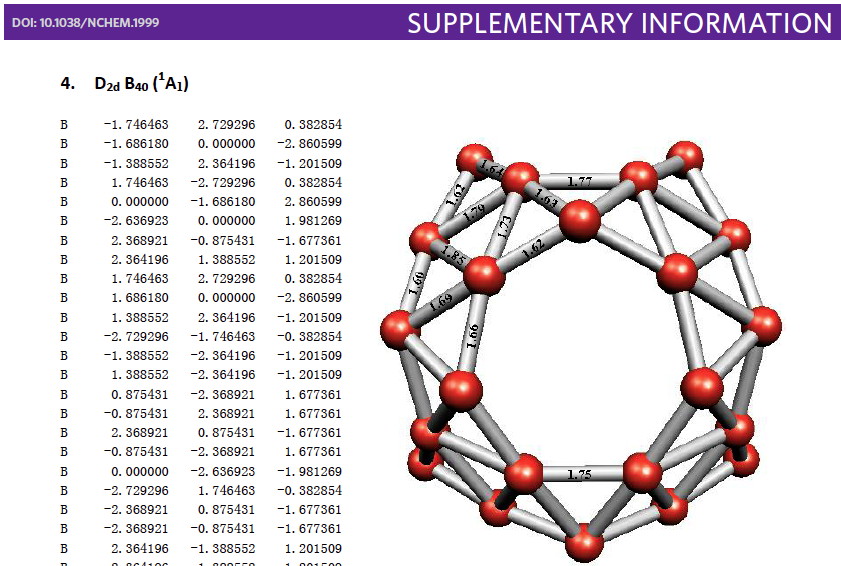 The coordinates are certainly there (that is not always the case), but you have to know a few tricks to make them usable.
(more…)
References
- H. Zhai, Y. Zhao, W. Li, Q. Chen, H. Bai, H. Hu, Z.A. Piazza, W. Tian, H. Lu, Y. Wu, Y. Mu, G. Wei, Z. Liu, J. Li, S. Li, and L. Wang, "Observation of an all-boron fullerene", Nature Chemistry, vol. 6, pp. 727-731, 2014. https://doi.org/10.1038/nchem.1999
- H.S. Rzepa, "The distortivity of π-electrons in conjugated boron rings", Physical Chemistry Chemical Physics, vol. 11, pp. 10042, 2009. https://doi.org/10.1039/b911817a
Tags:Acrobat, Adobe, chemical markup, DOS, operating systems, PDF, pence, Unix
Posted in Chemical IT, Interesting chemistry | 2 Comments »
Thursday, July 3rd, 2014
Increasingly, our access to scientific information is becoming a research topic in itself. Thus an analysis of big deal journal bundles[1] has attracted much interesting commentary (including one from a large scientific publisher[2]). In the UK, our funding councils have been pro-active in promoting the so-called GOLD publishing model, where the authors (aided by grants from their own institution or others) pay the perpetual up-front publication costs (more precisely the costs demanded by the publishers, which is not necessarily the same thing) so that their article is removed from the normal subscription pay wall erected by the publisher and becomes accessible to anyone. As the proportion of GOLD content increases, it was anticipated (hoped?) that the costs of accessing the remaining non-GOLD articles via a pay-walled subscription would decrease.
(more…)
References
- T.C. Bergstrom, P.N. Courant, R.P. McAfee, and M.A. Williams, "Evaluating big deal journal bundles", Proceedings of the National Academy of Sciences, vol. 111, pp. 9425-9430, 2014. https://doi.org/10.1073/pnas.1403006111
- C. Woolston, "Secret publishing deals exposed", Nature, vol. 510, pp. 447-447, 2014. https://doi.org/10.1038/510447f
Tags:GBP, typical article processing charge ranges, United Kingdom
Posted in Chemical IT, General | 8 Comments »
Sunday, June 8th, 2014
A word of explanation about this test page for experimenting with JSmol. Many moons ago I posted about how to include a generated 3D molecular model in a blog post, and have used that method on many posts here ever since. It relied on Java as the underlying software (first introduced in 1996), or almost 20 years ago. Like most software technologies, much has changed, and Java itself (as a compiled language) has had to move to improve its underlying security. In the last year, the Java code itself (in this case Jmol) has needed to be digitally signed in a standard manner, and this meant that many an old site that used unsigned older versions has started to throw up increasingly alarming messages.
(more…)
Tags:Bob Hanson, Java, JavaScript, Jim Hu, software technologies, Takanori Nakane, wonderful technology
Posted in Chemical IT | 1 Comment »
Saturday, May 17th, 2014
I remember a time when tracking down a particular property of a specified molecule was an all day effort, spent in the central library (or further afield). Then came the likes of STN Online (~1980) and later Beilstein. But only if your institution had a subscription. Let me then cut to the chase: consider this URL: http://search.datacite.org/ui?q=InChIKey%3DLQPOSWKBQVCBKS-PGMHMLKASA-N The site is datacite, which collects metadata about cited data! Most of that data is open in the sense that it can be retrieved without a subscription (but see here that it is not always made easy to do so). So, the above is a search for cited data which contains the InChIkey LQPOSWKBQVCBKS-PGMHMLKASA-N. This produces the result:
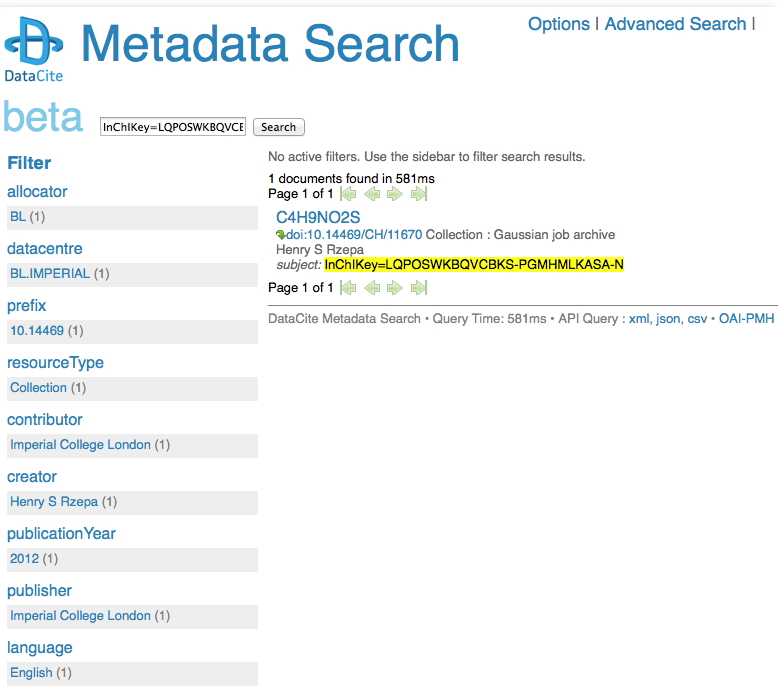
This tells you who published the data (but oddly, its date is merely to the nearest year? It is beta software after all). The advanced equivalent of this search looks like this:
(more…)
Tags:beta software, generic data search, molecular search engines, search engine, search engine optimisation, search looks, software agents
Posted in Chemical IT | No Comments »
Monday, May 5th, 2014
My name is displayed pretty prominently on this blog, but it is not always easy to find out who the real person is behind many a blog. In science, I am troubled by such anonymity. Well, a new era is about to hit us. When you come across an Internet resource, or an opinion/review of some scientific topic, I argue here that you should immediately ask: “what is its provenance?”
(more…)
Tags:0000-0002-8635-8390, added value site, API, Internet resource, ORCiD, programmer, United Kingdom
Posted in Chemical IT | No Comments »
Wednesday, April 30th, 2014
I love experiments where the insight-to-time-taken ratio is high. This one pertains to exploring the coordination chemistry of the transition metal region of the periodic table; specifically the tetra-coordination of the series headed by Mn-Ni. Is the geometry tetrahedral, square planar, or other? One can get a statistical answer in about ten minutes.
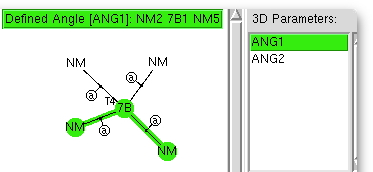 The (CCDC database) search definition required is shown above. The central atom defines the column of the period table, it is specified to have precisely four other atoms bonded to it, which can be any other element. These four bonds are specified as acyclic (to avoid any bias introduced by rings). And two angles are defined subtending the central atom. And off we go, defining on the way that the hits must be refined to an R-factor of < 0.05, have no disorder, and no errors.
(more…)
Tags:data, Pt[/caption] Square, search definition, transition metal region
Posted in Chemical IT, crystal_structure_mining, General | No Comments »
Tuesday, March 18th, 2014
OK, you have to be British to understand the pun in the title, a famous comedy skit about four candles. Back to science, and my mention of some crystal data now having a DOI in the previous post. I thought it might be fun to replicate the contents of one of my ACS slides here.
(more…)
Tags:ACS, DOI, Google, Handle, JSON, LOCATT
Posted in Chemical IT | 5 Comments »