The two previous surveys of the potential energy surface for this, it has to be said, rather obscure reaction led to energy barriers that were rather to high to be entirely convincing. So here is a third possibility.
Archive for the ‘reaction mechanism’ Category
The Willgerodt-Kindler Reaction: mechanistic reality check 3. A peek under the hood for transition state location.
Thursday, August 27th, 2020The Willgerodt-Kindler Reaction: mechanistic reality check 2.
Friday, August 14th, 2020Continuing an exploration of the mechanism of this reaction, an alternative new mechanism was suggested in 1989 (having been first submitted to the journal ten years earlier!).[1] Here the key intermediate proposed is a thiirenium cation (labelled 8 in the article) and labelled Int3 below.
References
- M. Carmack, "The willgerodt‐kindler reactions. 7. The mechanisms", Journal of Heterocyclic Chemistry, vol. 26, pp. 1319-1323, 1989. https://doi.org/10.1002/jhet.5570260518
The Willgerodt-Kindler Reaction: mechanistic reality check 1.
Tuesday, July 21st, 2020The Willgerodt reaction[1], discovered in 1887 and shown below, represents a transformation with a once famously obscure mechanism. A major step in the elucidation of that mechanism came[2] using the then new technique of 14C radio-labelling, shortly after the atom bomb projects during WWII made 14CO2 readily available to researchers. Here I am going to start the process of applying the far more recent technique of quantitative quantum mechanical modelling to see if some of the proposed mechanisms stand up to its scrutiny.
References
- C. Willgerodt, "Ueber die Einwirkung von gelbem Schwefelammonium auf Ketone und Chinone", Berichte der deutschen chemischen Gesellschaft, vol. 20, pp. 2467-2470, 1887. https://doi.org/10.1002/cber.18870200278
- W.G. Dauben, J.C. Reid, P.E. Yankwich, and M. Calvin, "The Mechanism of the Willgerodt Reaction<sup>1</sup>", Journal of the American Chemical Society, vol. 72, pp. 121-124, 1950. https://doi.org/10.1021/ja01157a034
Curly arrows in the 21st Century. Proton-coupled electron transfers.
Wednesday, June 10th, 2020One of the most fascinating and important articles dealing with curly arrows I have seen is that by Klein and Knizia on the topic of C-H bond activations using an iron catalyst.[1] These are so-called high spin systems with unpaired electrons and the mechanism of C-H activation involves both double headed (two electron) and fish-hook (single electron) movement. Here I focus on a specific type of reaction, the concerted proton-coupled-electron transfer or cPCET, as illustrated below. These sorts of reactions happen also to be of considerable biological importance, including e.g. the mechanism of photosynthesis and many other important transformations.
References
- J.E.M.N. Klein, and G. Knizia, "cPCET versus HAT: A Direct Theoretical Method for Distinguishing X–H Bond‐Activation Mechanisms", Angewandte Chemie International Edition, vol. 57, pp. 11913-11917, 2018. https://doi.org/10.1002/anie.201805511
Choreographing a chemical ballet: what happens if you change one of the actors?
Friday, May 8th, 2020Earlier, I explored the choreography or “timing”, of what might be described as the curly arrows for a typical taught reaction mechanism, the 1,4-addition of a nucleophile to an unsaturated carbonyl compound (scheme 1). I am now going to explore the consequences of changing one of the actors by adding the nucleophile to an unsaturated imine rather than carbonyl compound (scheme 2).
Discussion of (the) Room-temperature chemical synthesis of dicarbon – open and transparent science.
Wednesday, May 6th, 2020A little more than a year ago, a ChemRxiv pre-print appeared bearing the title referenced in this post,[1] which immediately piqued my curiosity. The report presented persuasive evidence, in the form of trapping experiments, that dicarbon or C2 had been formed by the following chemical synthesis. Here I describe some of what happened next, since it perhaps gives some insight into the processes of bringing a scientific result into the open.
References
- K. Miyamoto, S. Narita, Y. Masumoto, T. Hashishin, M. Kimura, M. Ochiai, and M. Uchiyama, "Room-Temperature Chemical Synthesis of C2", 2019. https://doi.org/10.26434/chemrxiv.8009633.v1
A databank of molecular dynamics reaction trajectories (DDT) focused on undergraduate teaching.
Wednesday, April 22nd, 2020In a previous post, I talked about a library of reaction pathway intrinsic reaction coordinates (IRCs) containing 115 examples of organic and organometallic reactions. Now (thanks Dean!) I have been alerted to a brand new databank of dynamics trajectories (DDT), with the focus on those reactions taught in undergraduate organic chemistry courses, some of which are shown below.
Choreographing a chemical ballet: a story of the mechanism of 1,4-Michael addition.
Monday, April 13th, 2020A reaction can be thought of as molecular dancers performing moves. A choreographer is needed to organise the performance into the ballet that is a reaction mechanism. Here I explore another facet of the Michael addition of a nucleophile to a conjugated carbonyl compound. The performers this time are p-toluene thiol playing the role of nucleophile, adding to but-2-enal (green) acting as the electrophile and with either water or ammonia serving the role of a catalytic base to help things along.†
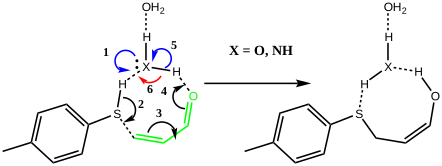
Substituent effects on the mechanism of Michael 1,4-Nucleophilic addition.
Sunday, March 29th, 2020In the previous post, I looked at the mechanism for 1,4-nucleophilic addition to an activated alkene (the Michael reaction). The model nucleophile was malonaldehyde after deprotonation and the model electrophile was acrolein (prop-2-enal), with the rate determining transition state being carbon-carbon bond formation between the two, accompanied by proton transfer to the oxygen of the acrolein.
The mechanism of Michael 1,4-Nucleophilic addition: a computationally derived reaction pathway.
Wednesday, March 25th, 2020In 2013, I created an iTunesU library of 115 mechanistic types in organic and organometallic chemistry, illustrated using video animations of the intrinsic reaction coordinate (IRC) computed using a high level quantum mechanical procedure. Many of those examples first derived from posts here. That collection is still available and is viewable in the iTunesU app on an iPhone or an iPad. The realisation struck me now‡ that one of the types not described in that library was Michael-type 1,4-nucleophilic addition to an activated alkene, as described at Wikipedia. So here is that addition.