In the previous post, I found intriguing the mechanism by which methane (CH4) inverts by transposing two of its hydrogens. Here I take a look at silane, SiH4.
Archive for the ‘reaction mechanism’ Category
How does silane invert (its configuration)?
Thursday, March 16th, 2017How does methane invert (its configuration)?
Thursday, March 16th, 2017This is a spin-off from the table I constructed here for further chemical examples of the classical/non-classical norbornyl cation conundrum. One possible entry would include the transition state for inversion of methane via a square planar geometry as compared with e.g. NiH4 for which the square planar motif is its minimum. So is square planar methane a true transition state for inversion (of configuration) of carbon?
Forming a stabilized m-benzyne.
Friday, January 20th, 2017The story so far. Inspired by the report of the most polar neutral compound yet made, I suggested some candidates based on the azulene ring system that if made might be even more polar. This then led to considering a smaller π-analogue of azulene, m-benzyne. Here I ponder how a derivative of this molecule might be made, using computational profiling as one reality check.
The smallest C-C-C angle?
Monday, October 31st, 2016Is asking a question such as “what is the smallest angle subtended at a chain of three connected 4-coordinate carbon atoms” just seeking another chemical record, or could it unearth interesting chemistry?
σ or π nucleophilic reactivity of imines? A mechanistic reality check using substituents.
Sunday, October 9th, 2016Previously, a mechanistic twist to the oxidation of imines using peracid had emerged. Time to see how substituents respond to this mechanism.
σ or π nucleophilic reactivity of imines? A mechanistic twist emerges.
Wednesday, September 28th, 2016The story so far. Imines react with a peracid to form either a nitrone (σ-nucleophile) or an oxaziridine (π-nucleophile).[1] The balance between the two is on an experimental knife-edge, being strongly influenced by substituents on the imine. Modelling these reactions using the “normal” mechanism for peracid oxidation did not reproduce this knife-edge, with ΔΔG (π-σ) 16.2 kcal/mol being rather too far from a fine balance.
References
- D.R. Boyd, P.B. Coulter, N.D. Sharma, W. Jennings, and V.E. Wilson, "Normal, abnormal and pseudo-abnormal reaction pathways for the imine-peroxyacid reaction", Tetrahedron Letters, vol. 26, pp. 1673-1676, 1985. https://doi.org/10.1016/s0040-4039(00)98582-4
σ or π? The ambident nucleophilic reactivity of imines: crystallographic and computational reality checks.
Wednesday, September 21st, 2016Nucleophiles are species that seek to react with an electron deficient centre by donating a lone or a π-bond pair of electrons. The ambident variety has two or more such possible sources in the same molecule, an example of which might be hydroxylamine or H2NOH. I previously discussed how for this example, the energetics allow the nitrogen lone pair (Lp) to win out over the O Lp. Here, I play a similar game, but this time setting an NLp up against a π-pair.
Molecule orbitals as indicators of reactivity: bromoallene.
Thursday, September 1st, 2016Bromoallene is a pretty simple molecule, with two non-equivalent double bonds. How might it react with an electrophile, say dimethyldioxirane (DMDO) to form an epoxide?[1] Here I explore the difference between two different and very simple approaches to predicting its reactivity. 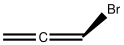
References
- D. Christopher Braddock, A. Mahtey, H.S. Rzepa, and A.J.P. White, "Stable bromoallene oxides", Chemical Communications, vol. 52, pp. 11219-11222, 2016. https://doi.org/10.1039/c6cc06395k
An alternative mechanism for nucleophilic substitution at silicon using a tetra-alkyl ammonium fluoride.
Friday, May 27th, 2016In the previous post, I explored the mechanism for nucleophilic substitution at a silicon centre proceeding via retention of configuration involving a Berry-like pseudorotation. Here I probe an alternative route involving inversion of configuration at the Si centre. Both stereochemical modes are known to occur, depending on the leaving group, solvent and other factors.[1],[2],[3]
References
- L. Wozniak, M. Cypryk, J. Chojnowski, and G. Lanneau, "Optically active silyl esters of phosphorus. II. Stereochemistry of reactions with nucleophiles", Tetrahedron, vol. 45, pp. 4403-4414, 1989. https://doi.org/10.1016/s0040-4020(01)89077-3
- L.H. Sommer, and H. Fujimoto, "Stereochemistry of asymmetric silicon. X. Solvent and reagent effects on stereochemistry crossover in alkoxy-alkoxy exchange reactions at silicon centers", Journal of the American Chemical Society, vol. 90, pp. 982-987, 1968. https://doi.org/10.1021/ja01006a024
- D.N. Roark, and L.H. Sommer, "Dramatic stereochemistry crossover to retention of configuration with angle-strained asymmetric silicon", Journal of the American Chemical Society, vol. 95, pp. 969-971, 1973. https://doi.org/10.1021/ja00784a081