Text books will announce that during aromatic electrophilic substitution, aromaticity is lost by the formation of a Wheland intermediate (and regained by eliminating a proton). Is that entirely true?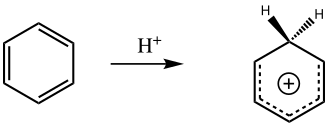
Author Archive
Does forming a Wheland intermediate disrupt all aromaticity?
Friday, December 6th, 2013A curly-arrow pushing manual
Wednesday, December 4th, 2013I have several times used arrow pushing on these blogs. But since the rules for this convention appear to be largely informal, and there appears to be no definitive statement of them, I thought I would try to produce this for our students. This effort is here shared on my blog. It is what I refer to as the standard version; an advanced version is in preparation. Such formality might come as a surprise to some; arrow-pushing is often regarded as far too approximate to succumb to any definition, although it is of course often examined.
Avoided (pericyclic) anti-aromaticity: Reactions of t-butyl-hydroxycarbene.
Wednesday, November 13th, 2013Not long ago, I described a cyclic carbene in which elevating the carbene lone pair into a π-system transformed it from a formally 4n-antiaromatic π-cycle into a 4n+2 aromatic π-cycle. From an entirely different area of chemistry, another example of this behaviour emerges; Schreiner’s[1] trapping and reactions of t-butyl-hydroxycarbene, as described on Steve Bachrach’s blog. A point I often make is that chemistry is all about connections, and so here I will discuss such a connection.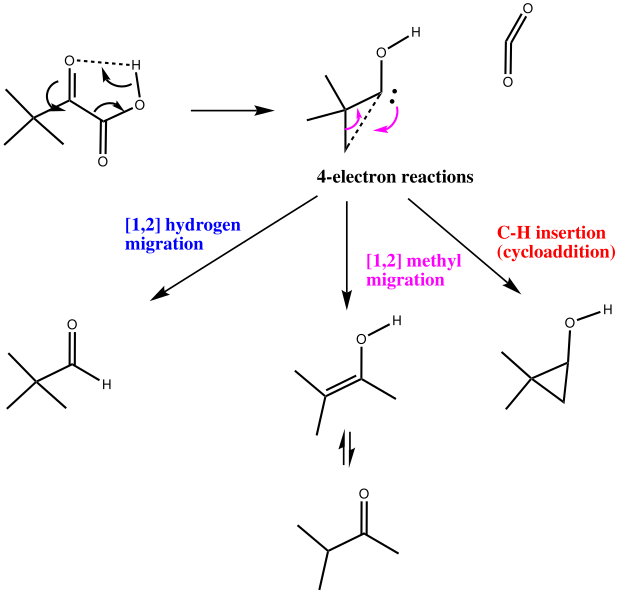
References
- D. Ley, D. Gerbig, and P.R. Schreiner, "Tunneling control of chemical reactions: C–H insertion versus H-tunneling in tert-butylhydroxycarbene", Chem. Sci., vol. 4, pp. 677-684, 2013. https://doi.org/10.1039/c2sc21555a
Multiple personalities of Magnesium.
Tuesday, November 5th, 2013The following is a short question in a problem sheet associated with introductory organic chemistry.
Kinetic vs thermodynamic enolization.
Tuesday, November 5th, 2013The concept of kinetic vs thermodynamic control of a reaction is often taught in the context of the enolisation of e.g. 1-methylcyclohexanone as induced by a base. The story goes that at low temperatures (-78°C), the rate of the sterically more hindered thermodynamic enolisation does not compete with the faster kinetic product but that at higher temperatures when an equilibrium is possible, the thermodynamically more stable tetrasubstituted enol is formed. I set out to see if this result can be modelled.
The world ash tree of the computer hardware industry… crystalline silicon from 1854.
Thursday, October 31st, 2013The element silicon best represents the digital era of the mid 20th century to the present; without its crystalline form, there would be no computers (or this blog). Although it was first prepared in pure amorphous (powder) form around 1823[1] by Berzelius, it was not until 1854 that Henri Sainte-Claire Deville made it in crystalline form, using metallic aluminium to isolate it. He described it [1] as having a “metallic luster”.