Author Archive

Web page decay and Journals: How an interactive “ESI” from 2006 was rescued.

Friday, August 12th, 2022

In 2006[1] we published an article illustrating various types of pseudorotations in small molecules. It’s been cited 20 times since then, so reasonable interest! We described rotations known as Lever and Turnstile as well as the better known Berry mode. Because the differences between these rotations are quite subtle, we included an interactive electronic supporting information to illustrate them. That ESI was written in HTML and used Jmol to animate the rotations. Now, 16 years is a long time in the Web ecosystem (some early wag suggested, like dogs, that one year in normal time approximates to about 7 years in Web time) and inevitably, like e.g. both Rasmol[2] and Chime before it, Jmol no longer works when invoked from a Web browser; Java applets are very much dead and we are now on the fourth generation of molecule viewer, JSmol. Two days ago I was contacted by someone (thanks Peter!) who had noticed that the journal landing page did not seem to point to any ESI. Here I tell the story of what happened next.

(more…)

References

  1. H.S. Rzepa, and M.E. Cass, "A Computational Study of the Nondissociative Mechanisms that Interchange Apical and Equatorial Atoms in Square Pyramidal Molecules", Inorganic Chemistry, vol. 45, pp. 3958-3963, 2006. https://doi.org/10.1021/ic0519988
  2. O. Casher, G.K. Chandramohan, M.J. Hargreaves, C. Leach, P. Murray-Rust, H.S. Rzepa, R. Sayle, and B.J. Whitaker, "Hyperactive molecules and the World-Wide-Web information system", Journal of the Chemical Society, Perkin Transactions 2, pp. 7, 1995. https://doi.org/10.1039/p29950000007
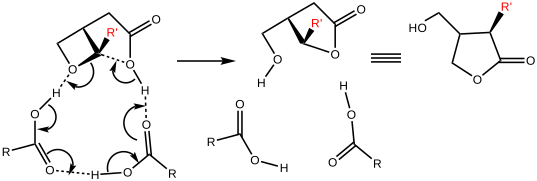
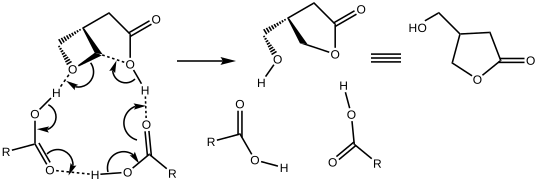
Unexpected Isomerization of Oxetane-Carboxylic Acids – a viable mechanism

Friday, August 12th, 2022

In the previous post, I looked at the intramolecular rearrangement of the oxetane carboxylic acid to a lactone, finding the barrier to the Sn2 reaction with retention was unfeasibly high. Here I explore alternatives.

(more…)

Unexpected Isomerization of Oxetane-Carboxylic Acids – a first look at the mechanism

Sunday, August 7th, 2022

Derek Lowe’s blog has a recent post entitled A Downside to Oxetane Acids which picks up on a recent article[1] describing how these acids are unexpectedly unstable, isomerising to a lactone at a significant rate without the apparent need for any catalyst. This is important because these types of compound occur frequently in the medicinal chemistry literature.

(more…)

References

  1. B. Chalyk, A. Grynyova, K. Filimonova, T.V. Rudenko, D. Dibchak, and P.K. Mykhailiuk, "Unexpected Isomerization of Oxetane-Carboxylic Acids", Organic Letters, vol. 24, pp. 4722-4728, 2022. https://doi.org/10.1021/acs.orglett.2c01402

Personal Impressions from WATOC 2020 – Dispersion and non Born-Oppenheimer models.

Monday, July 11th, 2022

WATOC 2020 was just held in 2022 in Vancouver Canada, over one week. With many lectures held in parallel, it is not possible for one person to cover anything like the topics presented, so this is a personal view of some of those talks that I attended. As happens with many such events, common themes gradually emerge and here I highlight just two that struck me as important for the future of computational chemistry.

(more…)

Dioxane tetraketone – an ACS molecule of the week with a mystery.

Wednesday, June 22nd, 2022

I have long been fascinated by polymers of either carbon dioxide, or carbon monoxide, or combinations of both. One such molecule, referred to as dioxane tetraketone when it was featured on the ACS molecule-of-the-week site and also known as the anhydride of oxalic acid, or more formally 1,4-dioxane-2,3,5,6-tetraone, has been speculated upon for more than a century.[1]

(more…)

References

  1. H. Staudinger, "Oxalylchlorid", Berichte der deutschen chemischen Gesellschaft, vol. 41, pp. 3558-3566, 1908. https://doi.org/10.1002/cber.19080410335

Checking a conclusion we made in 1987: Tetrahedral intermediates formed by nitrogen and oxygen attack of aromatic hydroxylamines on acetyl cyanide

Saturday, June 11th, 2022

Minds (and memories) can work in wonderful ways. In 1987[1] we were looking at the properties of “stable” tetrahedral intermediates formed in carbonyl group reactions. The reaction involved adding phenylhydroxylamine to acetyl cyanide. NMR signals for two new species were detected, and we surmised one was due to N-attack on the carbonyl and one was due to O-attack, in each case to form a stable tetrahedral intermediate. To try to identify which was which, 15N labelled hydroxylamine was used and then the 15N-13C coupling constants were measured, which could either be 1-bondJ (for N-attack) or 2-bondJ (for O-attack).

(more…)

References

  1. A.M. Lobo, M.M. Marques, S. Prabhakar, and H.S. Rzepa, "Tetrahedral intermediates formed by nitrogen and oxygen attack of aromatic hydroxylamines on acetyl cyanide", The Journal of Organic Chemistry, vol. 52, pp. 2925-2927, 1987. https://doi.org/10.1021/jo00389a050

3-Methyl-5-phenylpyrazole: a crystallographic enigma?

Thursday, May 19th, 2022

Previously, I explored the unusual structure of a molecule with a hydrogen bonded interaction between a phenol and a pyridine. The crystal structure name was RAKQOJ and it had been reported as having almost symmetrical N…H…O hydrogen bonds. This feature had been determined using neutron diffraction crystallography, which is thought very reliable at determining proton positions. Another compound with these characteristics is 3-methyl-5-phenylpyrazole or MEPHPY01.[1] Here the neutron study showed it to apparently have the structure represented below, where the solid N-H lines indicate a proton equidistant between two nitrogens.

(more…)

References

  1. F.H. Moore, A.H. White, and A.C. Willis, "3-Methyl-5-phenylpyrazole: a neutron diffraction study", Journal of the Chemical Society, Perkin Transactions 2, pp. 1068, 1975. https://doi.org/10.1039/p29750001068

Geometries of proton transfers: modelled using total energy or free energy?

Monday, April 18th, 2022

Proton transfers are amongst the most common of all chemical reactions. They are often thought of as “trivial” and even may not feature in many mechanistic schemes, other than perhaps the notation “PT”. The types with the lowest energy barriers for transfer often involve heteroatoms such as N and O, and the conventional transition state might be supposed to be when the proton is located at about the half way distance between the two heteroatoms. This should be the energy high point between the two positions for the proton. But what if a crystal structure is determined with the proton in exactly this position? Well, the first hypothesis is that using X-rays as the diffracting radiation is unreliable, because protons scatter x-rays very poorly. Then a more arduous neutron diffraction study is sometimes undertaken, which is generally assumed to be more reliable in determining the position of the proton. Just such a study was undertaken for the structure shown below (RAKQOJ)[1], dataDOI: 10.5517/cc57db3 for the 80K determination. The substituents had been selected to try to maximise the symmetry of the O…H…N motif via pKa tuning (for another tuning attempt, see this blog). The more general landscape this molecule fits into[2] is shown below:

(more…)

References

  1. T. Steiner, I. Majerz, and C.C. Wilson, "First O−H−N Hydrogen Bond with a Centered Proton Obtained by Thermally Induced Proton Migration", Angewandte Chemie International Edition, vol. 40, pp. 2651-2654, 2001. https://doi.org/10.1002/1521-3773(20010716)40:14<2651::aid-anie2651>3.0.co;2-2
  2. I. Majerz, and M.J. Gutmann, "Mechanism of proton transfer in the strong OHN intermolecular hydrogen bond", RSC Advances, vol. 1, pp. 219, 2011. https://doi.org/10.1039/c1ra00219h

C2N2: a 10-electron four-atom molecule displaying both Hückel 4n+2 and Baird 4n selection rules for ring aromaticity.

Thursday, April 7th, 2022

The previous examples of four atom systems displaying two layers of aromaticity illustrated how 4 (B4), 8 (C4) and 12 (N4) valence electrons were partitioned into 4n+2 manifolds (respectively 2+2, 6+2 and 6+6). The triplet state molecule B2C2 with 6 electrons partitioned into 2π and 4σ electrons, with the latter following Baird’s aromaticity rule.[1],[2]. Now for the final missing entry; as a triplet C2N2 has 10 electrons, which now partition into 4 + 6. But would that be 4π + 6σ or 4σ + 6π? Well, in a way neither! Read on.

(more…)

References

  1. N.C. Baird, "Quantum organic photochemistry. II. Resonance and aromaticity in the lowest 3.pi..pi.* state of cyclic hydrocarbons", Journal of the American Chemical Society, vol. 94, pp. 4941-4948, 1972. https://doi.org/10.1021/ja00769a025
  2. M. Rosenberg, C. Dahlstrand, K. Kilså, and H. Ottosson, "Excited State Aromaticity and Antiaromaticity: Opportunities for Photophysical and Photochemical Rationalizations", Chemical Reviews, vol. 114, pp. 5379-5425, 2014. https://doi.org/10.1021/cr300471v

Raw data and the evolution of crystallographic FAIR data. Journals, processed and raw structure data.

Monday, March 28th, 2022

In my previous post on the topic, I introduced the concept that data can come in several forms, most commonly as “raw” or primary data and as a “processed” version of this data that has added value. In crystallography, the chemist is interested in this processed version, carried by a CIF file. However on rare occasions when a query arises about the processed component, this can in principle at least be resolved by taking a look at the original raw data, expressed as diffraction images. I established with much appreciated help from CCDC that since 2016, around 65 datasets in the CSD (Cambridge structural database) have appeared with such associated raw data. The problem is easily reconciling the two sets of data (the raw data is not stored on CSD) and one way of doing this is via the metadata associated with the datasets. In turn, if this metadata is suitably registered, one can query the metadata store for such associations, as was illustrated in the previous post on the topic. Here I explore the metadata records for five of these 65 sets to find out their properties, selected to illustrate the five data repositories thus far that host such data for compounds in the CSD database.

(more…)