In 1993-1994, when the Web (synonymous in most minds now with the Internet) was still young, the pace of progress was so rapid that some wag worked out that one “web-year” was like a dog-year, worth about 7 years of normal human time. So in this respect, 1994 is now some 133 web-years ago. Long enough for an archaeological excavation.
Author Archive
Internet Archaeology: Blasts from the past.
Friday, October 11th, 2013A short non-bonding H…H interaction (continued)
Wednesday, October 2nd, 2013This is a continuation of the discussion started on Steve Bachrach’s blog about a molecule with a very short H…H interaction involving two Si-H groups with enforced proximity. It had been inferred from the X-ray structure[1] that the H…H distance was in the region of 1.50Å. It’s that cis-butene all over again! So is that H…H region a bond? Is it attractive or repulsive? Go read Steve’s blog first.
References
- J. Zong, J.T. Mague, and R.A. Pascal, "Exceptional Steric Congestion in an <i>in</i>,<i>in</i>-Bis(hydrosilane)", Journal of the American Chemical Society, vol. 135, pp. 13235-13237, 2013. https://doi.org/10.1021/ja407398w
Publishing a procedure with a doi.
Wednesday, October 2nd, 2013In the two-publisher model I proposed a post or so back, I showed an example of how data can be incorporated (transcluded) into the story narrative of a scientific article, with both that story and the data each having their own independently citable reference (using a doi for the citation). Here I take it a step further, by publishing a functional procedure in a digital repository[1] and assigned its own doi:10.6084/m9.figshare.811862.
References
- H.S. Rzepa, "Script for creating an NCI surface as a JVXL compressed file from a (Gaussian) cube of total electron density", 2013. https://doi.org/10.6084/m9.figshare.811862
An example of an extreme gauche effect: FSSF.
Saturday, September 21st, 2013The best known example of the gauche effect is 1,2-difluoroethane, which exhibits a relatively small preference of ~0.5 kcal/mol for this conformer over the anti orientation, which is also a minimum. But FSSF, which I discussed in the previous post, beats this hands down! It also, by the way, must surely be the smallest molecule (only four atoms) which could be theoretically resolved into two enantiomers (possibly at say 273K?).‡
Patterns of behaviour: serendipity in action for enantiomerisation of F-S-S-Cl
Thursday, September 19th, 2013Paul Schleyer sent me an email about a pattern he had spotted, between my post on F3SSF and some work he and Michael Mauksch had done 13 years ago with the intriguing title “Demonstration of Chiral Enantiomerization in a Four-Atom Molecule“.[1] Let me explain the connection, but also to follow-up further on what I discovered in that post and how a new connection evolved.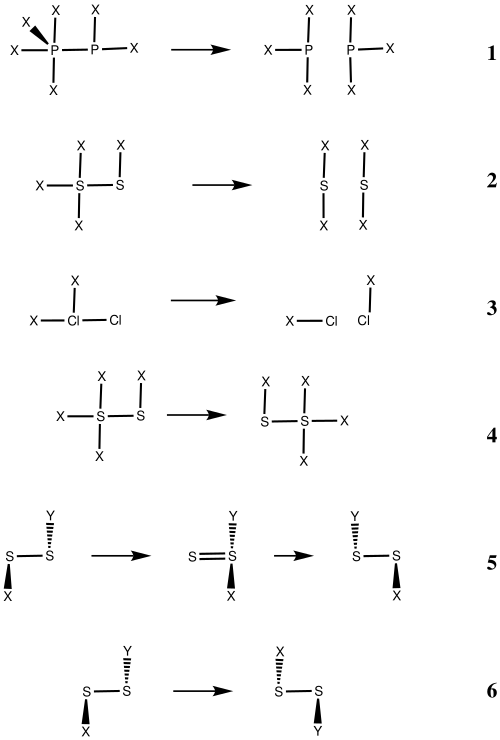
References
A two-publisher model for the scientific article: narrative+shared data.
Sunday, September 15th, 2013I do go on rather a lot about enabling or hyper-activating[1] data. So do others[2]. Why is sharing data important?
References
- O. Casher, G.K. Chandramohan, M.J. Hargreaves, C. Leach, P. Murray-Rust, H.S. Rzepa, R. Sayle, and B.J. Whitaker, "Hyperactive molecules and the World-Wide-Web information system", Journal of the Chemical Society, Perkin Transactions 2, pp. 7, 1995. https://doi.org/10.1039/p29950000007
- R. Van Noorden, "Data-sharing: Everything on display", Nature, vol. 500, pp. 243-245, 2013. https://doi.org/10.1038/nj7461-243a
The dimer of SF2: small is beautiful (and weird).
Thursday, September 12th, 2013Andy Extance at the Chemistry World blog has picked up on a fascinating article[1] on the dimer of SF2. This molecule has three F atoms on one S, and only one on the other; FSSF3. But all four S-F bonds are of different length. Lindquist and Dunning claim that the minimum energy pathway to dissociation to two SF2 molecules does not involve breaking either the longest or the weakest SF bond. This was too much for me to resist investigating further!
References
- B.A. Lindquist, and T.H. Dunning, "Bonding in FSSF<sub>3</sub>: Breakdown in Bond Length-Strength Correlations and Implications for SF<sub>2</sub> Dimerization", The Journal of Physical Chemistry Letters, vol. 4, pp. 3139-3143, 2013. https://doi.org/10.1021/jz401578h
Coarctate reactions as a third fundamental organic-mechanistic type.
Wednesday, September 4th, 2013According to Herges[1],[2] the mechanism of single-step (concerted) reactions can be divided into three basic types; linear (e.g. substitution, elimination etc), pericyclic (e.g. Diels Alder) and a third much rarer, and hence very often overlooked type that was named coarctate. This is based on the topology of bond redistribution patterns, an explicit real example[3] illustrating:
References
- R. Herges, "Coarctate transition states: the discovery of a reaction principle", Journal of Chemical Information and Computer Sciences, vol. 34, pp. 91-102, 1994. https://doi.org/10.1021/ci00017a011
- B.S. Young, R. Herges, and M.M. Haley, "Coarctate cyclization reactions: a primer", Chemical Communications, vol. 48, pp. 9441, 2012. https://doi.org/10.1039/c2cc34026g
- C. Berger, C. Bresler, U. Dilger, D. Geuenich, R. Herges, H. Röttele, and G. Schröder, "A Spontaneous Fragmentation: From the Criegee Zwitterion to Coarctate Möbius Aromaticity", Angewandte Chemie International Edition, vol. 37, pp. 1850-1853, 1998. https://doi.org/10.1002/(sici)1521-3773(19980803)37:13/14<1850::aid-anie1850>3.0.co;2-b
Experimental evidence for “hidden intermediates”? Epoxidation of ethene by peracid.
Sunday, August 25th, 2013The concept of a “hidden intermediate” in a reaction pathway has been promoted by Dieter Cremer[1] and much invoked on this blog. When I used this term in a recent article of ours[2], a referee tried to object, saying it was not in common use in chemistry. The term clearly has an image problem. A colleague recently sent me an article to read (thanks Chris!) about isotope effects in the epoxidation of ethene[3] and there I discovered a nice example of hidden intermediates which I share with you now.
References
- E. Kraka, and D. Cremer, "Computational Analysis of the Mechanism of Chemical Reactions in Terms of Reaction Phases: Hidden Intermediates and Hidden Transition States", Accounts of Chemical Research, vol. 43, pp. 591-601, 2010. https://doi.org/10.1021/ar900013p
- H.S. Rzepa, and C. Wentrup, "Mechanistic Diversity in Thermal Fragmentation Reactions: A Computational Exploration of CO and CO<sub>2</sub> Extrusions from Five-Membered Rings", The Journal of Organic Chemistry, vol. 78, pp. 7565-7574, 2013. https://doi.org/10.1021/jo401146k
- T. Koerner, H. Slebocka-Tilk, and R.S. Brown, "Experimental Investigation of the Primary and Secondary Deuterium Kinetic Isotope Effects for Epoxidation of Alkenes and Ethylene with <i>m</i>-Chloroperoxybenzoic Acid", The Journal of Organic Chemistry, vol. 64, pp. 196-201, 1998. https://doi.org/10.1021/jo981652x
Full-colour 3D printing of molecular models and orbitals (wavefunctions).
Sunday, August 18th, 2013We have been experimenting with full-colour 3D printing of molecular objects. I thought I might here share some of our observations. Firstly, I list the software used: