Theoretical Explanation.
Our story starts with Évariste Galois (1811-1832) who founded the theory based on the symmetries of permutations which we now know as group theory. The original explanation of Woodward and Hoffmann based on the nature of the highest occupied molecular orbitals was formalised with the help of Galois' group theory by Longuet-Higgins and Abrahamson (DOI: 10.1021/ja01087a033, see also 10.1021/ja01087a033). This involved generating a so called orbital correlation diagram for the reaction under consideration, and then carrying out the reaction in such a manner that the group theoretical symmetries of the reactant and product orbitals matched exactly. Such an approach, whilst theoretically more rigorous, is not readily applicable to the majority of more complex reactions which have no formal symmetry. Two much simpler methods have been subsequently outlined which avoid this problem. The first these, based on transition state aromaticity, will be expanded in more detail, whilst the second (based on frontier orbitals) will only be described briefly at the end of this lecture.

1. Conservation of Orbital Symmetry (Longuet-Higgins and Abrahamson)

Let us first define the symmetry properties of a 1s and a 2p orbital with respect to a plane of symmetry or an axis of symmetry as shown below;
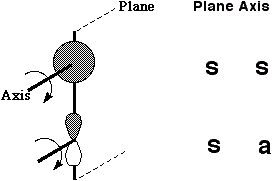
1s and 2p orbitals

One can take this one step further by considering the symmetry properties of molecular orbitals formed by the overlap of two or more atomic orbitals;

MOs formed from two overlapping σ orbitals:
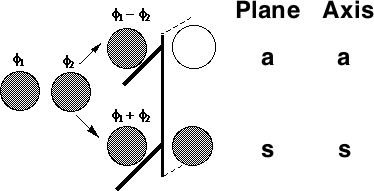
MOs formed from two overlapping σ orbitals

MOs formed from two overlapping p-orbitals (σ bonds):
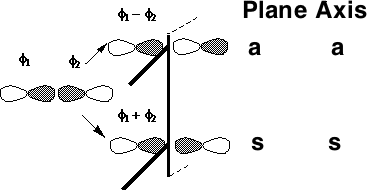
MOs formed from two overlapping p orbitals

MOs formed from two parallel overlapping p-orbitals (π bonds):
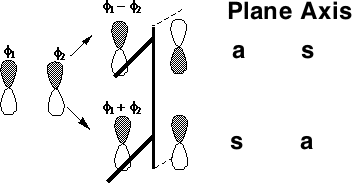
MOs formed from two parallel overlapping p orbitals

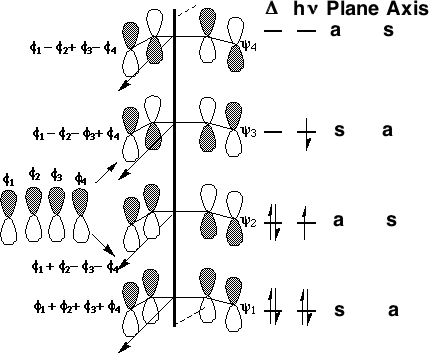
We can now use these basic orbitals to construct the relevant molecular orbitals for two interconverting molecules, cyclobutene and butadiene, with the purpose of following how these two sets of orbitals change when one molecule is converted into the other. Note particularly that we need only construct the MOs explicitly involved in the reaction; most of the σ framework remains unchanged and no orbitals derived from this need to be considered:
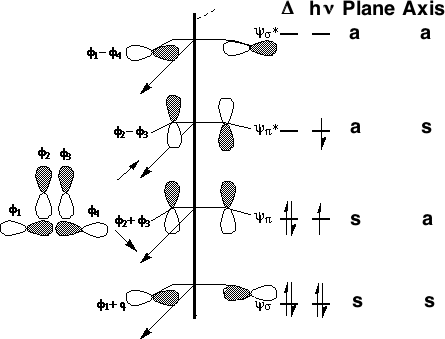

In order to interconvert cyclobutene and butadiene, the four MOs labelled ψ1, ψ2, ψ3, ψ4 must be converted into ψσ, ψπ, ψπ*, ψσ*. There are two stereochemically distinct ways in which this might be accomplished;
Conrotation:
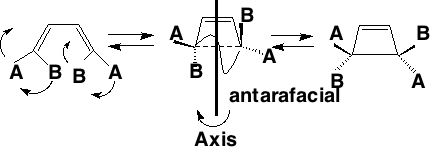
conrotation

Disrotation:
disrotation

This enables a correlation diagram for the reaction to be constructed, according to the following rules: no two orbitals of the same symmetry can cross during the reaction, whilst orbitals of different symmetry can cross. The favoured pathway is the one which results in a product of the same electronic excitation as the reactant (green).
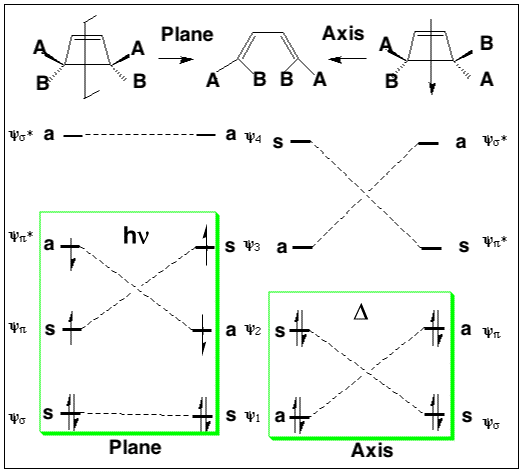
orbital correlation

Pathways which result in the product being formed in a higher electronic state than the reactant are said to be "forbidden" (red).
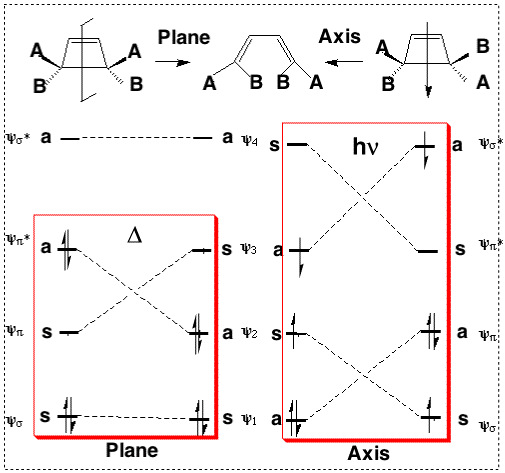
orbital correlation

Whilst this rule is normally followed fairly well for ground states, it can be overturned when for example steric or geometrical strain in the "allowed" pathway promotes the "forbidden" route. The situation is actually more complex for photochemical reactions, and much recent evidence suggests that the Woodward-Hoffmann rules are not always followed. These correlation diagrams can be generalised for any electrocyclic reaction with appropriate symmetry. However, correlation diagrams are less readily applied for reactions with no symmetry. Dewar and Zimmerman independently noticed that the 'topological' properties of these correlation diagrams are very similar to those obtained using eg Hückel theory for aromatic molecules. For example, the diagram for the electrocyclic conversion of hexatriene to cyclohexadiene is remarkably similar at the transition state to the ground state orbitals of benzene;

hexatriene

2. Alternative Approach: Transition State Aromaticity (Dewar and Zimmermann)

2.1. Hückel Aromatics

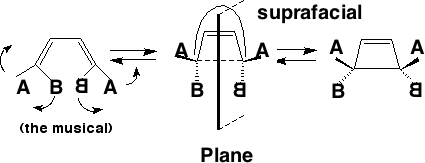
The suprafacial mode orbital correlation diagram for hexatriene can be generalised by reference to benzene, the archetypical aromatic molecule. The benzene molecule has this suprafacial topology, by which we mean that the π-electron density in benzene is cyclically continuous along the top and the bottom face of the molecule. In mathematics, this type of topological object is known as a two component torus link with a linking number of zero (explore links and knots here or here)

If the transition state for the pericyclic reaction has the same orbital nodal or derived π-electron density topology, it is said to be a "Hückel" system, in honour of Erich Hückel who first indicated why a molecule such as benzene should be especially stable (and also, as it happens, was also the first to formalise the separation of σ and π electrons).

A suprafacial or Hückel transition state in a pericyclic reaction is associated with an (idealized) plane of symmetry and this arrangement is particularly stable (=aromatic) if the number of cyclically conjugated π electrons in the transition state equals 4n+2 (the Hückel rule, where n = 0, 1, 2 etc. A rule incidentally not actually formulated by Hückel but by the organic chemist William von Doering, see DOI: 10.1021/ja01146a537). The advantage of this approach is that aromaticity is quite stable to (small to medium) perturbations to the symmetry of the system, and hence can be applied to unsymmetric pericyclic reactions (which of course are in the majority, see also here).

Some time after Hückel, it was shown that if a cyclic conjugated π system is irradiated with light so that it goes into the first excited (triplet) electronic state, stability (aromaticity) is associated with 4n (rather than 4n+2) cyclically conjugated π-electrons. Hence photochemically activated pericyclic reactions will proceed suprafacially via a Hückel transition state if the electron count corresponds to 4n.

2.2. Möbius Aromatics (Heilbronner)


The antarafacial mode described above is said to resemble "Möbius" topology, after August Ferdinand Möbius, who invented the famous strips (as did Johann Benedict Listing). An antarafacial mode can be formed by taking a cyclic alkene "strip" and giving its π-electron system a 180° (half) twist (and in doing create a two-fold axis of symmetry in the resulting molecule). Edgar Heilbronner in 1964 worked out that such a twisted system would be a closed shell molecule (later shown to be also aromatic) if it contained 4n conjugated π electrons.

The first explicit example of such a molecule was suggested in 1998, for the molecule C9H9+ (which has 8 cyclically conjugated π-electrons and is a 4n system, where n=2). It has π-orbitals that have quite different features from those of benzene. It is now recognized (DOI: 10.1039/b810301a) that the orbitals in such a system cannot be considered singly, but must be regarded in pairs. A topological analysis of such a pair results in an object known as a torus knot, which corresponds to a cyclically continuous band of electron density making two complete cycles of the ring, with a linking number of one (the specific name of the knot here is actually unknot) and which exhibits dissymetric chirality. In 2003, a crystalline Mobius annulene was first made (DOI: 10.1021/cr030092l) and quite a number of Mobius systems have been identified from 2006 onwards.

Just as with excited state Hückel aromatics, Möbius molecules in the excited (actually triplet) state are also thought to be aromatic if they contain 4n+2 rather than 4n π electrons. An article describing the above concepts in greater detail is available here.

2.3. Lemniscular or Double-twist Möbius Rings (Rzepa)

In 2005, the Möbius approach was extended to rings created by imparting two half-twists to a cyclic array of 2p-AOs. They are equivalent to molecules with two antarafacial components, but components which do not cancel each other. They retain the C2 axis axis of symmetry (in fact they can have three such axes). Such systems, like the single half-twist topology, are also chiral (disymmetric). The molecular orbitals (and the electron density) take the form of 212 torus links having linking numbers of two, and these often exhibit figure-8 (lemniscular) shapes (See DOI: 10.1039/b510508k and 10.1021/ol0518333).

It was recently recognized that this figure-eight is stabilized by a topological property known as writhe (or in molecular biology, supercoiling), which makes such geometries far more likely and accessible than they otherwise would be (DOI: 10.1021/ja710438j). Systems with up to six half twists have now been identified (DOI: 10.1021/ic800987f) and there is also a fascinating link to biological molecules known as cyclic or supercoiled DNA (DOI: 10.1016/j.cub.2006.02.029). Another bit of coiled helical fun!

These four types of aromaticity are most easily summarised by selection rules.

The Pericyclic Reaction Selection Rules

Condition+ Electron count+ Stereochemistry ⇒Aromatic transition state
Heat (Δ)4n+2Suprafacial (or two antarafacial)Hückel (or double twist Möbius)
Heat (Δ)4nOne (or three) antarafacialMöbius
Light (hν)4n+2One (or three) antarafacialMöbius
Light (hν)4nSuprafacial (or two antarafacial)Hückel (or double twist Möbius)

Another useful mnemonic for remembering the basic rules is due to Frost, Musulin and Zimmermann, formulated in this form in 1965:

3. Alternative Approach: The Frontier Orbital Method (Fukui)

(The following is optional and is intended for use in tutorials). This involves using the principles of quantum mechanics to generate the Highest Occupied Molecular Orbital (HOMO) and the Lowest Unoccupied Molecular Orbital (LUMO) for the reactant(s). The formation of the new σ bond must occur by appropriate overlap of the nodes of these orbitals. If only one σ bond is forming, as in an electrocyclic reaction, then only the overlap of the HOMO of the reactant is considered. Such overlap can occur in one of two fundamental ways; The suprafacial mode involves each component of the new σ bond being formed from the SAME face of the reactant π system. See DOI: 10.1016/S0040-4039(01)83901-0.

The antarafacial mode involves a 'twisting' of the orbitals so that the two components of the new σ bond come from OPPOSITE faces of the reactant π system. If two or more σ bonds form during the reaction, as in cycloaddition reactions, then the overlap of the HOMO of one reactant with the LUMO of the second reactant must be considered. For simple systems, the form of the HOMO and LUMO is not difficult to remember. For more complex systems, explicit calculations have to be carried out and the Frontier Orbital method becomes more difficult to apply. The advantage of the "FMO" method is that it can be expressed quantitatively in terms of the magnitude of the coefficients involved, and can hence be used to predict regioselectivity etc.

4. Modern Approach: The Transition State Potential Energy Surface Method

The next level of theory beyond the FMO method involves the explicit location of the pericyclic transition state using a Quantum Mechanical method. A complete worked example of such modelling of a pericylic reaction can be seen here (and is dealt with in detail in another lecture course).