Its a bit like a jigsaw puzzle in reverse, finding out to disassemble a chemical reaction into the pieces it is made from, and learning the rules that such reaction jigsaws follow. The following takes about 45-50 minutes to follow through with a group of students.
Posts Tagged ‘Reaction Mechanism’
Secrets of a university tutor: dissection of a reaction mechanism.
Wednesday, January 25th, 2012Mechanism of the reduction of a carboxylic acid by borane: revisited and revised.
Sunday, October 16th, 2011I asked a while back whether blogs could be considered a serious form of scholarly scientific communication (and so has Peter Murray-Rust more recently). A case for doing so might be my post of about a year ago, addressing why borane reduces a carboxylic acid, but not its ester, where I suggested a possible mechanism. Well, colleagues have raised some interesting questions, both on the blog itself and more silently by email to me. As a result, I have tried to address some of these questions, and accordingly my original scheme needs some revision! This sort of iterative process of getting to the truth with the help of the community (a kind of crowd-sourced chemistry) is where I feel blogs do have a genuine role to play.
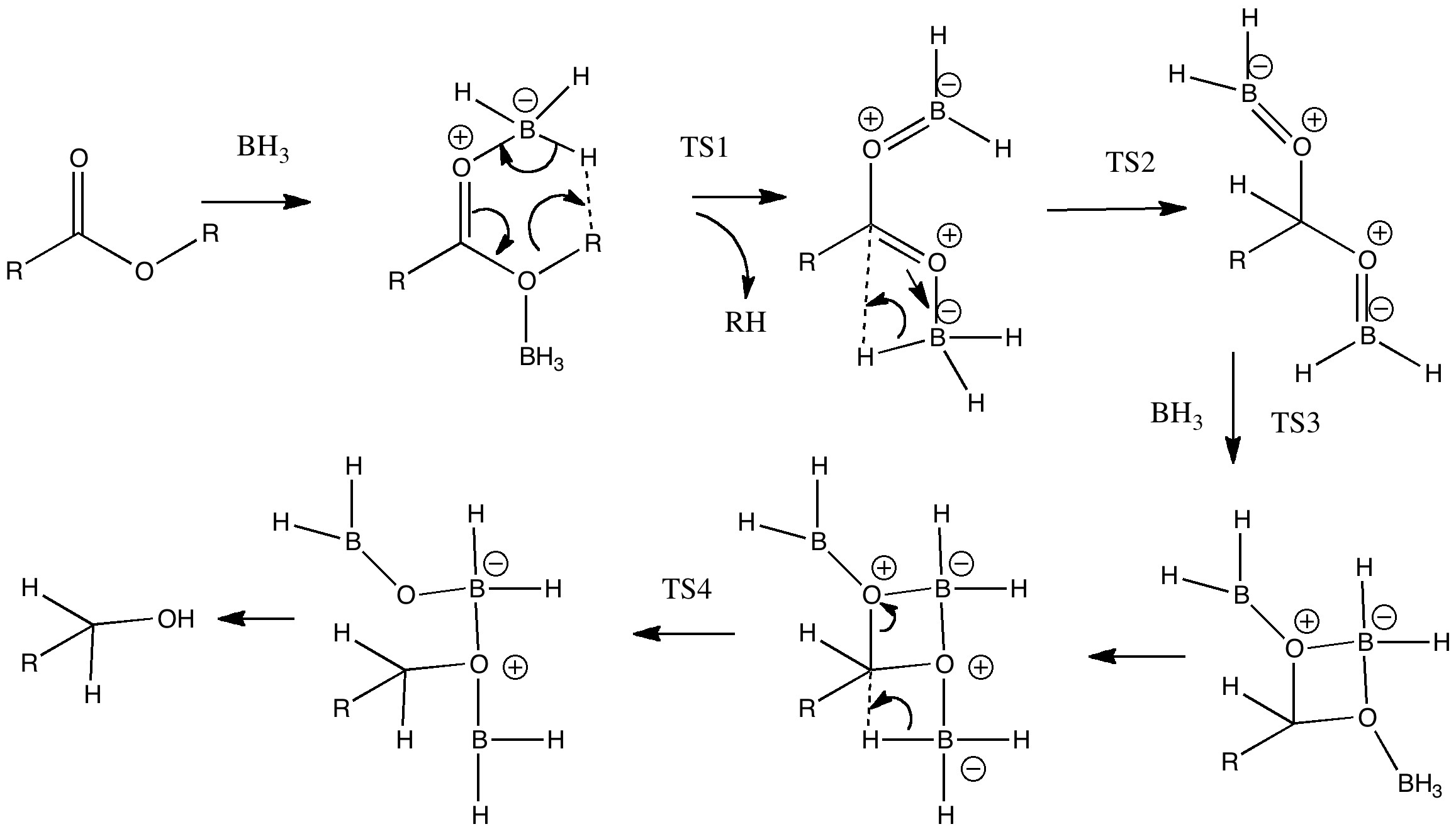
The reduction of a carboxylic acid by borane
Secrets of a university tutor: (curly) arrow pushing
Thursday, October 28th, 2010Curly arrows are something most students of chemistry meet fairly early on. They rapidly become hard-wired into the chemists brain. They are also uncontroversial! Or are they? Consider the following very simple scheme.
A Disrotatory 4n+2 electron anti-aromatic Möbius transition state for a thermal electrocyclic reaction.
Thursday, April 2nd, 2009Mauksch and Tsogoeva have recently published an article illustrating how a thermal electrocyclic reaction can proceed with distoratory ring closure, whilst simultaneously also exhibiting 4n electron Möbius-aromatic character[1]. Why is this remarkable? Because the simple Woodward-Hoffmann rules state that a disrotatory thermal electrocyclic reaction should proceed via a Hückel-aromatic 4n+2 electron transition state. Famously, Woodward and Hoffmann stated there were no exceptions to this rule. Yet here we apparently have one! So what is the more fundamental? The disrotatory character, or the 4n/Möbius character in the example above? Mauksch and Tsogoeva are in no doubt; it is the former that gives, and the latter is correct.
References
- M. Mauksch, and S. Tsogoeva, "A Preferred Disrotatory 4<i>n</i> Electron Möbius Aromatic Transition State for a Thermal Electrocyclic Reaction", Angewandte Chemie International Edition, vol. 48, pp. 2959-2963, 2009. https://doi.org/10.1002/anie.200806009