The discussion appended to the post on curly arrows is continued here. Recollect the curly arrow diagram (in modern style) derived from Robinson’s original suggestion:
Posts Tagged ‘Tutorial material’
The first ever curly arrows. And now for something completely different.
Saturday, July 21st, 2012The first curly arrows…lead to this?
Friday, July 20th, 2012Little did I imagine, when I discovered the original example of using curly arrows to express mechanism, that the molecule described there might be rather too anarchic to use in my introductory tutorials on organic chemistry. Why? It simply breaks the (it has to be said to some extent informal) rules! Consider the dimerisation of nitrosomethane (in fact a well-known equilibrium).
The first ever curly arrows.
Friday, July 20th, 2012I was first taught curly arrow pushing in 1968, and have myself taught it to many a generation of student since. But the other day, I learnt something new. Nick Greeves was kind enough to send me this link‡to the origin of curly arrow pushing in organic chemistry, where the following diagram is shown and Alan Dronsfield sent me two articles he co-wrote on the topic (T. M. Brown, A. T. Dronsfield and P. J. T Morris, Education in Chemistry, 2001, 38, 102-104, 107 and 2003, 40, 129-134);† thanks to both of them.
The direct approach is not always the best: ethene + dichlorocarbene
Tuesday, June 12th, 2012The reaction between a carbene and an alkene to form a cyclopropane is about as simple a reaction as one can get. But I discussed before how simple little molecules (cyclopropenyl anion) can hold surprises. So consider this reaction:
The mechanism (in 4D) of the reaction between thionyl chloride and a carboxylic acid.
Friday, May 25th, 2012If you have not previously visited, take a look at Nick Greeves’ ChemTube3D , an ever-expanding gallery of reactions and their mechanisms. The 3D is because all molecules are offered with X, Y and z coordinates. You also get arrow pushing‡ in 3D. Here, I argue that we should adopt Einstein, and go to the space-time continuum! By this, I mean one must also include the order in which things happen. To my knowledge, no compendium of (organic) reaction mechanisms incorporates this 4th dimension. My prelude to this post nicely illustrated this latter aspect. Here I continue with an exploration of the mechanism of forming an acyl chloride from a carboxylic acid using thionyl chloride. The mechanism shown at ChemTube3D is as below and will now be tested for its reasonableness using quantum mechanics.
Surprises (?) in the addition of HCl to a carbonyl group.
Thursday, May 24th, 2012HCl reacting with a carbonyl compound (say formaldehyde) sounds pretty simple. But often the simpler a thing looks, the more subtle it is under the skin. And this little reaction is actually my prelude to the next post.
Mechanism of the diazomethane alkylation of a carboxylic acid.
Saturday, May 19th, 2012Many reaction mechanisms involve a combination of bond formation/cleavage between two non-hydrogen atoms and those involving reorganisation of proximate hydrogens. The Baeyer-Villiger discussed previously illustrated a complex dance between the two types. Here I take a look at another such mechanism, the methylation of a carboxylic acid by diazomethane.
The mechanism of the Baeyer-Villiger rearrangement.
Monday, May 7th, 2012The Baeyer-Villiger rearrangement was named after its discoverers, who in 1899 described the transformation of menthone into the corresponding lactone using Caro’s acid (peroxysulfuric acid). The mechanism is described in all text books of organic chemistry as involving an alkyl migration. Here I take a look at the scheme described by Alvarez-Idaboy, Reyes and Mora-Diez[1], and which may well not yet have made it to all the text books!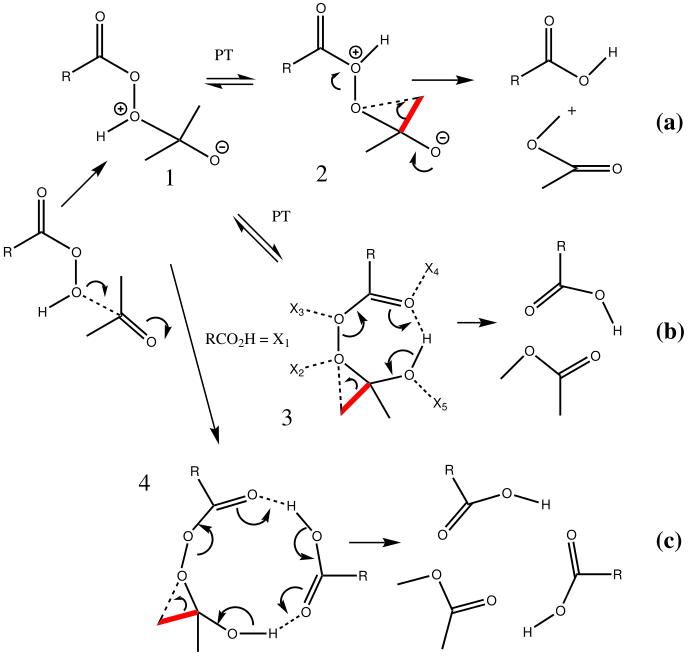
References
- J.R. Alvarez-Idaboy, L. Reyes, and N. Mora-Diez, "The mechanism of the Baeyer–Villiger rearrangement: quantum chemistry and TST study supported by experimental kinetic data", Organic & Biomolecular Chemistry, vol. 5, pp. 3682, 2007. https://doi.org/10.1039/b712608e