Posts Tagged ‘Reaction Mechanism’
Sunday, October 28th, 2012
The reaction described in the previous post (below) is an unusual example of nucleophilic attack at an sp2-carbon centre, reportedly resulting in inversion of configuration[1]. One can break it down to a sequence of up to eight individual steps, which makes teaching it far easier. But how real is that sequence?
(more…)
References
- T.C. Clarke, and R.G. Bergman, "Olefinic cyclization at a vinyl cation center. Inversion preference for intramolecular nucleophilic substitution by a double bond", Journal of the American Chemical Society, vol. 94, pp. 3627-3629, 1972. https://doi.org/10.1021/ja00765a062
Tags:immediate product, inversion, Reaction Mechanism, triflate leaving, Tutorial material, vinyl carbocation
Posted in Interesting chemistry | 1 Comment »
Saturday, October 27th, 2012
The reaction below plays a special role in my career. As a newly appointed researcher (way back now), I was asked to take tutorial groups for organic chemistry as part of my duties. I sat down to devise a suitable challenge for the group, and came upon the following reaction[1]. I wrote it down on page 2 of my tutorial book, which I still have. I continue to use this example in tutorials to this day, some 35 years later.
(more…)
References
- T.C. Clarke, and R.G. Bergman, "Olefinic cyclization at a vinyl cation center. Inversion preference for intramolecular nucleophilic substitution by a double bond", Journal of the American Chemical Society, vol. 94, pp. 3627-3629, 1972. https://doi.org/10.1021/ja00765a062
Tags:chemical knowledge, Reaction Mechanism, researcher, Tutorial material
Posted in Uncategorised | 1 Comment »
Monday, October 8th, 2012
Metathesis reactions are a series of catalysed transformations which transpose the atoms in alkenes or alkynes. Alkyne metathesis is closely related to the same reaction for alkenes, and one catalyst that is specific to alkynes was introduced by Schrock (who with Grubbs won the Nobel prize for these discoveries) and is based on tungsten (M=W(OR)3).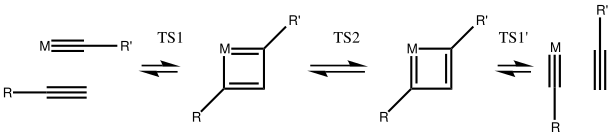
(more…)
Tags:Reaction Mechanism, X-ray
Posted in Interesting chemistry | No Comments »
Tuesday, September 25th, 2012
This is the follow-up to the previous post exploring a typical nucleophilic addition-elimination reaction. Here is the elimination step, which as before requires proton transfers. We again adopt a cyclic mechanism to try to avoid the build up of charge separation during those proton movements.
(more…)
Tags:Reaction Mechanism, Tutorial material
Posted in Uncategorised | 4 Comments »
Wednesday, September 19th, 2012
The four-electron thermal cycloaddition (in reverse a cheletropic elimination) of dichlorocarbene to ethene is a classic example of a forbidden pericyclic process taking a roundabout route to avoid directly violating the Woodward-Hoffmann rules. However, a thermal six-electron process normally does take the direct route, as in for example the Diels-Alder cycloaddition as Houk and co have recently showed using molecular dynamics[1]. So can one contrive a six-electron cycloaddition involving dichlorocarbene?
(more…)
References
- K. Black, P. Liu, L. Xu, C. Doubleday, and K.N. Houk, "Dynamics, transition states, and timing of bond formation in Diels–Alder reactions", Proceedings of the National Academy of Sciences, vol. 109, pp. 12860-12865, 2012. https://doi.org/10.1073/pnas.1209316109
Tags:asynchronous, Houk and co, pericyclic, Reaction Mechanism
Posted in Uncategorised | 1 Comment »
Saturday, September 15th, 2012
Semibullvalene is an unsettling molecule. Whilst it has a classical structure describable by a combination of Lewis-style two electron and four electron bonds, its NMR behaviour reveals it to be highly fluxional. This means that even at low temperatures, the position of these two-electron bonds rapidly shifts in the equilibrium shown below. Nevertheless, this dynamic behaviour can be frozen out at sufficiently low temperatures. But the barrier was sufficiently low that a challenge was set; could one achieve a system in which the barrier was removed entirely, to freeze out the coordinates of the molecule into a structure where the transition state (shown at the top) became instead a true minimum (bottom)? A similar challenge had been set for freezing out the transition state for the Sn2 reaction into a minimum, the topic also of a more recent post here. Here I explore how close we might be to achieving inversion of the semibullvalene [3,3] sigmatropic potential.
(more…)
Tags:candidate for synthesis perhaps, energy, pericyclic, Postscript, Reaction Mechanism
Posted in Interesting chemistry | 3 Comments »