The layout of floor 2 of the chemistry department here contains a number of small rooms which function as tutorial areas. Each has a (non-interactive) whiteboard used by students and tutors for, inter-alia, thought-showering. It was in one such room that I found myself with three colleagues this monday afternoon. We soon all sensed something not quite right about the room; it slowly dawned that the whiteboard was entirely devoid of thoughts (it is normally left adorned with chemical hieroglyphics). Before we departed, one of our number crept up to the board and showered the following (the red bit only followed by a ?; thanks Willie!). The chemistry equivalent you might say of Guerrilla gardening. The product shown in blue below is for your benefit here. It is an example of a double fragmentation reaction; by an odd coincidence following on nicely from the previous post.
More stereo electronics: the Eschenmoser double fragmentation and guerrilla tutorials.
December 10th, 2015A tutorial problem in stereoelectronic control. A Grob alternative to the Tiffeneau-Demjanov rearrangement?
November 28th, 2015In answering tutorial problems, students often need skills in deciding how much time to spend on explaining what does not happen, as well as what does. Here I explore alternatives to the mechanism outlined in the previous post to see what computation has to say about what does (or might) not happen.
A tutorial problem in stereoelectronic control. The Tiffeneau-Demjanov rearrangement as part of a prostaglandin synthesis.
November 23rd, 2015This reaction emerged a few years ago (thanks Alan!) as a tutorial problem in organic chemistry, in which students had to devise a mechanism for the reaction and use this to predict the stereochemical outcome at the two chiral centres indicated with *. It originates in a brief report from R. B. Woodward’s group in 1973 describing a prostaglandin synthesis,[1] the stereochemical outcome being crucial. Here I take a look at this mechanism using computation.
References
- R.B. Woodward, J. Gosteli, I. Ernest, R.J. Friary, G. Nestler, H. Raman, R. Sitrin, C. Suter, and J.K. Whitesell, "Novel synthesis of prostaglandin F2.alpha.", Journal of the American Chemical Society, vol. 95, pp. 6853-6855, 1973. https://doi.org/10.1021/ja00801a066
The roles of water in the hydrolysis of an acetal.
November 18th, 2015In the previous post, I pondered how a substituent (X below) might act to slow down the hydrolysis of an acetal. Here I extend that by probing the role of water molecules in the mechanism of acetal hydrolysis.
How to stop (some) acetals hydrolysing.
November 12th, 2015Derek Lowe has a recent post entitled "Another Funny-Looking Structure Comes Through". He cites a recent medchem article[1] in which the following acetal sub-structure appears in a promising drug candidate (blue component below). His point is that orally taken drugs have to survive acid (green below) encountered in the stomach, and acetals are famously sensitive to hydrolysis (red below). But if X=NH2, compound "G-5555" is apparently stable to acids.[1] So I pose the question here; why?
References
- C.O. Ndubaku, J.J. Crawford, J. Drobnick, I. Aliagas, D. Campbell, P. Dong, L.M. Dornan, S. Duron, J. Epler, L. Gazzard, C.E. Heise, K.P. Hoeflich, D. Jakubiak, H. La, W. Lee, B. Lin, J.P. Lyssikatos, J. Maksimoska, R. Marmorstein, L.J. Murray, T. O’Brien, A. Oh, S. Ramaswamy, W. Wang, X. Zhao, Y. Zhong, E. Blackwood, and J. Rudolph, "Design of Selective PAK1 Inhibitor G-5555: Improving Properties by Employing an Unorthodox Low-p <i>K</i> <sub>a</sub> Polar Moiety", ACS Medicinal Chemistry Letters, vol. 6, pp. 1241-1246, 2015. https://doi.org/10.1021/acsmedchemlett.5b00398
Interactions responsible for the lowest energy structure of the trimer of fluoroethanol.
October 23rd, 2015Steve Bachrach on his own blog has commented on a recent article[1] discussing the structure of the trimer of fluoroethanol. Rather than the expected triangular form with three OH—O hydrogen bonds, the lowest energy form only had two such bonds, but it matched the microwave data much better. Here I explore this a bit more.
References
- J. Thomas, X. Liu, W. Jäger, and Y. Xu, "Unusual H‐Bond Topology and Bifurcated H‐bonds in the 2‐Fluoroethanol Trimer", Angewandte Chemie International Edition, vol. 54, pp. 11711-11715, 2015. https://doi.org/10.1002/anie.201505934
Pierre and Marie Curie.
October 23rd, 2015I have previously shown the grave of William Perkin, a great british organic chemist. On a recent visit to Paris, I went to see the crypt in the Panthéon, the great french secular necropolis. What a contrast to Perkin!
Impressions of China 2: The colour of porcelain.
October 14th, 2015In Jingdezhen an Imperial Kiln was built in 1369 to produce porcelain that was “white as jade, thin as paper, bright as a mirror and tuneful as a bell”. It’s the colours of the glazes that caught my eye, achieved by a combination of oxidative and reductive firing in the kiln, coupled with exquisite control of the temperature.
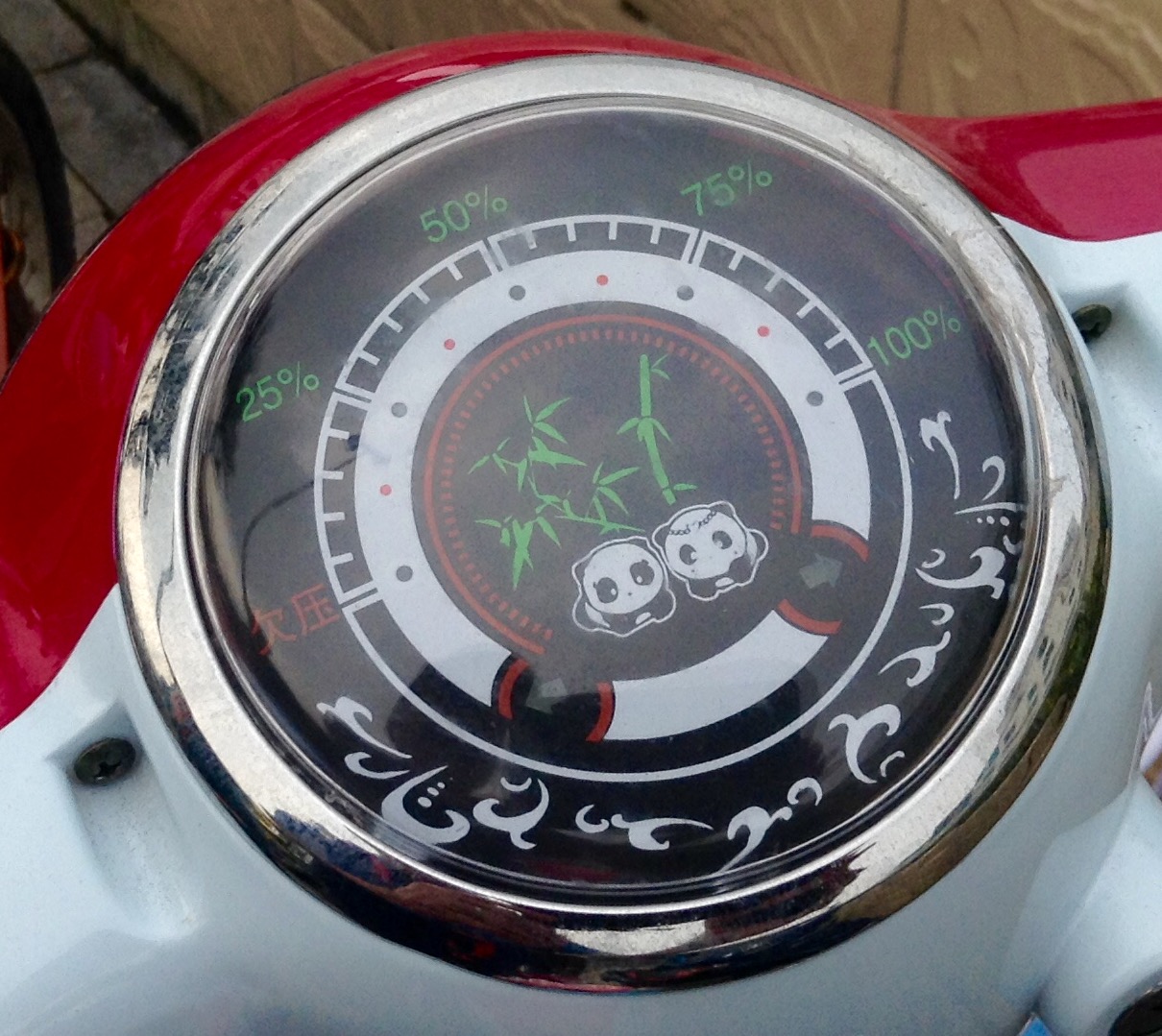
Impressions of China. New units of speed and old ways of counting.
October 9th, 2015This comes to you from China, and the city of Suzhou. To set the scene, cities in China have a lot of motorbikes. Electric ones. With their own speed units, a % of Panda speed.