Posts Tagged ‘Nature’
Saturday, December 24th, 2016
The previous posts produced discussion about the dipole moments of highly polar molecules. Here to produce some reference points for further discussion I look at the dipole moment of glycine, the classic zwitterion (an internal ion-pair).
(more…)
Tags:aqueous solution, Chemical polarity, Chemistry, dielectric, Dipole, Electric dipole moment, Electromagnetism, Magnetism, Moment, Nature, Physical quantities, Physics, Potential theory, zwitterion
Posted in crystal_structure_mining, Interesting chemistry | 1 Comment »
Monday, December 19th, 2016
I am completing my survey of the vote for molecule of the year candidates, which this year seems focused on chemical records of one type or another.
(more…)
Tags:chemical publishing, chemical records, human chemical perception, Matter, metal, Molecule, Nature, search query, search software, Voting
Posted in crystal_structure_mining, Interesting chemistry | 2 Comments »
Thursday, December 1st, 2016
Following on from a search for long C-C bonds, here is the same repeated for C=C double bonds.
(more…)
Tags:Chemical bond, chemical bonding, Chemical nomenclature, Chemistry, Conjugated system, double bond, energy, Nature, Nonmetal, Organic chemistry, Physical organic chemistry, search query, Substituent
Posted in crystal_structure_mining, Interesting chemistry | 2 Comments »
Thursday, September 1st, 2016
Bromoallene is a pretty simple molecule, with two non-equivalent double bonds. How might it react with an electrophile, say dimethyldioxirane (DMDO) to form an epoxide?[1] Here I explore the difference between two different and very simple approaches to predicting its reactivity. 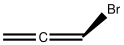
(more…)
References
- D. Christopher Braddock, A. Mahtey, H.S. Rzepa, and A.J.P. White, "Stable bromoallene oxides", Chemical Communications, vol. 52, pp. 11219-11222, 2016. https://doi.org/10.1039/c6cc06395k
Tags:chemical bonding, chemical reaction, Chemistry, Delocalized electron, double bond, energy, energy difference, HOMO/LUMO, lowest energy, Molecular orbital, Natural bond orbital, Nature, Physics, Quantum chemistry, stable HOMO-1
Posted in reaction mechanism | No Comments »