Following on from discussing octet expansion in species such as SeMe6, ClMe3 and ClMe5, I felt impelled to return to SF6, often used as an icon for hypervalence.
Hypervalence and octet-expansion in sulfur hexafluoride.
November 20th, 2017PIDapalooza 2018: the open festival for persistent identifiers.
November 14th, 2017PIDapalooza is a new forum concerned with discussing all things persistent, hence PID. You might wonder what possible interest a chemist might have in such an apparently arcane subject, but think of it in terms of how to find the proverbial needle in a haystack in a time when needles might look all very similar. Even needles need descriptions, they are not all alike and PIDs are a way of providing high quality information (metadata) about a digital object.
VSEPR Theory: Octet-busting or not with trimethyl chlorine, ClMe3.
November 12th, 2017A few years back, I took a look at the valence-shell electron pair repulsion approach to the geometry of chlorine trifluoride, ClF3 using so-called ELF basins to locate centroids for both the covalent F-Cl bond electrons and the chlorine lone-pair electrons. Whereas the original VSEPR theory talks about five “electron pairs” totalling an octet-busting ten electrons surrounding chlorine, the electron density-based ELF approach located only ~6.8e surrounding the central chlorine and no “octet-busting”. The remaining electrons occupied fluorine lone pairs rather than the shared Cl-F regions. Here I take a look at ClMe3, as induced by the analysis of SeMe6.
Hypervalence revisited. The odd case of hexamethyl selenium.
November 7th, 2017One thread that runs through this blog is that of hypervalency. It was therefore nice to come across a recent review of the concept[1] which revisits the topic, and where a helpful summary is given of the evolving meanings over time of the term hypervalent. The key phrase “it soon became clear that the two principles of the 2-centre-2-electron bond and the octet rule were sometimes in conflict” succinctly summarises the issue. Two molecules that are discussed in this review caught my eye, CLi6 and SeMe6. The former is stated as “anomalous in terms of the Lewis model“, but as I have shown in an earlier post, the carbon is in fact not anomalous in a Lewis sense because of a large degree of Li-Li bonding. When this is taken into account, the Lewis model of the carbon becomes more “normal”. Here I take a look at the other cited molecule, SeMe6.
References
- M.C. Durrant, "A quantitative definition of hypervalency", Chemical Science, vol. 6, pp. 6614-6623, 2015. https://doi.org/10.1039/c5sc02076j
Elongating an N-B single bond is much easier than stretching a C-C single bond.
October 24th, 2017An N-B single bond is iso-electronic to a C-C single bond, as per below. So here is a simple question: what form does the distribution of the lengths of these two bonds take, as obtained from crystal structures?
Dyotropic Ring Expansion: more mechanistic reality checks.
October 1st, 2017I noted in my WATOC conference report a presentation describing the use of calculated reaction barriers (and derived rate constants) as mechanistic reality checks. Computations, it was claimed, have now reached a level of accuracy whereby a barrier calculated as being 6 kcal/mol too high can start ringing mechanistic alarm bells. So when I came across this article[1] in which calculated barriers for a dyotropic ring expansion observed under mild conditions in dichloromethane as solvent were used to make mechanistic inferences, I decided to explore the mechanism a bit further.
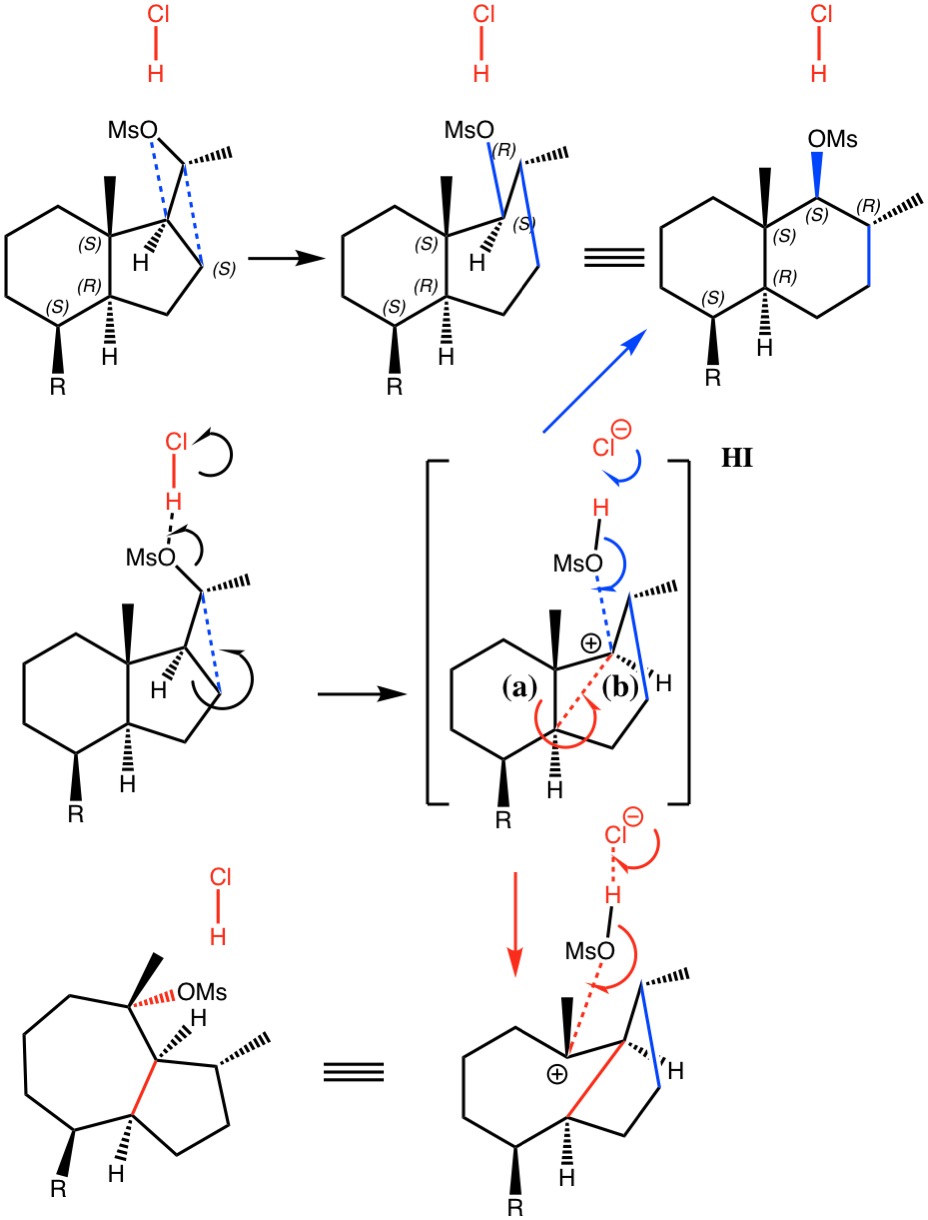
References
- H. Santalla, O.N. Faza, G. Gómez, Y. Fall, and C. Silva López, "From Hydrindane to Decalin: A Mild Transformation through a Dyotropic Ring Expansion", Organic Letters, vol. 19, pp. 3648-3651, 2017. https://doi.org/10.1021/acs.orglett.7b01621
The di-anion of dilithium (not the Star Trek variety): Another “Hyper-bond”?
September 16th, 2017Early in 2011, I wrote about how the diatomic molecule Be2 might be persuaded to improve upon its normal unbound state (bond order ~zero) by a double electronic excitation to a strongly bound species. I yesterday updated this post with further suggestions and one of these inspired this follow-up.
Two new types in the chemical bonding zoo: exo-bonds and hyper-bonds?
September 6th, 2017The chemical bond zoo is relatively small (the bond being a somewhat fuzzy concept, I am not sure there is an actual count of occupants). So when two new candidates come along, it is worth taking notice. I have previously noted the Chemical Bonds at the 21st Century-2017: CB2017 Aachen conference, where both were discussed.