My previous two posts on the topic of strongest bonds have involved mono and diprotonating N2 and using quantum mechanics to predict the effect this has on the N-N bond via its length and vibrational stetching mode. Such species are very unlikely to be easily observed for verification. But how about a metal M+ instead of H+? It turns out that structures containing the fragment Ru-N≡N-Ru are a small but well studied class of organometallic. Here is a search of the CSD crystal database for this motif.
The strongest bond in the universe: revisited ten years on.
May 23rd, 2020I occasionally notice that posts that first appeared here many years ago suddenly attract attention. Thus this post, entitled The strongest bond in the universe, from ten years back, has suddently become the most popular, going from an average of 0-2 hits per day to 92 in a single day on May 22nd (most views appear to originate from India). I can only presume that a university there has set some course work on this topic and Google has helped some of the students identify my post. Well, re-reading something you wrote ten years ago can be unsettling. Are the conclusions still sound? Would I establish my claim the same way now? After all, one picks up a little more experience in ten years. So here is my revisitation.
Choreographing a chemical ballet: what happens if you change one of the actors?
May 8th, 2020Earlier, I explored the choreography or “timing”, of what might be described as the curly arrows for a typical taught reaction mechanism, the 1,4-addition of a nucleophile to an unsaturated carbonyl compound (scheme 1). I am now going to explore the consequences of changing one of the actors by adding the nucleophile to an unsaturated imine rather than carbonyl compound (scheme 2).
Discussion of (the) Room-temperature chemical synthesis of dicarbon – open and transparent science.
May 6th, 2020A little more than a year ago, a ChemRxiv pre-print appeared bearing the title referenced in this post,[1] which immediately piqued my curiosity. The report presented persuasive evidence, in the form of trapping experiments, that dicarbon or C2 had been formed by the following chemical synthesis. Here I describe some of what happened next, since it perhaps gives some insight into the processes of bringing a scientific result into the open.
References
- K. Miyamoto, S. Narita, Y. Masumoto, T. Hashishin, M. Kimura, M. Ochiai, and M. Uchiyama, "Room-Temperature Chemical Synthesis of C2", 2019. https://doi.org/10.26434/chemrxiv.8009633.v1
A databank of molecular dynamics reaction trajectories (DDT) focused on undergraduate teaching.
April 22nd, 2020In a previous post, I talked about a library of reaction pathway intrinsic reaction coordinates (IRCs) containing 115 examples of organic and organometallic reactions. Now (thanks Dean!) I have been alerted to a brand new databank of dynamics trajectories (DDT), with the focus on those reactions taught in undergraduate organic chemistry courses, some of which are shown below.
A molecular sponge for hydrogen storage- the future for road transport?
April 19th, 2020In the news this week is a report of a molecule whose crystal lattice is capable of both storing and releasing large amounts of hydrogen gas at modest pressures and temperatures. Thus “NU-1501-Al” can absorb 14 weight% of hydrogen. To power a low-polluting car with a 500 km range, about 4-5 kg of hydrogen gas would be need to be stored and released safely. The molecule is of interest since it opens a systematic strategy of synthetically driven optimisation towards a viable ultra-porous storage material,[1] much like a lead drug compound can be optimised.
References
- Z. Chen, P. Li, R. Anderson, X. Wang, X. Zhang, L. Robison, L.R. Redfern, S. Moribe, T. Islamoglu, D.A. Gómez-Gualdrón, T. Yildirim, J.F. Stoddart, and O.K. Farha, "Balancing volumetric and gravimetric uptake in highly porous materials for clean energy", Science, vol. 368, pp. 297-303, 2020. https://doi.org/10.1126/science.aaz8881
Choreographing a chemical ballet: a story of the mechanism of 1,4-Michael addition.
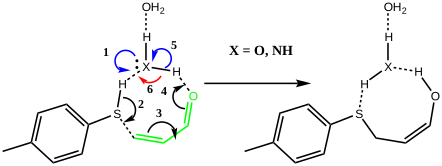
April 13th, 2020A reaction can be thought of as molecular dancers performing moves. A choreographer is needed to organise the performance into the ballet that is a reaction mechanism. Here I explore another facet of the Michael addition of a nucleophile to a conjugated carbonyl compound. The performers this time are p-toluene thiol playing the role of nucleophile, adding to but-2-enal (green) acting as the electrophile and with either water or ammonia serving the role of a catalytic base to help things along.†
A cascading tutorial in finding rich NMR data using the Datacite datasearch engine.
April 11th, 2020In the previous post, I introduced three of a new generation of search engines specialising in the discovery of data. Data has some special features which make its properties slightly different from the conceptual (or natural language) searches we are used to performing for general information and so a search engine specifically for data is invariably going to reflect this. At the simplest level, the data search can retain much of the generic simplicity of a regular search, but to exploit the unique features of data, one really does have to move on to an advanced mode. Here, by introducing a set of search definitions that gradually increase in specificity and power, I hope to convey some of the flavour of one way in which this could be done.
New generations of globally aggregating search engines – for (chemical) data.
April 7th, 2020Chemists have long been familiar with search engines that aspire to index a large proportion of the chemical literature. Think for example the old-generation (and commercial) SciFinder (Scholar) and Reaxys or those that arrived in the 1990s in the online era‡ such as the non-commercial Pubchem or ChemSpider (there are more). But you may not be as familiar with the latest generation of global search engines and here I will focus on three relatively new ones that specialise specifically in tracking down data rather than just publications.
Substituent effects on the mechanism of Michael 1,4-Nucleophilic addition.
March 29th, 2020In the previous post, I looked at the mechanism for 1,4-nucleophilic addition to an activated alkene (the Michael reaction). The model nucleophile was malonaldehyde after deprotonation and the model electrophile was acrolein (prop-2-enal), with the rate determining transition state being carbon-carbon bond formation between the two, accompanied by proton transfer to the oxygen of the acrolein.